

Walk into a crowded room and your eyes will skim over dozens of neutral expressions without really registering them. But let one person glare, jaw clenched, brows drawn tight, and it feels like your brain slams on the brakes. That angry face cuts through the noise like a siren. You do not politely decide to notice it; your attention is yanked toward it almost automatically.
Evolutionary psychology argues this is not some modern social quirk or the result of too many drama-filled TV shows. It is an ancient survival feature, older than cities, older than writing, older than anything we usually think of as “civilization.” Our ancestors who quickly picked up on signs of anger and aggression were more likely to survive and pass on their genes. In a sense, every time you instantly spot an angry face in a crowd, a tiny, efficient piece of Stone Age code is still running in your brain.
The Brain’s Built-In Threat Radar

Here is the wild part: you can be casually scrolling, walking, or daydreaming, and yet your brain is quietly scanning for danger like a smoke detector in the background. Angry faces are one of the fastest triggers for that system. From an evolutionary point of view, this makes painful sense. An angry individual in a small band of hunter–gatherers could mean an imminent attack, rejection from the group, or a dangerous conflict over food or mates.
Scientists have found that people tend to detect angry or threatening faces more quickly than friendly or neutral ones, even when they are not consciously looking for them. It is like your visual system gives them VIP status, pushing them to the front of the line. Imagine you are at a concert: even if you are focused on the music, you will probably still notice a sudden shouting match at the back of the crowd. Your attention locks onto the potential threat, whether you want it to or not, because your brain is biased toward “better safe than sorry.”
From the Savannah, Not the City

It is tempting to think this hyper-awareness of anger is something we picked up dealing with bosses, traffic, and social media fights. But the machinery behind it is far older than any of that. Long before skyscrapers and smartphones, early humans lived in small, tightly connected groups where conflict could literally be a matter of life or death. If a dominant group member turned angry, reading that signal correctly could mean avoiding a blow, a wound, or expulsion from the tribe, all of which could reduce your chances of survival.
Those ancestral environments rewarded quick detection of interpersonal threat. Imagine living in a world with no police, no formal laws, and very few strangers. Your safety hinged on the moods and intentions of the handful of people around you every day. Anger was like thunder before a storm: ignore it, and you might pay the price. Our brains were shaped in that world, not in the world of offices and subway platforms, and we still carry that ancient sensitivity into every modern interaction.
The Visual Search Advantage of Anger

Researchers often study this phenomenon using visual search tasks: people are asked to find a face with a particular expression among many other faces. Again and again, angry faces tend to pop out more quickly than happy ones, as if they are outlined with invisible highlighter. This does not mean happiness is unimportant; it just means that, when it comes to survival, missing an angry face is potentially more costly than missing a smiling one.
You can think of it like the difference between missing a sale sign and missing a fire alarm. One is a lost opportunity; the other might be a disaster. Our cognitive system appears tuned to prioritize the fire alarm, and angry expressions serve exactly that function. They are treated as urgent signals demanding attention, which is why even a small frown or narrowed eyes can feel uncomfortably loud, especially in tense situations.
The Amygdala: Your Ancient Alarm Bell
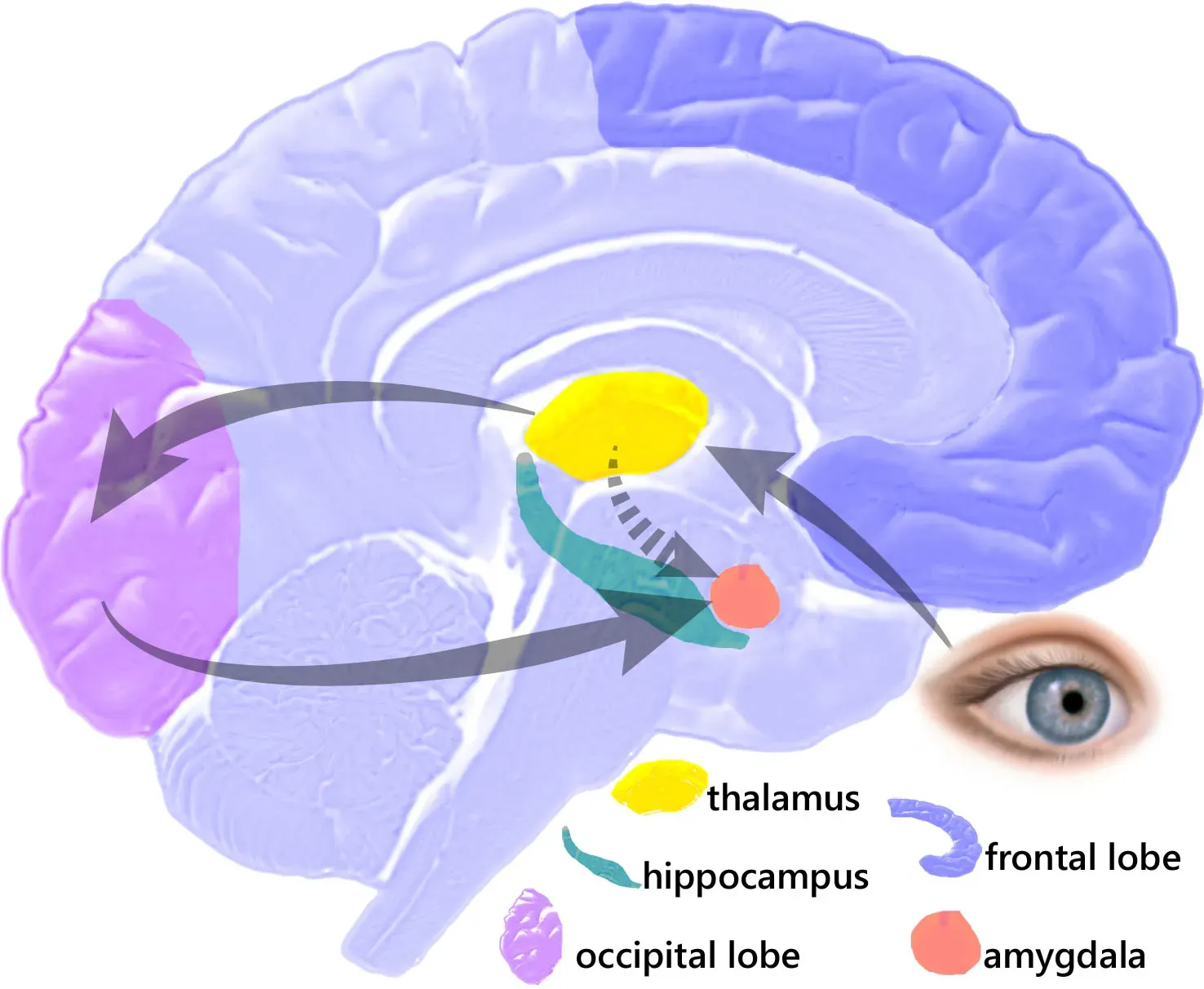
Deep inside your brain sits a pair of almond-shaped structures called the amygdala, central players in detecting and responding to emotional significance, especially threat. When you see an angry face, this region tends to light up quickly, often before you have fully processed the details of what you are seeing. It functions like an early warning system that yells “Pay attention!” long before your calm, logical reasoning kicks in.
What makes this especially striking is that the amygdala can react even when the visual information is faint, brief, or partly outside your awareness. That is why a fleeting glare from across a room can leave you feeling uneasy without quite knowing why. The system is not subtle or diplomatic; it is biased toward false alarms rather than missed threats. From an evolutionary perspective, that trade-off is worth it: it is better to overreact to a harmless scowl than to underreact to genuine danger.
Why Negative Emotions Shout Louder Than Positive Ones

Angry faces fall under a broader pattern psychologists sometimes call a negativity bias: our brains weigh negative information more heavily than positive information. Losing stings more than winning delights, insults land harder than compliments, and hostile expressions grab us more forcefully than warm smiles. If you think about our ancestral past, this skew makes harsh sense. A single misread threat could end your life, while missing one friendly signal usually just meant a lost chance at connection.
In social life today, this bias shapes everything from workplace tension to online drama. You can receive twenty supportive comments and one harsh criticism, and it is the harsh one that loops through your mind all night. The same goes for faces: surrounded by neutral or pleasant expressions, your attention snaps to the one person who looks irritated. This is not proof that the world is overwhelmingly hostile; it is evidence that your brain gives hostility a megaphone.
Modern Mismatch: Ancient Hardware in a New World

The tricky part is that our threat-detection system evolved in environments with relatively small groups and face-to-face interactions. Today, we are flooded with facial expressions: meetings, classrooms, public transport, video calls, and endless images on screens. The same ancient wiring that once kept us safe in tight-knit bands can now make us feel constantly on edge in packed cities and digital spaces full of conflict and outrage.
In modern life, this can create what some researchers call a mismatch: our old psychological tools are not perfectly suited to our new conditions. A sharp tone from a manager, a stranger’s glare on a train, or an inflammatory post on social media can trigger that same archaic system, even when there is no real physical danger. The result is a low-level background of stress and vigilance that can wear us down if we are not aware it is happening. We are walking around with Stone Age alarms in a high-speed, hyperconnected world.
How This Ancient Bias Shapes Relationships and Conflict

Our tendency to notice and remember anger faster does not just color isolated moments; it can shape entire relationships. If your brain is constantly primed to catch signs of irritation, you might start “seeing” anger even where there is only mild discomfort or a passing bad mood. Over time, that can make partners, friends, or colleagues seem more hostile than they really are, feeding misunderstandings and unnecessary conflict.
I have definitely misread a tired or distracted face as angry and then spent an entire day feeling oddly defensive, only to find out later nothing was wrong. Many of us do something similar without realizing it. Because our attention locks onto anger, it can overshadow all the neutral or positive signals in the same interaction. One frown can cancel out ten smiles in how we remember a conversation, which is unfair to the other person and exhausting for us. Being aware of this bias is not a magic fix, but it does give us a chance to pause and question our first impression before we react.
Can We Override the Angry-Face Shortcut?

The fact that we are wired to spot anger quickly does not mean we are doomed to be controlled by it. Evolution gave us more than just alarms; it also gave us the capacity for reflection, self-awareness, and deliberate practice. You can learn to notice your own reaction to angry faces and choose how you respond, instead of letting that ancient surge of threat dictate your behavior every time.
Practices like mindfulness, emotional regulation training, and even simple habits – like deliberately looking for neutral or positive cues when you sense tension – can help rebalance your attention. You might still notice the angry face first, but you can remind yourself that fast does not always mean accurate. In my view, that is the sweet spot of modern psychology: not pretending our evolutionary history does not matter, but also not surrendering to it as destiny. We acknowledge the shortcut, then decide whether to take it.
Conclusion: Ancestral Fears in a Hyperconnected Age

At the end of the day, our knack for noticing angry faces is less a flaw than a fossil: a living trace of the environments that shaped us. It protected our ancestors from sudden violence and social exclusion, and it still helps us navigate conflict today. But in a world saturated with images, arguments, and emotional signals, that same system can easily become overloaded, making everything feel more dangerous and hostile than it really is. We carry a warrior’s alarm into office meetings, group chats, and dating apps.
My opinion is that understanding this bias is not just intellectually interesting; it is ethically important. If we realize our brains are naturally drawn to anger, we can resist letting the loudest, angriest signals define our sense of reality or other people. We can give more weight to quiet kindness, calm faces, and subtle goodwill that our ancient wiring tends to overlook. The angry face might still be the first thing you notice – but does it really have to be the one that controls what you believe and how you act?