Researchers have uncovered compelling evidence that certain ancient dinosaurs developed elaborate wings covered in feathers, yet remained firmly grounded. Fossils of Anchiornis huxleyi, preserved with remarkable detail from 160 million years ago, reveal irregular feather growth patterns that precluded flight. These findings challenge assumptions about the straightforward path to avian flight and highlight the diverse roles feathers played in dinosaur evolution.
Rare Fossils Unlock a Hidden Past
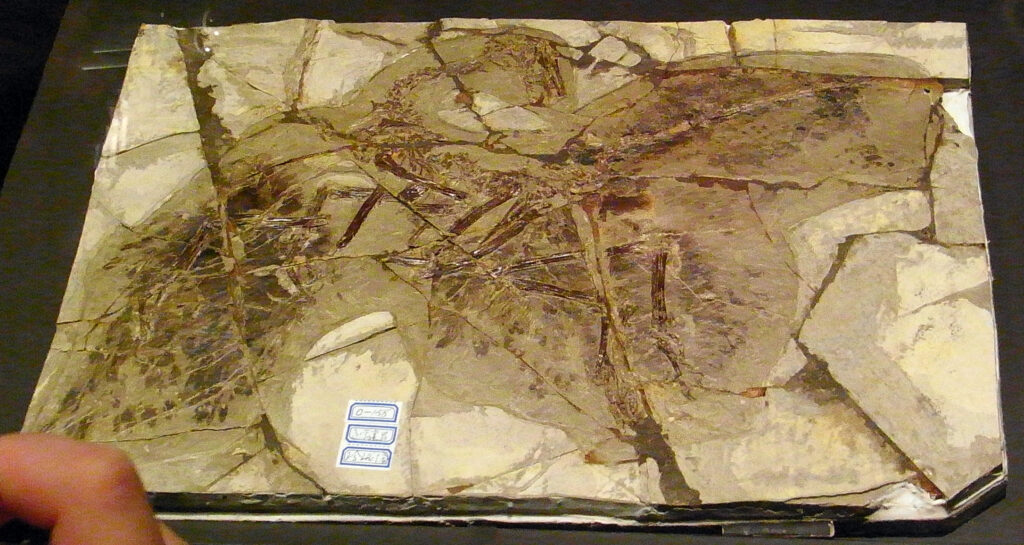
Rare Fossils Unlock a Hidden Past (Image Credits: Wikimedia)
Nine exceptionally preserved specimens of Anchiornis from eastern China’s Tiaojishan Formation provided scientists with an unprecedented glimpse into feather biology. These Late Jurassic fossils retained not just skeletal structures but also feather coloration – white wings accented by black tips and spots – allowing detailed analysis of growth and replacement cycles. Such preservation is rare, as feathers typically degrade over millions of years.
The discovery stemmed from a collaborative effort led by Dr. Yosef Kiat of Tel Aviv University’s School of Zoology and Steinhardt Museum of Natural History, alongside experts from China and the United States. Published in Communications Biology, the study examined wing morphology across the specimens, noting variations like 20 to 28 primary feathers per wing. This level of detail transformed what might have been overlooked into proof of flightlessness.
Irregular Molting Reveals Grounded Wings
Flying birds replace feathers through a precise, symmetrical molt to ensure wings remain balanced for sustained flight. In contrast, Anchiornis showed chaotic patterns: immature feathers grew unevenly, disrupting color bars and creating asymmetry between wings. Continuous black spots on developing feathers misaligned with mature ones, a telltale sign of random replacement unfit for aerodynamics.
Dr. Kiat noted, “Feather molting seems like a small technical detail – but when examined in fossils, it can change everything we thought about the origins of flight.” The dinosaurs’ wings featured extensive primary coverts – over 80 percent coverage – far exceeding those in modern flying birds, further suggesting non-flight functions like display or insulation. Ancestral reconstructions confirmed sequential molting as the baseline in related groups, with irregularity evolving separately in Anchiornis.
Pennaraptora’s Complex Path to Flight
Pennaraptora, a theropod clade emerging around 175 million years ago, marked a pivotal moment when symmetrical pennaceous feathers first appeared, suited for flight. This group includes birds’ closest dinosaur relatives and the sole dinosaur lineage to endure the mass extinction 66 million years ago. Yet, not all members took to the skies; Anchiornis exemplifies secondary flightlessness within this diverse assembly.
Environmental shifts likely prompted some species to abandon powered flight, mirroring patterns seen elsewhere in evolution. The high energy demands of flight became expendable in certain habitats, leading to retained wing structures for other purposes. Dr. Kiat explained that Pennaraptora “developed feathers for flight, but it is possible that when environmental conditions changed, some of these dinosaurs lost their flight ability.”
Lessons from Today’s Flightless Birds
Modern ostriches and penguins offer parallels: they possess reduced wings yet molt irregularly, prioritizing terrestrial or aquatic lifestyles over soaring.[1] Anchiornis’ feather count and covert extent resemble these species more than volant birds, hinting at similar adaptations.
- Ostriches use vestigial wings for balance during high-speed runs.
- Penguins’ flipper-like wings excel in swimming, with near-total covert coverage.
- Flightless cormorants show frequent, asymmetrical molts akin to Anchiornis.
- All share random feather replacement, freeing resources from flight maintenance.
- These traits underscore flight’s repeated loss across avian history.
Such comparisons illuminate how dinosaurs experimented with feathered limbs before birds refined flight. The Anchiornis evidence supports the “neoflightless hypothesis,” positing flight as ancestral in paravians, lost secondarily in some branches.
This research redefines wing evolution as a winding road of gains and losses, not a linear ascent. Anchiornis now stands among confirmed feathered non-flyers, urging further scrutiny of Mesozoic plumage.
- Irregular molting in Anchiornis fossils proves flightlessness despite four winged limbs.
- Pennaraptora feathers evolved ~175 million years ago, with flight gained and lost in branches.
- Patterns echo modern ostriches, revealing versatile roles beyond soaring.
What insights do these grounded dinosaurs offer about flight’s origins? Share your thoughts in the comments.