Thiruvananthapuram, Kerala – Local fishers confronted a thrashing giant in their traditional kambavala net during a routine haul, marking yet another chapter in India’s evolving relationship with the world’s largest fish.
A Tense Encounter at Sea
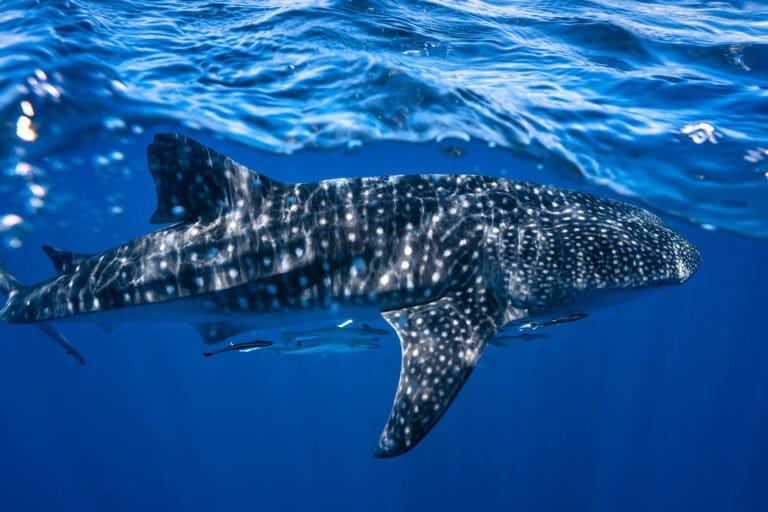
A Tense Encounter at Sea (Image Credits: Imgs.mongabay.com)
Fishers spotted the dark, speckled form of a whale shark struggling against the bamboo poles and nylon webbing fixed to the seabed. The creature’s cavernous mouth and white-dotted back emerged as they approached. A damaged net threatened a month’s income for these small-scale operators.
Ajit Shanghumukhom, a trained volunteer from the Wildlife Trust of India (WTI), stood on the shore and urged action. “We can’t let it die,” he declared. For 30 minutes, the team sliced through the mesh with knives and ropes until the shark broke free. Silence fell over the beach as the net floated ruined on the waves, yet the fishers smiled at their choice.
From Hunters to Protectors
Two decades earlier, India’s west coast witnessed rampant slaughter of whale sharks for liver oil and meat, especially in Gujarat’s Veraval and Diu. Poultry industries bought carcasses when fresh meat demand waned. In 2001, WTI launched the Save the Whale Shark campaign with support from the International Fund for Animal Welfare.
A spiritual leader, Morari Bapu, renamed the species “Vhali,” or “the beloved one,” and called for protection. Street plays, pledges, and school programs shifted perceptions. That year, India listed whale sharks under Schedule I of the Wild Life (Protection) Act, equating their status to tigers. Since then, fishers released more than 1,000 individuals from nets along the Arabian Sea coast.
Kerala’s Coastal Traps and Responses
In Kerala, shallow waters near Thiruvananthapuram and Kollam attract whale sharks to plankton blooms and small fish. Traditional kambavala nets, funnel-shaped barriers for tides, ensnare these giants alongside mullets and prawns as water recedes. WTI verifies rescues via photos or videos and pays 25,000 rupees ($276) per damaged net.
“We realized that people wanted to help, they just couldn’t afford to,” stated Sajan John, WTI’s head of marine projects. Fishers now alert networks upon sighting entanglements, releasing sharks at sea before they reach shore. Shanghumukhom’s team alone freed 50 whale sharks over seven years, 35 by his direct efforts.
- Stake nets guide fish into pockets but trap large species during tidal shifts.
- Compensation covers net losses but not fuel or time spent on rescues.
- Training emphasizes safe disentanglement to minimize risks to both shark and fishers.
- Awareness campaigns use posters, films, and puppet shows to highlight harmless plankton-feeding habits.
- Youth and women’s groups now promote ocean ethics in coastal villages.
Expansion and Future Hurdles
The movement extends from Gujarat through Maharashtra, Goa, Karnataka, Kerala, and Lakshadweep Islands. Volunteers conduct programs in schools and fishing collectives. Children paint whale sharks, learning about ancient migrations. “When children begin to care, killing becomes impossible,” Shanghumukhom noted.
Challenges persist. Compensation covers only a fraction of costs, as Charles George of the Kerala Fishermen Coordination Committee pointed out: “The compensation we get is barely a third of what a large fishing net costs.” Experts like K.V. Thomas advocate for insurance, training as citizen scientists, and eco-tourism incentives. P.V. Johnson, a veteran fisher, warned, “If the sea loses her biggest fish, we will soon lose everything smaller, too.”
Key Takeaways
- More than 1,000 whale sharks rescued since 2001 through community efforts.
- WTI’s compensation and training turned potential losses into acts of stewardship.
- Awareness spans schools, unions, and islands, fostering lasting marine empathy.
India’s fishers have woven conservation into their daily rhythms, proving that local action sustains global species. Their sacrifices preserve ocean balance amid threats like pollution and climate shifts. What steps can communities elsewhere take to protect marine giants? Share your thoughts in the comments.