Amazon Rainforest – Deep within the verdant expanse, tiny froghoppers demonstrate extraordinary adaptations that shield them from a perilous world of predators and harsh conditions.
A Nymph’s Foamy Fortress
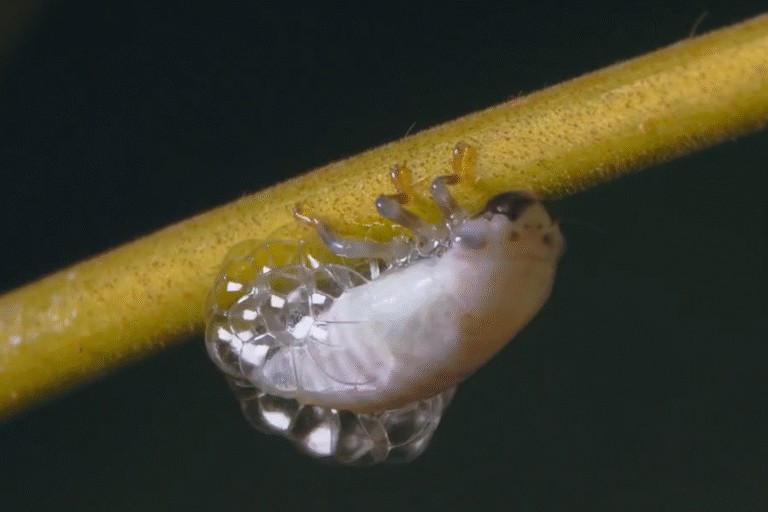
A Nymph’s Foamy Fortress (Image Credits: Imgs.mongabay.com)
Picture a minuscule insect expelling a frothy mass from its rear to create an impenetrable hideout – this is the froghopper nymph in action. These young stages, pale yellow or green and wingless, suck sap from plant stems using piercing mouthparts. The excess fluid, rich in water and sugars, emerges as watery excretions mixed with glandular secretions.
Nymphs draw air into their abdomen and expel it into the mixture, whipping the concoction into stable foam resembling beaten egg whites. This spittle mass envelops the nymph completely, positioning head-down on stalks for full coverage. Predators overlook the unassuming blob, mistaking it for plant disease or sap overflow. The foam also retains moisture, buffers temperature swings, and blocks ultraviolet rays, ensuring the nymph thrives while feeding undetected.
Transformation into Leaping Powerhouses
Adult froghoppers emerge as robust jumpers, capable of propelling themselves nearly 100 times their body length in height – one of nature’s most impressive feats relative to size. Measuring less than 1.5 centimeters long, these adults boast stout hind legs equipped with spines for grip and thrust. Their frog-like build, wider at the rear, aids in these explosive escapes from threats.
In the wild, adults dart across grasses and herbs, feeding on sap much like their offspring. Species vary in color from mottled browns to black, blending seamlessly into foliage. This aerial prowess allows them to evade birds, spiders, and other hunters that dominate rainforest understories.
Life Cycle and Rainforest Habitat
Froghoppers complete their metamorphosis on a range of host plants, from grasses to shrubs, across diverse ecosystems including the Amazon. Eggs laid in plant tissue hatch into nymphs that construct spittle masses in spring, developing through five instars over about 50 days. Adults appear in summer, mate, and lay eggs for the next generation.
Biologist Romi Castagnino highlighted these insects in Episode 6 of the Stranger Creatures series, venturing into the Amazon to showcase such bizarre survivors. The rainforest’s humidity and abundance of vegetation provide ideal conditions for their sap-sucking lifestyle. While common worldwide, tropical varieties thrive amid intense competition and predation.
Defensive Strategies at a Glance
| Stage | Primary Defense | Secondary Benefit |
|---|---|---|
| Nymph | Foam camouflage | Moisture retention[2] |
| Adult | Powerful jumps | Camouflaged wings |
- Sap intake exceeds needs, fueling foam production without harm to most plants.
- Foam deters ants and parasites with its sticky texture.
- Jumps reach heights equivalent to a human leaping over a skyscraper proportionally.
- Polyphagous diet supports populations on over 170 plant species.
- No major threats; populations remain stable in suitable habitats.
Key Takeaways
- Froghopper nymphs engineer personal shelters from waste products, turning vulnerability into strength.
- Adults rival fleas and grasshoppers in jumping efficiency, scaled to their tiny frames.
- These adaptations underscore the Amazon’s biodiversity, vital for ecosystem balance.
The froghopper exemplifies nature’s ingenuity, where even waste becomes a weapon for survival. Protecting rainforest habitats ensures such marvels persist for future discovery. What intrigues you most about these bubble-building jumpers? Tell us in the comments.