Colombo, Sri Lanka – Once a familiar sight in coastal waters, the sawfish now haunts the memories of older fishers while remaining unknown to the young. Researchers recently uncovered evidence suggesting that small populations might persist despite widespread fears of functional extinction. This distinctive ray, prized for its toothed rostrum, faces mounting pressures from overfishing and habitat loss, yet targeted surveys offer a pathway toward potential recovery.
Fishers Recall a Bygone Abundance
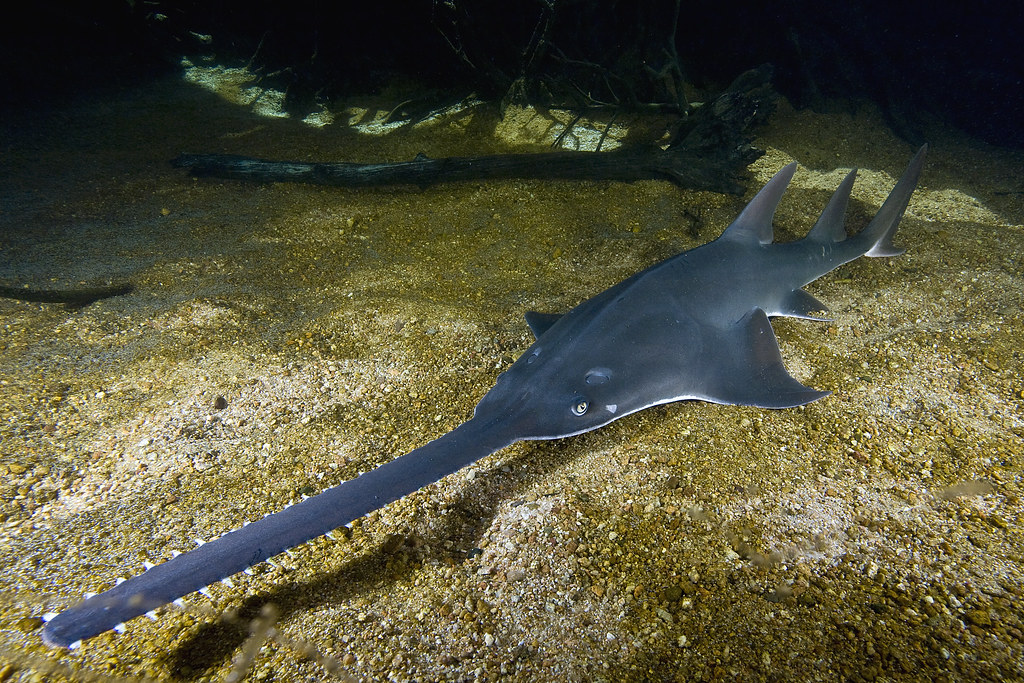
Fishers Recall a Bygone Abundance (Image Credits: Flickr)
A team from the Blue Resources Trust conducted interviews with 300 fishers across 21 harbors along Sri Lanka’s coastline. None under age 30 recognized the sawfish from photos, while half of those who had seen one reported no encounters since 1992. Only 32 individuals ever caught the creature, underscoring a sharp generational divide in knowledge.
Older fishers painted a vivid picture of past plenty. Many over 50 described frequent sightings and even practical uses for the rostrum, such as building fences to protect drying fish from stray dogs. “Fishers are often the most reliable source of such historical information,” noted Akshay Tanna, a researcher involved in the effort. Collective community memory filled gaps where formal records fell short.
Historical Presence Meets Modern Absence
Sawfish appeared in Sri Lankan checklists as early as 1889, with three species documented: the narrow sawfish (Anoxypristis cuspidata), largetooth sawfish (Pristis pristis), and green sawfish (P. zijsron). The last verified catch occurred in 2017 near Kuchchaveli in Trincomalee district, where a fisher photographed the unusual visitor and framed the image.
Global trends mirror this local story. All five sawfish species rank as endangered or critically endangered on the IUCN Red List, victims of drastic declines driven by overfishing and habitat degradation. Their slow growth, late maturity, and low reproductive output hinder rebound, with even modest mortality spikes causing prolonged setbacks, according to Rima Jabado, chair of the IUCN Shark Specialist Group.
Functional extinction looms large, defined by populations too sparse to reproduce viably. Yet the absence of landings since 2017 does not confirm total loss, prompting calls for expanded monitoring.
Threats Entangle a Unique Predator
The sawfish’s signature rostrum serves dual purposes: a slashing weapon and a sensory tool packed with electroreceptors to detect hidden prey in murky bottoms. This adaptation proves fatal in nets, where the toothed snout snags easily. Fisheries interactions dominate the toll, compounded by vanishing nurseries in estuaries and river mouths ravaged by development, pollution, and destructive gear.
Declines accelerated from the 1980s amid rising fishing pressure and aquaculture expansion. Fishers attributed falling numbers directly to these forces, with 30 of 32 who caught sawfish noting the pattern. All species enjoy CITES Appendix I protection, barring international trade, but local enforcement lags.
- Bycatch in gillnets and trawls
- Habitat loss in coastal shallows
- Overexploitation for meat and fins
- Delayed maturity prolonging vulnerability
- Degraded breeding grounds from pollution
A Recent Catch Ignites Optimism
Fieldwork revealed flickers of persistence. Sahan Thilakaratna of Ocean Rosy documented a recent capture in Balapitiya’s brackish waters, prime breeding territory. “Sawfish do use brackish habitats as breeding and nursery grounds, and these environments are critical for their survival,” he observed.
Cultural traces bolster the case. Coastal churches preserve rostra as offerings for safe seas, signaling former commonality and symbolic worth. These finds underscore untapped community insights for conservation.
Charting a Recovery Course
Urgent steps could stem the slide. Protecting estuaries, curbing bycatch through gear tweaks and release incentives, and boosting fisher awareness top the list. Science-driven policies must extend to kin like guitarfishes and wedgefishes, vital to ecosystems and livelihoods.
Sri Lanka’s shark and ray diversity demands action. Bans on bottom trawling and marine reserves mark progress, but robust enforcement and monitoring remain essential. Jabado emphasized coordinated efforts: strong laws, fisher education, and compensation for live releases.
Key Takeaways
- Prioritize surveys in brackish zones to confirm remnants.
- Enforce habitat safeguards against development.
- Empower communities with reporting tools and incentives.
The sawfish’s plight warns of broader marine unraveling, yet proactive measures could restore balance. Small populations, if located and shielded, hold recovery promise. What do you think about these conservation efforts? Tell us in the comments.