Researchers in northern China uncovered a remarkable stegosaur specimen that dates back 130 million years, providing an unprecedented view of dinosaur integument. The find, from the Early Cretaceous period, includes not only a nearly complete skeleton but also extensive skin impressions scattered across the remains. This discovery highlights the unique geological conditions that allowed soft tissues to fossilize in such detail.
A Breakthrough Unearthed in Fengning
A Breakthrough Unearthed in Fengning (Image Credits: Facebook)
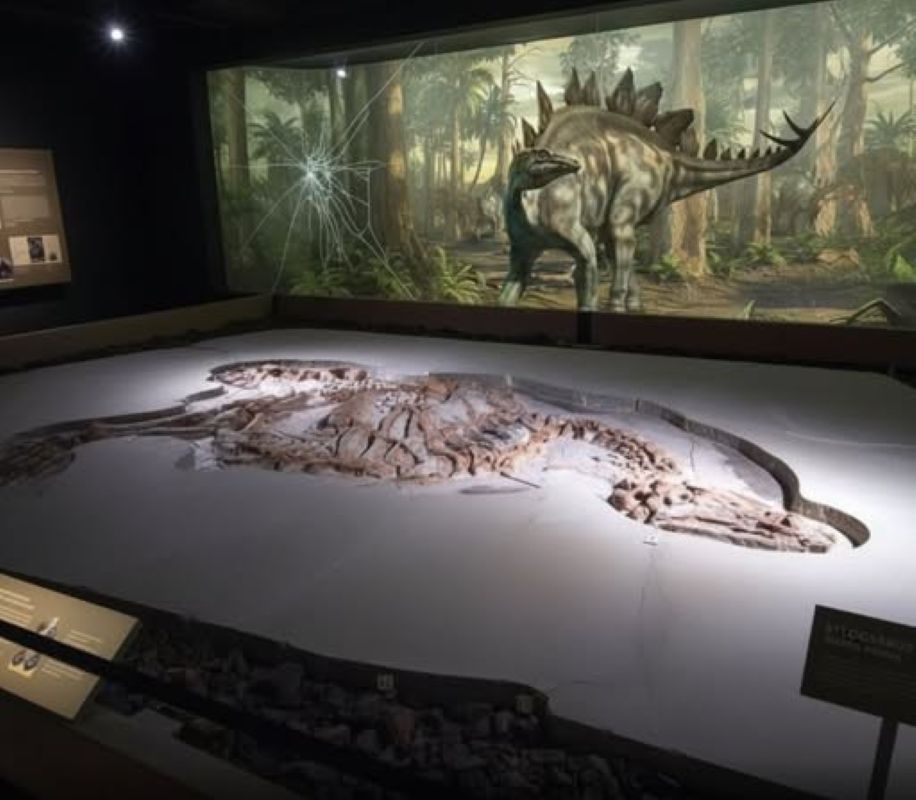
Paleontologists first spotted the fossil during excavations in 2017 in Fengning Manchu Autonomous County, Chengde city. The site yielded two dinosaurs: the stegosaur and a primitive ornithischian, possibly an early ceratopsian relative. Workers at the Fengning fossil conservation center labored for years to extract and restore the specimens.
The stegosaur measured roughly 5 meters in length, featuring a well-preserved skeleton complete with four distinctive tail spurs. These thagomizer spikes marked it clearly as a member of the stegosaur group. Restoration efforts revealed the extraordinary extent of preservation, setting this find apart from typical bone-only fossils.
Skin Impressions Defy the Odds
Soft tissues rarely survive the fossilization process, yet this specimen preserved skin over approximately 3 square meters. The impressions showed tightly packed, scale-like patterns reminiscent of modern lizards or snakes. Clear lines formed polygonal scales that covered much of the body, offering direct evidence of the dinosaur’s external texture.
Associate Professor Guo Ying of Linyi University explained the rarity: “The dinosaur skin fossil is exceptionally rare. The bones and teeth of dinosaurs became fossils relatively easily, making well-preserved dinosaur skin fossils a rarity.” Volcanic ash and rapid burial near a ancient river or lake shielded the body from scavengers and decay. Such conditions turned the skin into mineralized replicas, capturing details lost in most discoveries.
Adaptations Revealed Through Scales
The scaly skin likely served multiple purposes beyond protection. It helped retain moisture, allowing the herbivore to thrive in drier landscapes. During the Early Cretaceous, the region featured forests and rivers, but shifting climates demanded resilience.
Professor Zhang Fucheng, leader of the research team, noted the challenges of soft tissue fossilization: “The hard parts, such as bones and teeth of dinosaurs, are relatively easy to form fossils, but the soft parts, such as skin and muscle, are easy to rot, and the conditions for forming fossils are extremely harsh.” The scales reduced water loss, enhancing survival as environments changed. This trait paralleled adaptations in today’s reptiles.
Key Features of the Fossil
- Nearly complete 5-meter skeleton with tail spurs.
- Skin impressions spanning 3 square meters, showing scale patterns.
- First stegosaur recorded in Hebei Province.
- Companion primitive ornithischian fossil for comparative study.
- Preserved through volcanic ash burial near water.
These elements combine to make the specimen a treasure for paleontologists. The paired find also aids research into early ornithischian evolution.
Implications for Stegosaur Distribution
This marks the first stegosaur from Hebei, proving these plated dinosaurs roamed northern China 130 million years ago. Previous finds concentrated in southern regions, so the discovery expands known ranges. It suggests migrations or wider habitats during the Early Cretaceous.
Experts anticipate further analysis will clarify evolutionary links. The skin details could inform models of dinosaur physiology and behavior. Restoration continues, promising more revelations.
Key Takeaways
- Rare skin preservation offers direct look at stegosaur exterior.
- Scales aided moisture retention in changing climates.
- First northern China stegosaur reshapes distribution maps.
This Hebei stegosaur stands as a testament to nature’s preservation prowess, bridging 130 million years to modern labs. It reminds us how fragile yet revealing the fossil record can be. What do you think this tells us about ancient ecosystems? Tell us in the comments.