NASA’s Hubble Space Telescope recently peered into the Lupus 3 cloud, revealing a dynamic stellar nursery 500 light-years distant in the constellation Scorpius.
A Spectral Canvas of Gas and Dust
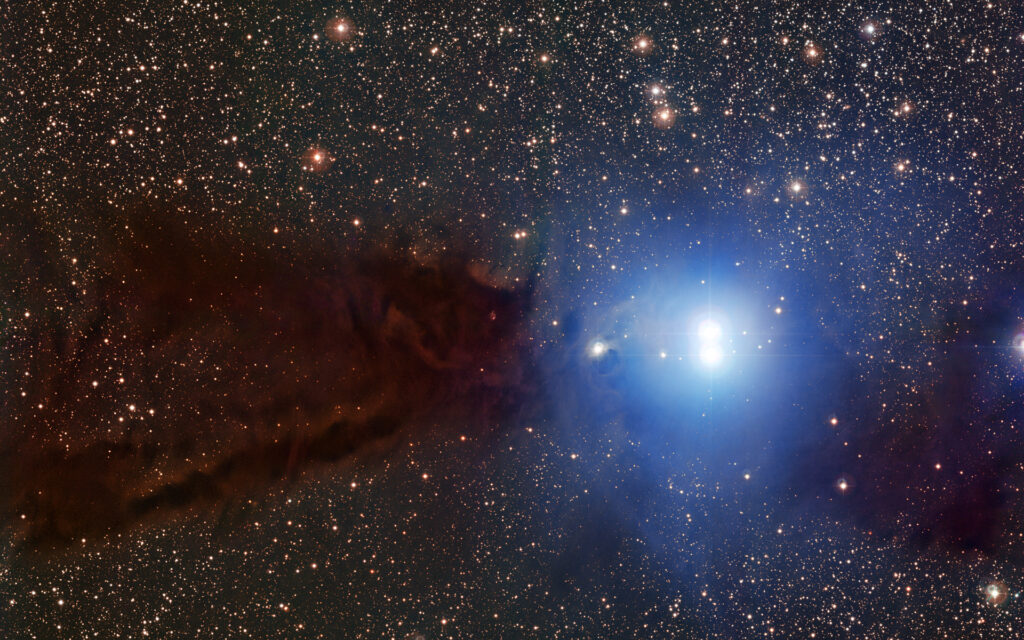
A Spectral Canvas of Gas and Dust (Image Credits: Upload.wikimedia.org)
The image presents a haunting vista dominated by misty, bluish-white expanses of gas that permeate the scene. Scattered stars pierce through this nebulous backdrop, creating points of brilliance amid the haze. A prominent dark dust cloud anchors the lower-left region, starkly contrasting the glowing surroundings.
White wisps of gas twist and curl across the field, hinting at turbulent motions within the cloud. This structure marks Lupus 3 as an active site where gravity gathers material to ignite new suns. Astronomers value such observations for their clarity in ultraviolet, visible, and near-infrared wavelengths.
Spotlighting Young T Tauri Stars
Bright T Tauri stars command attention in the composition, positioned at the left edge, bottom right, and upper center. These youthful protostars, younger than 10 million years, represent a pivotal phase in stellar evolution. Other nascent stellar objects sprinkle the frame, underscoring the region’s prolific output.
- Left side: A cluster of luminous T Tauri stars emerges from the gaseous veil.
- Bottom right: Isolated bright points signal individual star formation events.
- Upper center: Additional T Tauri exemplars glow against the diffuse backdrop.
- Throughout: Fainter young objects indicate ongoing birth processes.
Credits for the image go to NASA, ESA, and K. Stapelfeldt of the Jet Propulsion Laboratory, with processing by Gladys Kober of NASA and the Catholic University of America.
Unraveling the Dynamics of Star Birth
T Tauri stars shed their natal shrouds through radiation and stellar winds, which propel outflows of particles outward. These mechanisms clear away enveloping gas and dust, allowing the stars to shine more vividly. Instabilities in surrounding accretion disks fuel random brightness fluctuations as material spirals inward and ignites surface flares.
Periodic dimming and brightening arise from massive sunspots rotating into view, mimicking solar activity on a grander scale. Gravity compels these stars to contract, paving the way toward main-sequence stability where hydrogen fuses into helium. Such details emerged from Hubble’s precise imaging, part of its ongoing exploration of stellar nurseries.
Broader Implications for Astronomy
Lupus 3 belongs to a complex known for fostering low-mass stars, akin to our Sun’s probable birthplace billions of years ago. Observations here complement studies of higher-mass star formation, filling gaps in cosmic evolution models. The cloud’s features, including pre-stellar cores and potential jets, offer a laboratory for these processes.
Hubble’s vantage continues to yield treasures, even as newer telescopes join the effort. For more, visit NASA’s Hubble site.
Key Takeaways
- Lupus 3 hosts T Tauri stars actively dispersing their birth cocoons via winds and radiation.
- Brightness variations reveal accretion disk chaos and rotating sunspots.
- These sights advance knowledge of low-mass star formation, mirroring the Sun’s origins.
Hubble’s gaze into Lupus 3 not only captivates but also deepens comprehension of the universe’s ceaseless creativity. What aspects of star formation intrigue you most? Tell us in the comments.