The Spinosaurus, one of the most enigmatic dinosaurs ever discovered, continues challenging paleontologists’ understanding of prehistoric life. Over the past century, our conception of this massive theropod has undergone dramatic revisions—from a land-dwelling apex predator to potentially the first known aquatic dinosaur. Recent fossil discoveries have ignited passionate debate within the scientific community about just how aquatic this creature truly was. As new evidence emerges, our understanding of Spinosaurus keeps evolving, making it one of paleontology’s most fascinating case studies in how scientific knowledge develops and changes over time.
The Discovery Journey: Spinosaurus Through Time
The Spinosaurus saga began in 1912 when German paleontologist Ernst Stromer discovered the first partial skeleton in Egypt’s Bahariya Formation. These initial remains suggested a massive carnivorous dinosaur with unusual neural spines forming a sail-like structure along its back. Unfortunately, Stromer’s original specimens were destroyed during World War II when Allied bombing raids hit the Munich museum housing them, creating a significant setback for Spinosaurus research. For decades afterward, paleontologists could only work from Stromer’s detailed drawings and notes, leaving much about the creature’s lifestyle and adaptations to speculation. This tragic loss of the holotype created a scientific mystery that would take nearly a century to unravel with subsequent discoveries in Morocco and elsewhere in North Africa.
Anatomical Peculiarities: Not Your Typical Theropod

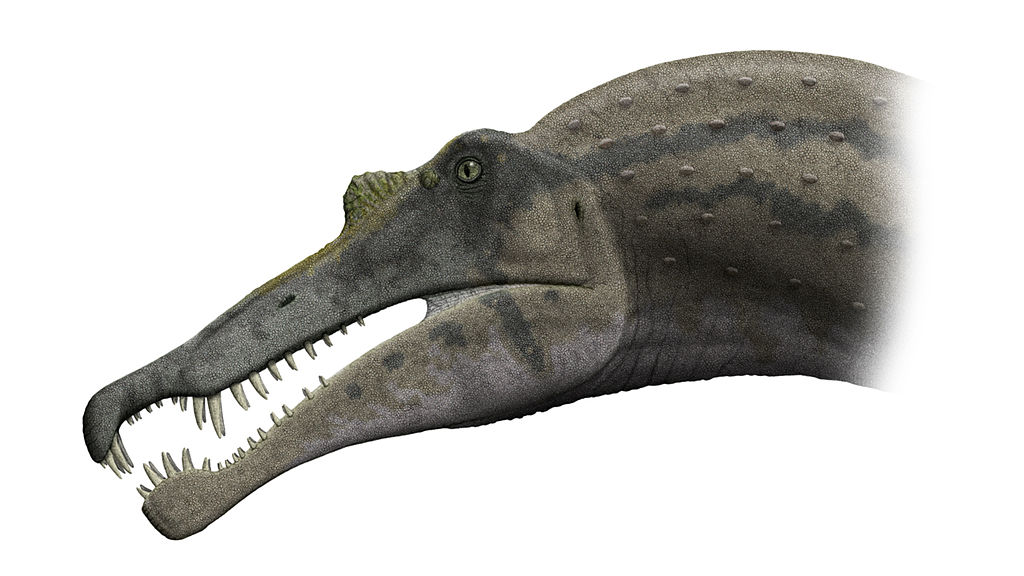
Spinosaurus exhibits several anatomical features that set it apart from other large theropods like Tyrannosaurus or Allosaurus. Most notably, its skull is elongated and crocodile-like, with conical teeth better suited for catching slippery prey than the serrated, bone-crushing teeth of terrestrial predators. The creature’s forelimbs were unusually robust for a theropod, suggesting they may have been used for specialized functions beyond typical predatory behavior. Perhaps most distinctive is its neural spine sail, which could have reached over 5 feet tall—a structure that has variously been interpreted as a temperature regulation device, a fat storage area, or a display feature for attracting mates. These anatomical oddities have long suggested that Spinosaurus occupied a different ecological niche than other large theropods, but exactly what that niche was remained contentious until recently.
The 2014 Revelation: Evidence for Aquatic Adaptation

The Spinosaurus debate took a dramatic turn in 2014 when paleontologist Nizar Ibrahim and colleagues published groundbreaking research based on new fossil material from Morocco. This partial skeleton revealed several previously unknown features pointing toward aquatic adaptation, including unusually dense bones that could have aided buoyancy control, similar to those seen in modern diving birds and aquatic mammals. The creature’s center of gravity appeared shifted forward, suggesting a posture that would make sense for a swimming animal but would be awkward for efficient terrestrial locomotion. Most surprisingly, the 2014 reconstruction showed relatively short hind limbs inappropriate for chasing prey on land. This evidence led Ibrahim’s team to propose that Spinosaurus was primarily aquatic—a revolutionary claim, as no other known non-avian dinosaur had adapted so comprehensively to life in water.
The Tail Revelation of 2020

Perhaps the most compelling evidence for Spinosaurus’s aquatic lifestyle came in 2020 with the discovery of a remarkably complete tail fossil. Ibrahim’s team revealed that Spinosaurus possessed a tall, flexible tail with elongated neural spines forming a fin-like structure, unlike anything seen in other theropod dinosaurs. Biomechanical analysis suggested this tail would have been an efficient propulsion mechanism in water, capable of generating significant thrust through side-to-side undulation, similar to how crocodiles and some fish swim. The researchers conducted experiments with a physical model of the tail, demonstrating its effectiveness as a swimming appendage. This discovery strongly reinforced the aquatic hypothesis, as such a specialized tail structure would have provided little advantage on land but significant benefits in water, representing a clear evolutionary adaptation to an aquatic lifestyle.
The Alternative View: Was Spinosaurus a Shore-Dwelling Specialist?

Despite mounting evidence for aquatic adaptations, some paleontologists remain skeptical about just how water-dependent Spinosaurus truly was. An alternative hypothesis proposes that Spinosaurus may have been more of a shoreline specialist—perhaps wading in shallow waters to hunt fish much like modern herons or storks, rather than swimming actively in deeper waters. Some critics point to the creature’s large size and certain skeletal features that might still have allowed effective terrestrial movement. They argue that Spinosaurus might have been semi-aquatic at most, primarily hunting along waterways while maintaining the ability to move efficiently on land. This middle-ground position acknowledges the aquatic adaptations while suggesting a more versatile ecological role than being fully committed to an aquatic lifestyle.
The Limb Controversy: Legs Built for Land or Water?

One of the most contentious aspects of Spinosaurus research concerns its limb proportions and what they reveal about locomotion. The 2014 reconstruction by Ibrahim showed relatively short hind limbs, suggesting limited mobility on land. However, subsequent analyses by other researchers questioned this interpretation, arguing that the limb proportions had been incorrectly assessed. In 2020, paleontologist Donald Henderson published a study suggesting that Spinosaurus would have been too buoyant and unstable to be an effective underwater hunter despite its aquatic adaptations. The debate intensified when some researchers proposed that the dinosaur may have been quadrupedal on land—an unusual posture for a theropod dinosaur. These competing interpretations highlight how challenging it is to understand locomotion in extinct animals, especially those with unusual anatomical features that have no perfect modern analogues.
Fossil Ecosystem: The Kem Kem Beds Context

Understanding Spinosaurus requires examining the environment in which it lived, primarily the Kem Kem beds of what is now Morocco. During the mid-Cretaceous period, approximately 95-100 million years ago, this region was a vast river system teeming with aquatic life. The fossil record reveals an ecosystem dominated by water, inhabited by massive fish, sh including the car-sized coelacanth Mawsonia and the sawfish-like Onchopristis, which reached lengths of over 20 feet. The abundance of fish fossils suggests a rich aquatic food web that could have supported specialized piscivorous predators. Significantly, the Kem Kem beds contained multiple large theropod dinosaurs besides Spinosaurus, including Carcharodontosaurus and Deltadromeus, suggesting ecological partitioning, with Spinosaurus potentially specializing in aquatic prey while other large theropods hunted on land. This paleoenvironmental context provides crucial evidence supporting the aquatic specialization hypothesis.
The Isotope Evidence: Chemical Clues to Lifestyle

Beyond anatomical features, researchers have turned to biochemical evidence to understand Spinosaurus’s lifestyle. Studies examining oxygen isotope ratios in Spinosaurus teeth have provided intriguing insights into the creature’s habitat preferences. These analyses can help determine whether an animal spent significant time in water by comparing isotope signatures with those of known aquatic and terrestrial animals from the same ecosystem. Recent isotope studies have shown that Spinosaurus teeth contain oxygen isotope ratios more similar to those of crocodilians and turtles than to terrestrial dinosaurs, suggesting substantial time spent in aquatic environments. Furthermore, analysis of calcium isotopes in the teeth suggests a diet heavily composed of aquatic prey. These chemical signatures provide independent lines of evidence supporting the aquatic hypothesis, complementing the anatomical features observed in the fossil record.
Bone Density: The Submariner’s Adaptation

One of the most compelling lines of evidence for Spinosaurus’s aquatic lifestyle comes from studies of its bone microstructure. Recent research has revealed that Spinosaurus bones exhibit pachyostosis—extreme bone density and compactness similar to that seen in modern diving animals like penguins, hippos, and manatees. This adaptation helps counter buoyancy, allowing animals to submerge more easily and remain underwater with less effort. Comparative studies show that Spinosaurus had bone density far exceeding that of other theropod dinosaurs and more closely matching aquatic animals. The dense bone structure would have provided little advantage on land—in fact, it would have made terrestrial movement more energetically costly—but would have been highly advantageous for an animal spending significant time swimming or diving for food. This evidence of convergent evolution with modern semi-aquatic and aquatic vertebrates strongly supports the aquatic hypothesis.
Feeding Mechanics: How Did Spinosaurus Hunt?

Understanding how Spinosaurus captured and consumed its prey provides crucial insights into its lifestyle. Biomechanical studies of its unusual skull suggest adaptations for catching fish rather than battling large terrestrial prey. The long, narrow snout with conical teeth resembles the specialized morphology seen in crocodilians and gharials—modern fish-catching specialists. Computer modeling indicates that Spinosaurus likely employed quick sideways head movements to snatch fish, rather than the powerful crushing bite used by terrestrial predators like Tyrannosaurus. Sensory adaptations in the snout, including possible pressure receptors similar to those in crocodilians, may have allowed Spinosaurus to detect prey movements in murky water. These specialized feeding adaptations would have been highly advantageous for hunting in aquatic environments but would have provided limited benefits for terrestrial hunting, further supporting the aquatic specialist hypothesis.
The Continuing Scientific Debate

The Spinosaurus aquatic hypothesis remains one of paleontology’s most vibrant debates, illustrating how science progresses through competing interpretations of evidence. Prominent paleontologists continue to publish studies supporting different views of Spinosaurus’s lifestyle, with some favoring a fully aquatic existence while others argue for a more amphibious or even primarily terrestrial lifestyle with fishing specializations. This ongoing scientific conversation has stimulated new research methodologies, including biomechanical modeling, isotope studies, and comparative anatomy approaches. The debate has also encouraged paleontologists to reconsider assumptions about dinosaur ecology more broadly, asking whether other dinosaurs might have had specialized ecological niches previously overlooked. Rather than indicating a failure of scientific consensus, this active debate demonstrates science working as it should—with hypotheses continually refined as new evidence emerges.
Future Research Directions

As the Spinosaurus debate continues, several promising research avenues may provide clearer answers about its lifestyle. Ongoing excavations in Morocco and elsewhere in North Africa offer the possibility of discovering more complete Spinosaurus specimens that could resolve questions about its overall body plan and proportions. New technologies like synchrotron scanning can reveal internal bone structures that might provide further evidence of aquatic adaptations. Refined biomechanical modeling incorporating complete tail and limb data could better simulate how Spinosaurus moved both in water and on land. Additionally, further isotope studies comparing Spinosaurus with various modern animals of known ecological habits could strengthen our understanding of its diet and habitat preferences. As these research efforts progress, our picture of Spinosaurus will continue to evolve, potentially resolving the aquatic lifestyle question definitively within the coming decades.
Spinosaurus in Popular Culture

The enigmatic nature of Spinosaurus has captured public imagination, making it one of the most recognizable dinosaurs in popular culture despite being less well-known than Tyrannosaurus or Velociraptor until recently. Most famously, Spinosaurus featured as the main antagonist in “Jurassic Park III” (2001), where it was portrayed defeating a Tyrannosaurus in combat—an artistic choice that generated both public interest and scientific critique. As research has progressed, museums worldwide have updated their Spinosaurus reconstructions, often highlighting the aquatic hypothesis with dramatic poses showing the dinosaur swimming after prey. Documentary series like PBS’s “NOVA” and BBC’s “Planet Dinosaur” have featured segments on Spinosaurus’s changing story, bringing the scientific debate to public attention. This cultural visibility has helped generate public interest in paleontology as an evolving science rather than a field with fixed, unchanging knowledge about prehistoric life.
Conclusion: A Dinosaur That Challenges Categories
Spinosaurus represents a fascinating case study in how paleontological knowledge evolves with discoveries and methodologies. From its initial discovery over a century ago to the revolutionary findings of the past decade, our understanding of this remarkable dinosaur continues to shift and develop. While the debate about exactly how aquatic Spinosaurus was remains ongoing, the evidence increasingly suggests it occupied a unique ecological niche unlike any other known dinosaur—a specialized fish-hunter with multiple adaptations for an aquatic lifestyle. Whether fully aquatic or semi-aquatic, Spinosaurus challenges our traditional categories of dinosaur lifestyles and reminds us that prehistoric ecosystems likely contained specialized animals exploiting every available ecological niche, just as modern ecosystems do. As research continues, Spinosaurus will likely continue surprising us, demonstrating the dynamic nature of paleontological science and the endless fascination of prehistoric life.