Shallow waters near Johor Bahru now bustle with crabs, marine worms, and mollusks, marking the resurgence of seagrass meadows once obliterated by land reclamation.
Land Reclamation’s Heavy Toll
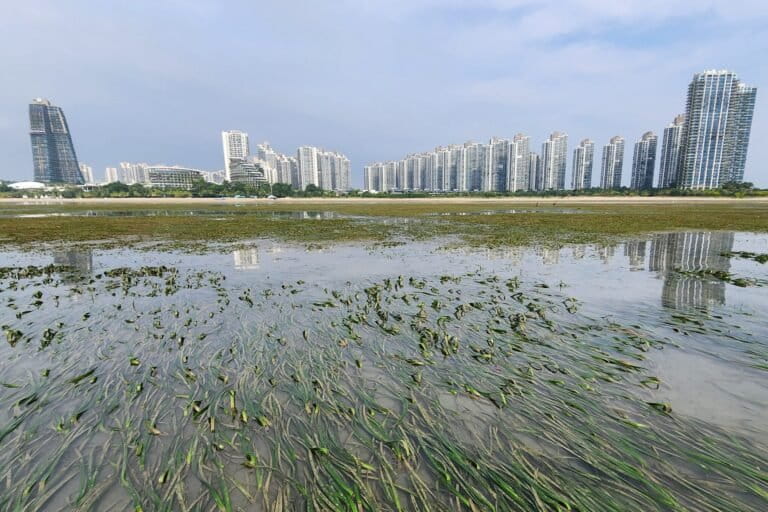
Land Reclamation’s Heavy Toll (Image Credits: Imgs.mongabay.com)
In 2014, dredging for the Forest City project scattered sediment plumes across Merambong Shoal in the Sungai Pulai estuary, erasing nearly 10 hectares of vital seagrass habitat. The Malaysian Department of Environment halted operations that year, but the ecosystem had suffered irreversible initial damage from smothering sands and turbidity.
Country Garden Pacificview Sdn. Bhd., the developer, then partnered with researchers from Universiti Putra Malaysia (UPM) to launch a comprehensive restoration and monitoring effort spanning 2015 to 2025. Seagrass beds like those at Merambong play essential roles in filtering runoff, stabilizing sediments, and nurturing marine life, yet they often fall victim to unchecked coastal growth.
Strategic Seedling Deployment
UPM scientists, led by Muta Harah Zakaria, drew on decades of local research to pioneer a multi-species seedling transplant method. They first planted sturdy Enhalus acoroides seedlings to anchor sandy bottoms with their deep roots, then introduced faster-spreading Halophila species – H. ovalis, H. major, and H. spinulosa – beneath the canopy.
Over 8,591 seedlings filled 324 square meters of plots, sourced from nearby healthy areas and nurtured in lab tanks for viability. “When the Enhalus is established, the smaller [Halophila] species come in to grow together under its canopy,” Zakaria explained. This sequence mirrored natural succession, outperforming single-species trials where survival dipped below expectations.
Biodiversity Boom and Metrics of Success
By 2024, multi-species plots achieved up to 66% seedling survival, far exceeding single-species controls, with coverage rebounding to 79-84% in key zones. Nine additional species naturally recolonized, yielding 13 of Malaysia’s 17 seagrass types, including the nationally new Halophila nipponica and four local firsts. Macrobenthic communities flourished, with over 100 invertebrate species documented, alongside dugong feeding trails signaling trophic recovery.
The table below contrasts restoration outcomes:
| Method | Survival Rate | Coverage Peak |
|---|---|---|
| Multi-species seedlings | Up to 66% | 79-84% |
| Single-species | <22% | Declined |
Macroalgae blooms receded as seagrass stabilized substrates and improved water clarity.
Broader Implications for Tropical Coasts
Milica Stankovic of Prince of Songkhla University hailed the results: “The findings from the Merambong Shoal provide proof that planting a combination of species might be a viable way forward… It’s very nice to see something actually working.”
Challenges persist, including sediment control and donor site protection, but the model offers a scalable blueprint for Indo-Pacific regions facing similar threats.
Key seagrass benefits include:
- Carbon sequestration for climate mitigation
- Fish nursery habitats supporting fisheries
- Shoreline erosion buffers
- Pollutant filtration from urban runoff
- Biodiversity hotspots for invertebrates and larger fauna
Key Takeaways
- Multi-species approaches enhance resilience and survival over monocultures.
- Developer-scientist partnerships can drive effective mitigation.
- Long-term monitoring ensures sustained gains amid ongoing pressures.
This Johor success proves degraded seagrass can rebound with informed, diverse strategies – yet it demands stricter coastal regulations to prevent future losses. What do you think about balancing development and marine restoration? Tell us in the comments.