Jordan – Researchers uncovered a fossilized tooth within amber deposits from the region, transporting scientists back to the Early Cretaceous period around 140 million years ago. This specimen belongs to a carnivorous theropod dinosaur, a group known for its predatory prowess. The find underscores the untapped potential of Jordan’s fossil sites in revealing ancient life forms.
A Predator’s Relic Frozen in Time
A Predator’s Relic Frozen in Time (Image Credits: Wikimedia)
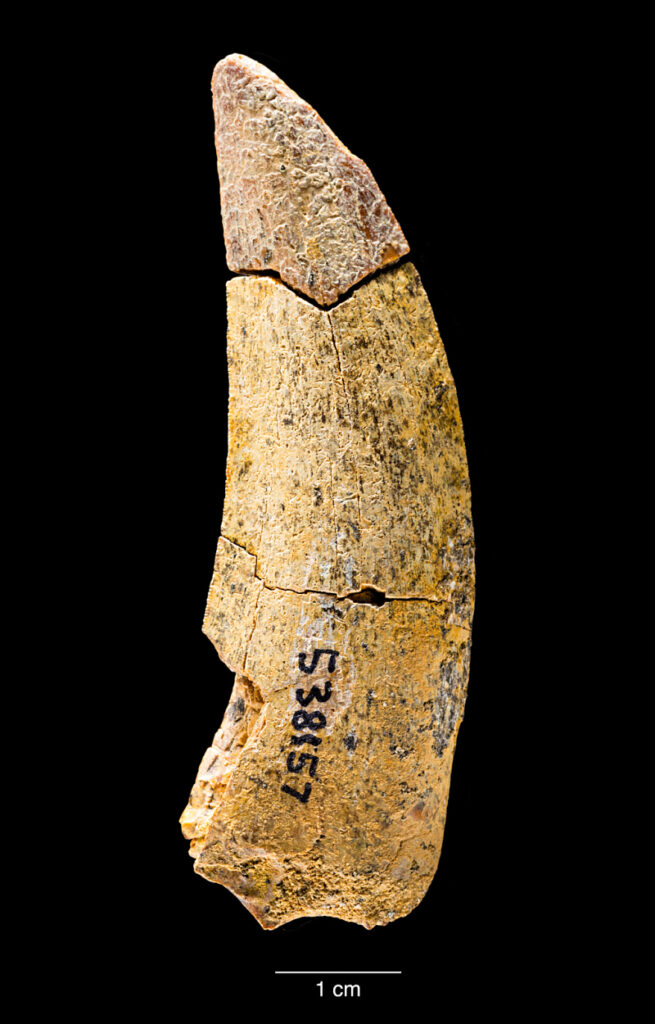
Buried within the golden hues of amber, the tooth stands as a testament to a fierce ancient hunter. Experts identified it through careful examination, noting its preservation in a material typically associated with insects and plants rather than large vertebrates. This rarity elevates the discovery’s profile among paleontologists.
The amber hails from Jordan’s fossil-rich zones, where resin from prehistoric trees captured moments from the Early Cretaceous. Theropod dinosaurs dominated as apex predators during this era, roaming landscapes far different from today’s deserts. The tooth’s emergence adds a thrilling chapter to regional paleontology.
Distinctive Features of the Fossil
The tooth exhibits a curved conical form, complete with a sharp apex designed for piercing prey. Its relatively thick base suggests robust construction suited to tearing flesh. Such traits align closely with those of carnivorous theropods, evoking images of swift, bipedal hunters.
- Curved conical shape for efficient prey capture.
- Sharp apex to inflict deep wounds.
- Thick base indicating strength against tough hides.
- Serrated edges implied in cutting structure.
These characteristics preserved impeccably in amber provide a clear window into the dinosaur’s dental arsenal. Unlike sedimentary fossils prone to distortion, amber offers three-dimensional fidelity.
Striking Parallels to Tyrannosaurus rex
Morphological analysis revealed notable similarities to teeth from Tyrannosaurus rex, the Late Cretaceous icon from about 66 million years ago. Both share comparable curvature and cutting structures, hinting at evolutionary continuity among theropods. However, the vast temporal gap rules out direct kinship with T. rex.
Instead, the Jordan tooth likely came from an earlier theropod species thriving millions of years prior. This comparison highlights how predatory adaptations persisted across epochs. Paleontologists value such links for tracing theropod diversification.
| Feature | Jordan Tooth (140 mya) | T. rex Tooth (66 mya) |
|---|---|---|
| Shape | Curved conical | Curved conical |
| Apex | Sharp | Sharp |
| Curvature | Similar | Matching profile |
| Cutting Structure | Comparable serrations | Advanced serrations |
Insights into Ancient Jordanian Ecosystems
The discovery confirms carnivorous dinosaurs prowled the area now known as Jordan during the Early Cretaceous. It bolsters evidence of diverse fauna in a once-lush environment conducive to amber formation. Scientists anticipate further revelations from these deposits.
Dr. Abbas Haddadin detailed the find in a recent report, emphasizing its role in ecosystem reconstruction. Jordan’s amber record increasingly documents prehistoric biodiversity, from flora to fauna. This tooth joins other fossils, painting a vivid prehistoric portrait.
Key Takeaways
- A 140-million-year-old theropod tooth preserved in Jordanian amber showcases carnivorous traits.
- Similarities to T. rex teeth bridge Early and Late Cretaceous predators.
- The find enriches understanding of Jordan’s ancient ecosystems.
This exceptional fossil reminds us that amber holds secrets of vanished worlds, challenging assumptions about fossil preservation. As studies continue, more pieces of the prehistoric puzzle may surface from Jordan’s amber. What other ancient marvels lie waiting in these resin tombs? Share your thoughts in the comments.