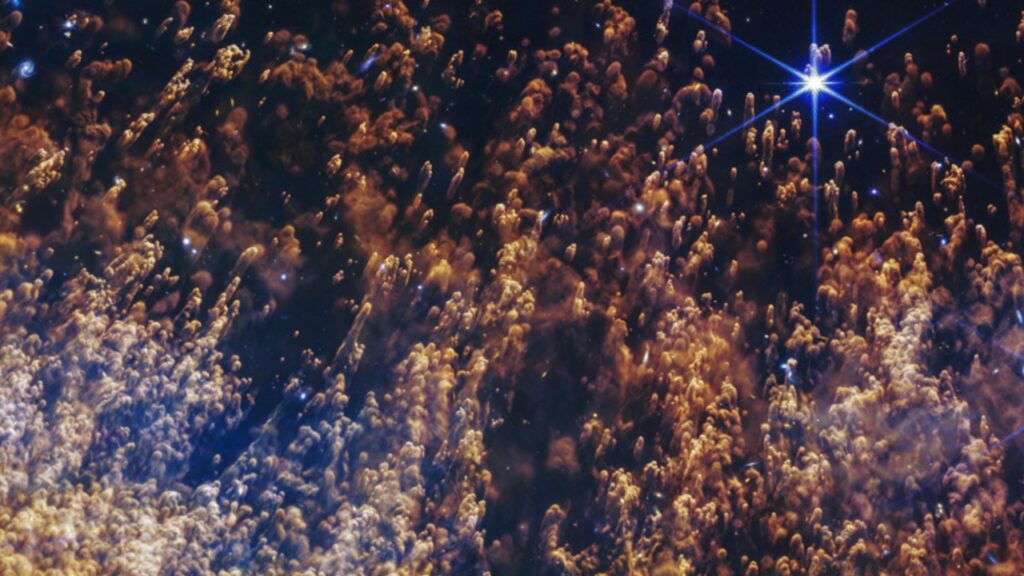
The James Webb Space Telescope recently unveiled a captivating image of the Helix Nebula, showcasing swirling gases and intricate structures that evoke the mesmerizing motion of a lava lamp.
A Planetary Nebula’s Final Glow
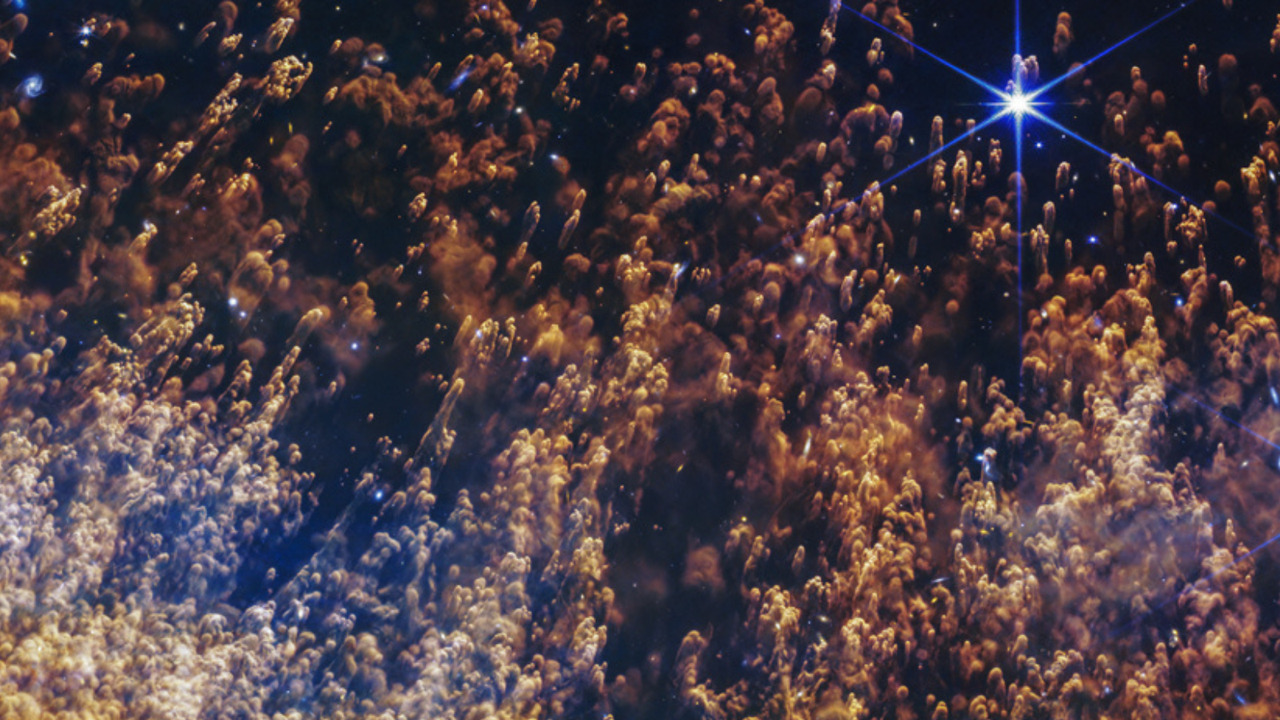
A Planetary Nebula’s Final Glow (Image Credits: Cdn.mos.cms.futurecdn.net)
Astronomers marveled at the sheer detail in the latest James Webb Space Telescope image of the Helix Nebula, often called the Eye of God for its striking resemblance to a celestial pupil.
This planetary nebula, located about 650 light-years away in the constellation Aquarius, formed from the outer layers of a dying sun-like star. The central white dwarf, the remnant core, continues to shape the surrounding gas clouds through intense ultraviolet radiation. Previous observations from telescopes like Hubble captured broad strokes, but Webb’s infrared vision pierced deeper into the dust-obscured regions. Scientists noted the nebula’s dynamic appearance, with bright blobs and dark lanes creating a fluid, lamp-like effect. This view marked the clearest glimpse yet of the structure’s complexity.
Unrivaled Clarity from Infrared Eyes
Webb’s advanced instruments revealed comet-like knots within the Helix Nebula, structures previously hinted at but now sharply defined.
These knots, elongated tails of gas and dust, stretch up to 100 billion kilometers long and glow under the white dwarf’s heat. The telescope’s near-infrared camera highlighted cooler dust components invisible to optical observatories. Researchers observed layered shells of ejected material, expanding outward at speeds around 20 kilometers per second. Stellar winds carved intricate patterns, blending hues of oxygen, hydrogen, and helium emissions. Such precision offered fresh insights into the nebula’s turbulent evolution.
- Comet-like knots with glowing heads and dusty tails
- Swirling gas filaments resembling lava bubbles
- Dark absorption lanes blocking background starlight
- Central white dwarf piercing through the cosmic veil
- Outer envelope of molecular hydrogen
Tracing a Star’s Last Breath
The Helix Nebula serves as a nearby laboratory for understanding the end stages of stellar life, much like our sun’s future fate in billions of years.
Webb’s data illuminated how the dying star shed its atmosphere in repeated bursts, forming concentric rings now disrupted by interactions. Gas temperatures vary dramatically, from scorching inner regions to frigid outer edges. Astronomers identified potential sites where future stars might form from dense clumps, though the dominant process remains destruction over creation. This image built on decades of study, refining models of mass loss and chemical enrichment in interstellar space.
Broader Cosmic Implications
Beyond its visual allure, the observation advanced knowledge of planetary nebulae, key players in galactic chemistry.
These structures disperse heavy elements forged inside stars, seeding the next generation of planets and life. The Helix’s proximity allowed detailed spectroscopy, revealing isotopic ratios that inform supernova histories. Teams analyzed how magnetic fields influence gas flows, adding to theories on nebula morphology.
Key Takeaways
- Webb’s infrared gaze exposed hidden knots and dust lanes in the Helix Nebula.
- The image captures a white dwarf sculpting its gaseous shroud like a cosmic artist.
- Insights into stellar death cycles mirror our sun’s distant destiny.
This latest portrayal of the Helix Nebula not only captivated skywatchers but also deepened scientific appreciation for the universe’s recycling processes. What stands out most to you in this cosmic spectacle? Share your thoughts in the comments.