Western Australia — Researchers have delved into fossils from a Devonian-era reef system, revealing intricate details about early lungfish that paved the way for vertebrates to conquer land. Advanced CT scans of specimens from Australia and China exposed hidden anatomical features, shedding light on a pivotal evolutionary shift more than 400 million years ago. These findings build on decades of work at the Gogo Formation, a fossil-rich site in the Kimberley region.
A Puzzling Fossil Comes into Focus
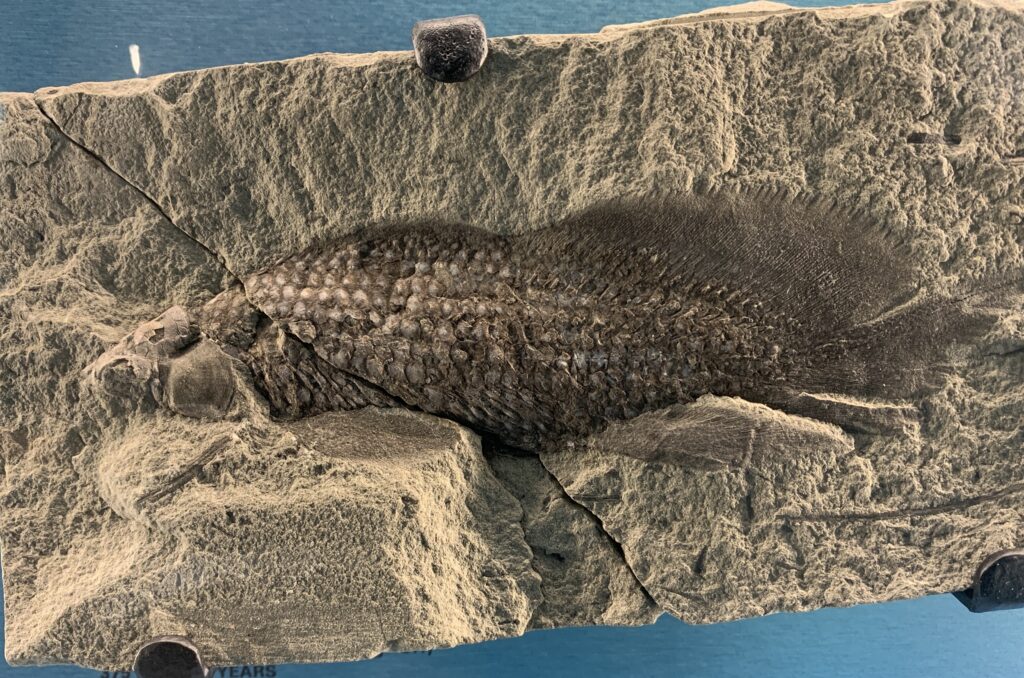
A Puzzling Fossil Comes into Focus (Image Credits: Wikimedia)
One damaged specimen from the Late Devonian Gogo Formation baffled scientists when first described in 2010. Experts initially wondered if it represented an entirely new type of fish. Recent CT scans flipped that view literally, confirming earlier images had been oriented upside down and backward.
Lead author Dr. Alice Clement of Flinders University’s Palaeontology Lab spearheaded the analysis. The scans produced detailed digital models of the external and internal cranium, highlighting the brain cavity’s complexity. Comparisons of the inner ear with other Gogo lungfish added crucial data to the site’s diverse vertebrate record. Coauthor Hannah Thiele collaborated with institutions like the Australian Nuclear Science and Technology Organisation to process the images. The results appeared in the Canadian Journal of Zoology.
New Species Emerges from Chinese Rocks
In southern China, a 410-million-year-old skull from Yunnan province yielded another breakthrough. Paleontologists reconstructed the fossil, naming it Paleolophus yunnanensis, or “old crest from Yunnan.” This lungfish swam in ancient seas during the Early Devonian, bridging a gap in the group’s early history.
Dr. Brian Choo of Flinders University worked with the Chinese Academy of Sciences’ Institute of Vertebrate Paleontology and Paleoanthropology. The team noted similarities to primitive forms like Diabolepis from China, Uranolophus from Wyoming, and Australia’s Dipnorhynchus. Yet distinct feeding adaptations hinted at rapid diversification. Published in Current Biology, the study captured a transitional phase in lungfish evolution.
Lungfish as Evolutionary Architects
Lungfish belong to the lobe-finned fishes, sarcopterygians whose descendants include all tetrapods—four-limbed animals from amphibians to humans. Modern species, like Australia’s Queensland lungfish, survive as living fossils. These ancient specimens illustrate how such fish developed traits essential for terrestrial life.
The Gogo Formation, often called Australia’s first Great Barrier Reef, preserved exceptional three-dimensional fossils. Access to the site involved collaboration with the Gooniyandi community. Both studies emphasized lungfish diversification across Gondwana and beyond during the Devonian. “It adds to the wider understanding of the evolution of these earliest lobe-finned fishes,” Thiele noted.
Key Anatomical Revelations
Advanced imaging transformed fragmentary remains into treasure troves of information. Here’s what the scans disclosed:
- Complex brain cavities in Cainocara enigma, rivaling better-preserved relatives.
- Refined inner ear structures, aiding balance and hearing in ancestral vertebrates.
- Early skull features in Paleolophus yunnanensis for specialized feeding.
- Confirmation of morphological shifts between Early and Late Devonian lungfish.
- Global comparisons revealing convergent and unique evolutionary paths.
These details filled gaps in the vertebrate family tree. Funding from the Australian Research Council supported both efforts.
| Fossil | Location/Age | Key Insight |
|---|---|---|
| Cainocara enigma | Gogo Formation, ~400 mya | Cranium reorientation, brain/ear details |
| Paleolophus yunnanensis | Yunnan, China, 410 mya | Feeding adaptations, diversification |
Charting the Path to Land
The discoveries underscore lungfish’s role in the Devonian explosion of life forms. As oceans teemed with lobe-finned innovators, subtle changes in skulls and senses set the stage for limbs to push against mudflats. Dr. Choo observed, “Paleolophus gives us an unprecedented look at a lungfish from a time between their earliest appearance and their great diversification.”
Though tetrapods appeared later, these fish embodied the prelude. The work continues Flinders University’s legacy at Gogo, enriching global paleontology.
Key Takeaways
- CT scans revived “unstudyable” fossils, revealing brain and ear evolution.
- Lungfish bridged aquatic and terrestrial vertebrates through Devonian innovations.
- International collaboration connected Australian reefs to Chinese seas.
These ancient lungfish remind us that life’s grand transitions hinged on overlooked details in forgotten rocks. What aspects of this evolutionary saga intrigue you most? Share your thoughts in the comments.