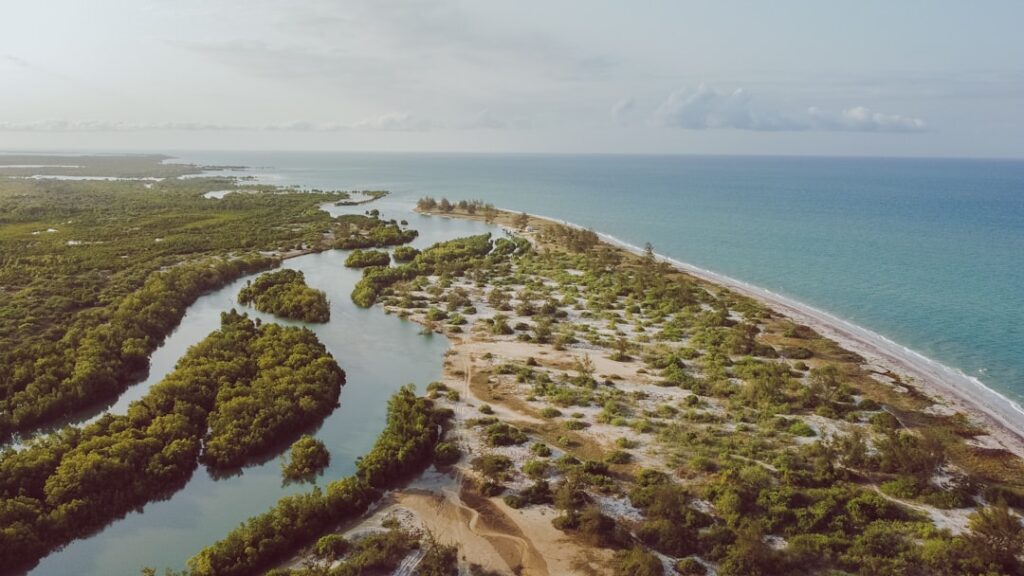
Coastal communities worldwide face escalating threats from storms, erosion, and rising seas, with mangroves historically serving as vital natural barriers. Recent modeling reveals that restoring these forests in front of existing dikes creates powerful hybrid systems, blending nature’s resilience with engineered strength. This approach not only dampens waves but also cuts flood damages significantly, offering hope for vulnerable shorelines.
Waves Tamed: The Mechanics of Mangrove-Dike Synergy
Waves Tamed: The Mechanics of Mangrove-Dike Synergy (Image Credits: Unsplash)
Researchers demonstrated through global simulations that mangroves positioned ahead of dikes dramatically lessen wave impacts on infrastructure. Waves lose height and energy as they navigate the forests’ dense roots and branches, arriving weaker at the dikes behind. This synergy prevents overtopping, where water spills over barriers during surges.
Dense mangrove belts reduce wind and swell waves by 13 to 66 percent over just 100 meters, according to detailed analyses of their structure. Structures alone reflect waves, amplifying erosion in front, but mangroves dissipate energy naturally. Studies confirm this combination outperforms standalone defenses, especially under intensifying storms.
Global Scale of Protection
Under present conditions, hybrid systems could avert $800 million in annual flood and storm damages while shielding 140,000 people from impacts each year. Projections show even greater returns as climate change worsens: in a high-emissions scenario, savings exceed $65 billion annually, protecting hundreds of thousands more.
Southeast Asia leads with potential reductions of $270 million in damages today, followed by West Africa at $221 million and South Asia at $167 million. Countries like Nigeria, Indonesia, and India stand to gain most, where degraded mangroves back many dikes. Restoration targets areas with restoration potential, excluding intact forests or urbanized coasts.
| Region | Current Damage Reduction (USD) | People Protected (Annual) |
|---|---|---|
| Southeast Asia | $270 million | 70,000 |
| West Africa | $221 million | 38,000 |
| South Asia | $167 million | 23,000 |
Beyond Floods: Ecosystems and Economics in Harmony
Mangroves deliver more than wave reduction; their roots stabilize sediments, curbing erosion that threatens shorelines. They filter pollutants, nurture fish nurseries, and store carbon, supporting fisheries and biodiversity in coastal zones.
Economically, benefits outweigh costs three to six times over, yielding a net present value of $44 to $125 billion globally. Restoration proves viable in 41 to 50 percent of assessed subnational regions, prioritizing low-income areas where poverty rates exceed 67 percent in flood-prone spots. “Having those two together is actually a very smart idea,” noted study leader Timothy Tiggeloven.
- Wave attenuation reduces dike maintenance needs.
- Sediment trapping builds land against sea-level rise.
- Biodiversity boosts sustain local livelihoods like fishing.
- Carbon sequestration aids climate mitigation.
- Lower construction heights for new dikes cut expenses.
Real-World Promise and Pathways Forward
Projects in places like Guyana and Indonesia already plant mangroves before dikes, validating models with on-ground success. Yet challenges persist, including coastal squeeze from development and the need for cross-disciplinary collaboration among ecologists and engineers.
Environmental economist Jonah Busch emphasized, “This paper really should put wind in the sails of green-gray infrastructure.” Future efforts may pair mangroves with salt marshes or reefs, amplifying protection further.
Key Takeaways
- Hybrid defenses cut current global flood damages by $800 million yearly, scaling to $65 billion in worst-case futures.
- Benefits concentrate in Southeast Asia, West Africa, and South Asia, aiding poor communities most.
- Cost-benefit ratios of 3-6 make restoration a high-return investment for resilience.
As seas rise and storms intensify, hybrid mangrove-dike systems offer a blueprint for sustainable coastal security, merging nature’s adaptability with human ingenuity. What steps should your community take to embrace such solutions? Tell us in the comments.