Northern Saudi Arabia – Scientists exploring remote cave networks unearthed seven naturally mummified cheetahs and skeletal remains of 54 others, offering vital clues to the species’ ancient presence in the region.
Unexpected Trove Challenges Assumptions
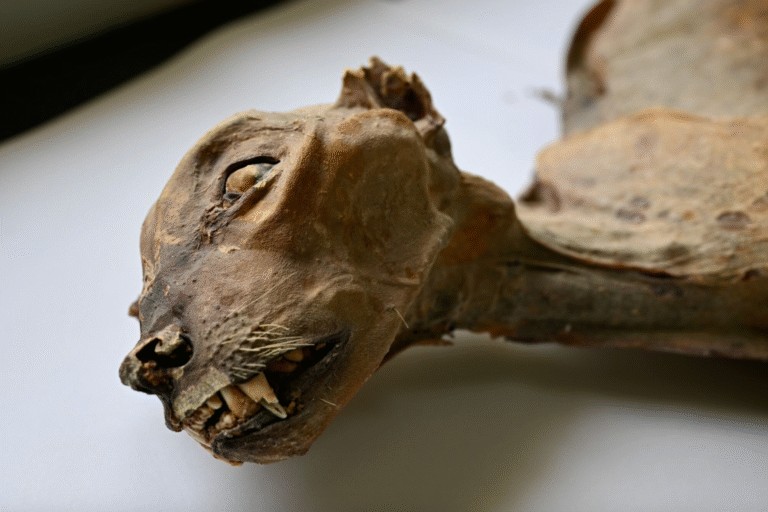
Unexpected Trove Challenges Assumptions (Image Credits: Imgs.mongabay.com)
Researchers from Saudi Arabia’s National Center for Wildlife surveyed 134 caves across 1,211 square kilometers near the city of Arar in 2022 and 2023. They concentrated their efforts in the Lauga network, where hyper-arid conditions preserved the remains remarkably well. Lead author Ahmed Al Boug described the find as highly surprising, noting it marked the first documented natural mummification of cheetahs.
Most remains appeared in five specific caves, with 80 percent clustered in four of them. Many belonged to subadults aged 18 to 24 months or even cubs, hinting at possible denning behavior. The caves also held skeletons of 164 gazelles in one site, alongside mummified foxes and a wolf, underscoring their role as natural traps or shelters.
DNA Unlocks Subspecies Mystery
Radiocarbon dating placed the youngest mummy at about 127 years old and the oldest skeletal remains at over 4,200 years. Scientists extracted DNA from three samples for the first time from naturally mummified large felines. This analysis clustered the recent specimen with the Asiatic cheetah (Acinonyx jubatus venaticus), while older ones aligned more closely with the Northwest African subspecies (A. j. hecki) in nuclear DNA.
Al Boug highlighted the breakthrough: “The key insight from our discovery is that more than one subspecies of cheetah inhabited Saudi Arabia.” This evidence positioned northern Saudi Arabia as a historical bridge for cheetah lineages, not merely a peripheral habitat. Mitochondrial DNA linked all samples to the Asiatic haplogroup, but nuclear genomes revealed greater diversity.
Preservation in Arid Depths
The caves’ stable microclimates – averaging 26 to 29 degrees Celsius with 24 to 28 percent humidity – desiccated the bodies, halting bacterial decay. Soft tissues, skulls, and even encephalons remained intact, allowing 3D reconstructions. Cheetahs entered via sinkholes or steep slopes, averaging 127 meters from entrances.
Prey scarcity inside suggested the predators did not store food there. Instead, the sites likely captured animals unintentionally. Such conditions turned the limestone karst into biodiversity archives, rare outside permafrost zones.
Rewilding Informed by History
Cheetahs vanished from the Arabian Peninsula by the 1970s due to overhunting and habitat loss. Saudi Arabia now reintroduces ungulates like Arabian oryx and sand gazelles, creating prey bases. The findings guide sourcing: Northwest African cheetahs may suit rewilding better than scarce Asiatic ones, now fewer than 30 wild individuals in Iran.
Partners like the Cheetah Conservation Fund support these efforts. Experts emphasize matching historical ecology boosts success. Paleogenomic data bridges gaps in lost baselines, enhancing genetic diversity.
| Subspecies | Sample Link | Implications |
|---|---|---|
| Asiatic (A. j. venaticus) | Youngest mummy | Confirms prior assumptions |
| Northwest African (A. j. hecki) | Older samples | Expands sourcing options |
Key Takeaways
- Multiple cheetah subspecies roamed ancient Arabia, per DNA evidence.
- Caves preserve invaluable records for conservation.
- Rewilding can prioritize genetically matched populations for viability.
This discovery transforms speculation into strategy, proving Saudi deserts once sustained thriving cheetah populations. As restoration accelerates, these mummified messengers ensure reintroductions honor the past. What do you think about bringing cheetahs back? Tell us in the comments.