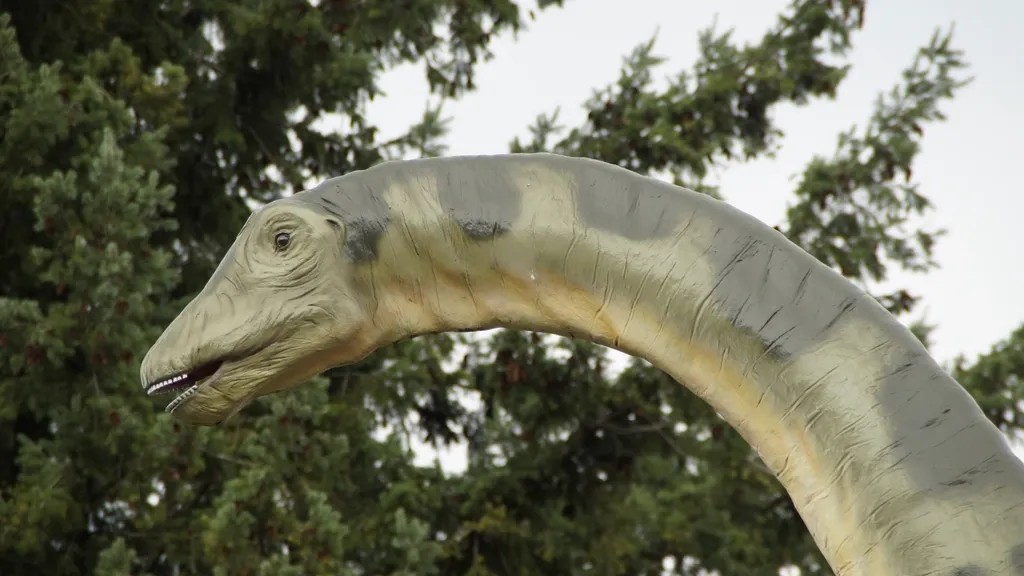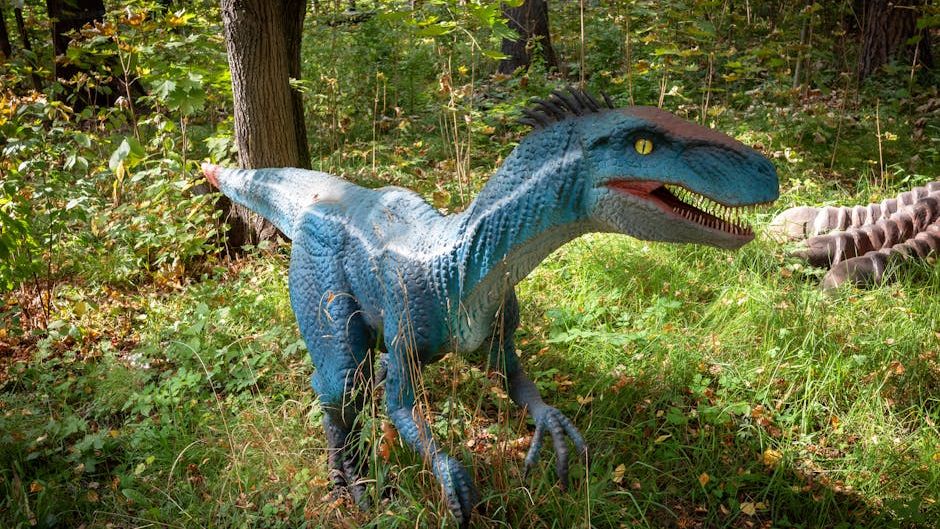
For most of the history of paleontology, dinosaur color was considered permanently unknowable. Artists painted them in muddy greens and browns, museum models wore the same dull grays for decades, and textbooks treated vivid pigmentation as a matter of pure speculation. That assumption has been steadily dismantled by a series of remarkable discoveries, and the picture emerging from modern fossil science is far more vibrant than anyone expected.
Dinosaur coloration is generally one of the unknowns in the field of paleontology, as skin pigmentation is nearly always lost during the fossilization process. Studies of feathered dinosaurs and skin impressions, however, have shown that the color of some species can now be inferred through the analysis of color-determining organelles known as melanosomes, preserved in fossilized skin and feathers. What researchers have found since those early breakthroughs is enough to make you reconsider everything you thought you knew about how Mesozoic animals actually looked.
The Tiny Structures That Changed Everything: Melanosomes Explained
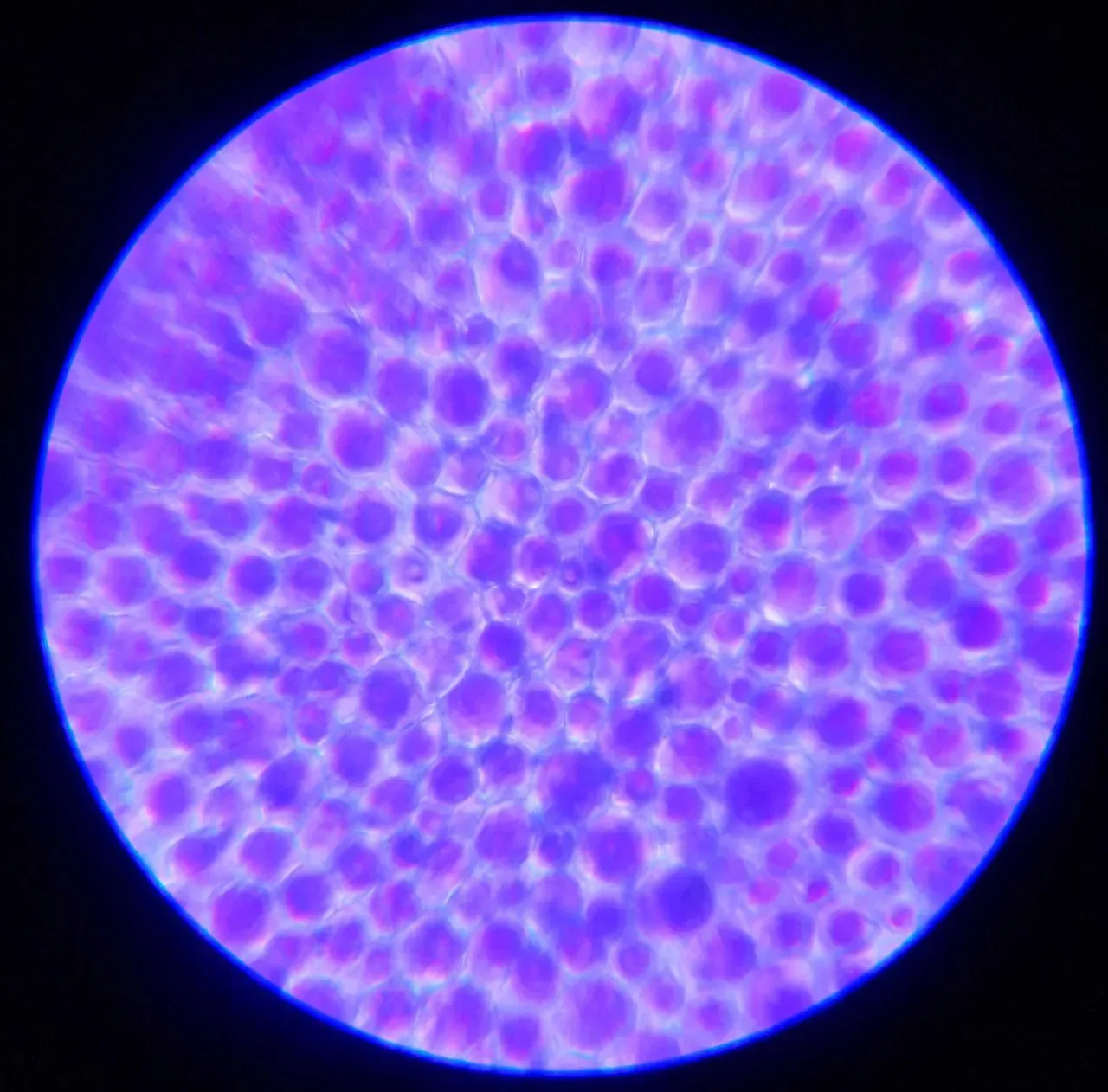
Before you can appreciate what we now know about dinosaur color, you need to understand the mechanism that makes it possible. The biological key to solving the coloration puzzle comes down to minuscule structures called melanosomes, tiny blobby organelles that contain pigment, or melanin, and are present in soft tissues such as skin, scales, and feathers. Their shape is what matters most.
Eumelanosomes are rod-like and are associated with the colors black and gray. Pheomelanosomes are round and produce colors ranging from reddish brown to yellow. A lack of melanosomes makes white. That elegant three-way system means that even a fossil tens of millions of years old can, under the right conditions, reveal not just that color existed but what that color actually was.
Since the publication of the earliest melanosome discoveries, researchers have investigated the chemistry of fossil melanin and substantiated the observation that melanin can survive for millions of years, almost chemically intact. That survival is the foundation of everything that follows.
Reading Color from Stone: How Scientists Actually Do It
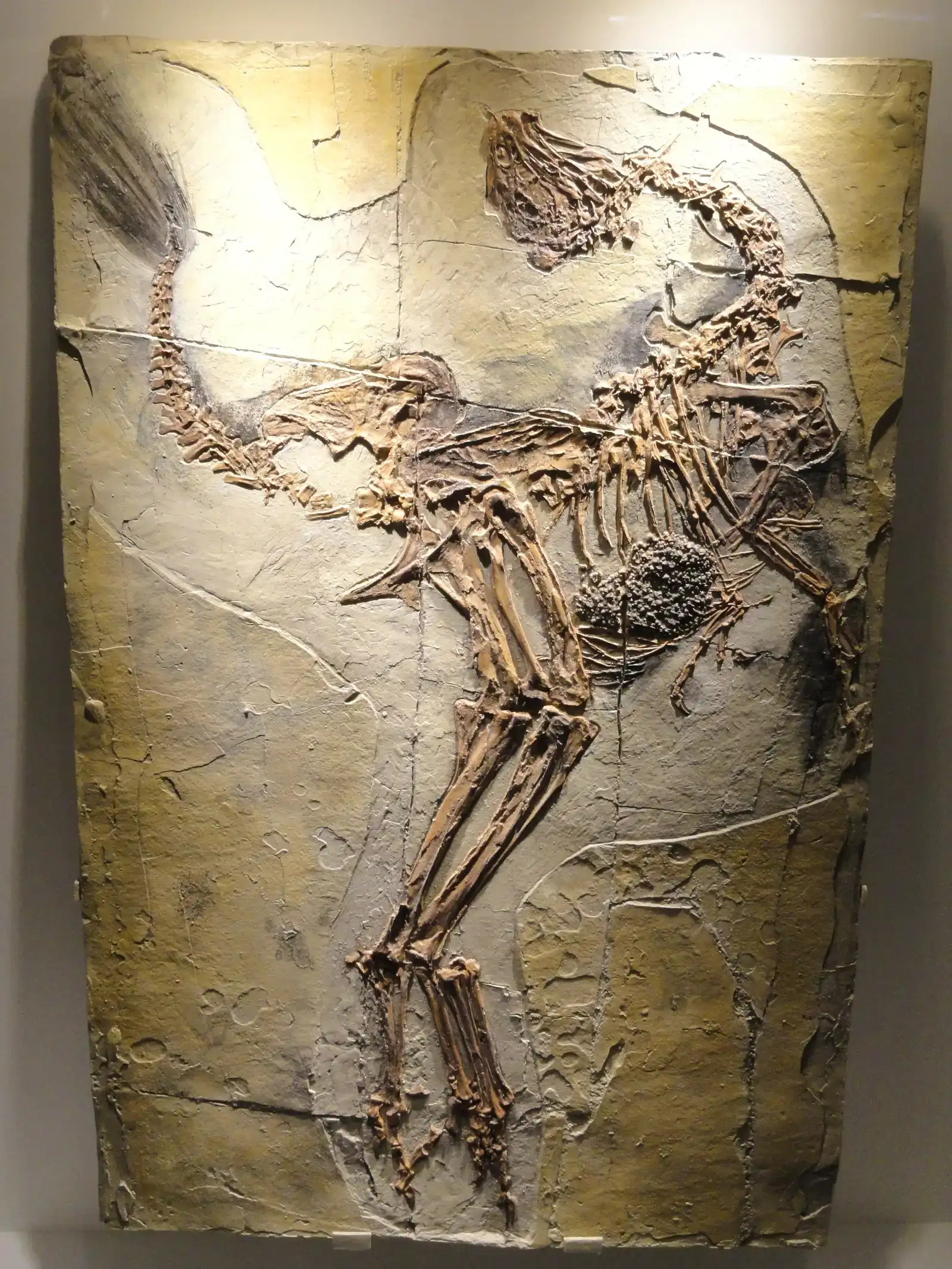
Pulling color from the past requires a combination of lucky finds and advanced imaging techniques. Paleontologists need a fossil with more than just bones, specifically one with feathers, skin, or hair. These fossils often contain both melanosomes and chemically degraded melanin pigment, and when such a fossil turns up, modern technology can take a closer look.
You start by looking for the microbodies using instruments like scanning electron microscopes, and once those characteristic shapes appear, chemical analysis can confirm the presence of melanin pigment. This step was particularly critical early in fossil melanin studies because there was still some doubt that the microbodies were in fact melanosomes and not other similar structures, like bacteria.
Researchers took measurements of melanosomes from multiple tiny samples collected from various places on a fossil surface and compared them to the size ranges, shape ranges, and arrangements of melanosomes in the feathers of living birds. This allowed scientists to interpret color to a more sophisticated degree and to express results in terms of probability. The rigor is real, and it keeps improving.
Sinosauropteryx: The World’s First Known Ginger Dinosaur
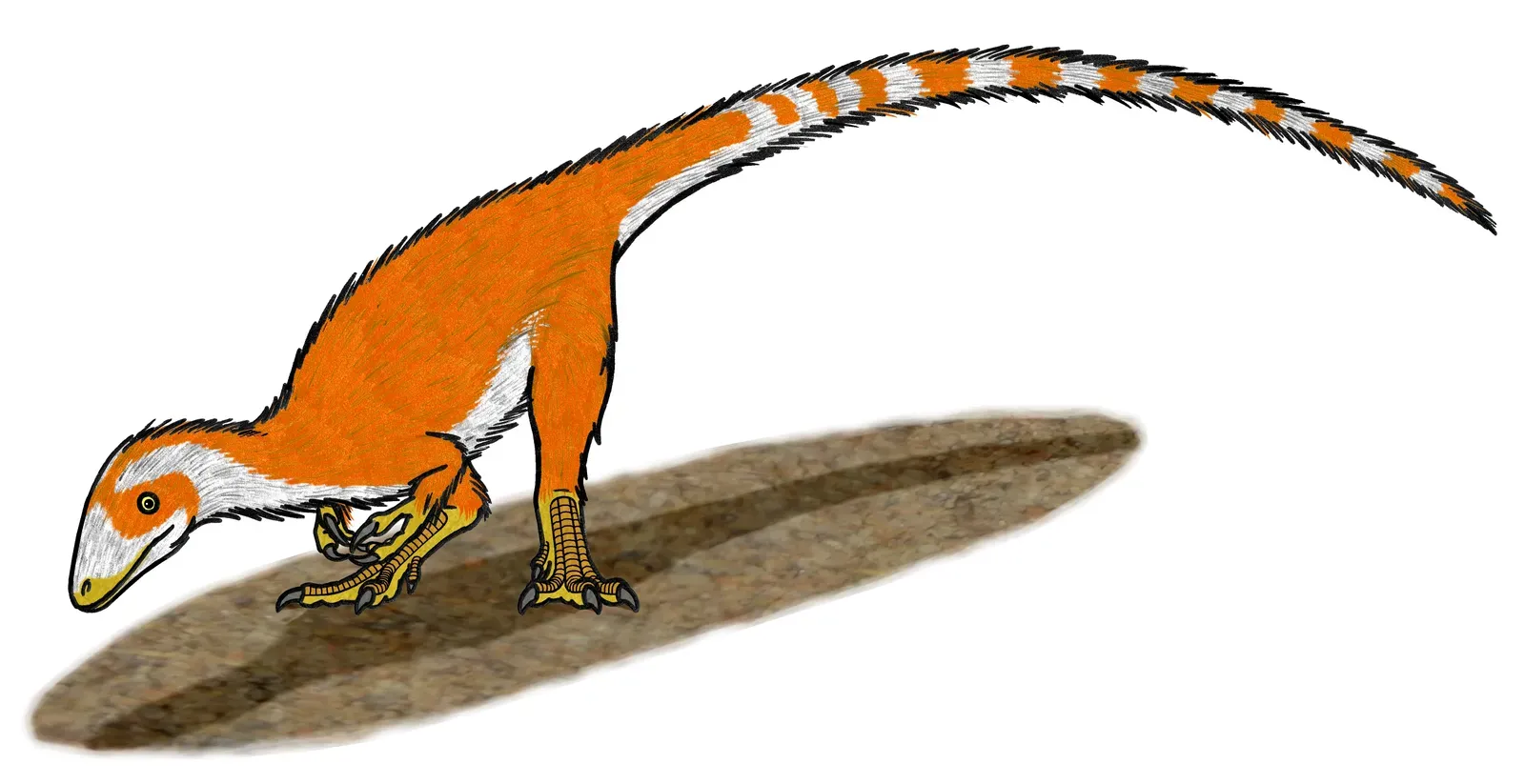
The pattern of meatball melanosomes in the fuzz-covered dinosaur Sinosauropteryx implied that it had sported a reddish coat and a tiger-striped tail, making it the first known ginger dinosaur. That discovery alone forced a fundamental rethink of what early feathered dinosaurs actually looked like walking through their Cretaceous environments.
In 1996, Sinosauropteryx became the first dinosaur known to have had feathers. In 2010, it entered the ranks of the first dinosaurs to have their color elucidated, when analysis suggested it had a fetching tail of ginger-and-white stripes. Later work reconstructed the color pattern across its entire body, revealing that Sinosauropteryx was countershaded, dark on top and light underneath, and sported a “bandit” mask on its face, resembling that of a raccoon. That mask, it turns out, may have had a practical purpose: birds often have facial stripes to hide their eyes, which are key visual cues used by both predators and prey to detect would-be attackers or a potential meal, and eye stripes also reduce glare, allowing animals to see better in bright light.
Caihong juji: The Rainbow Dinosaur That Outshone Hummingbirds
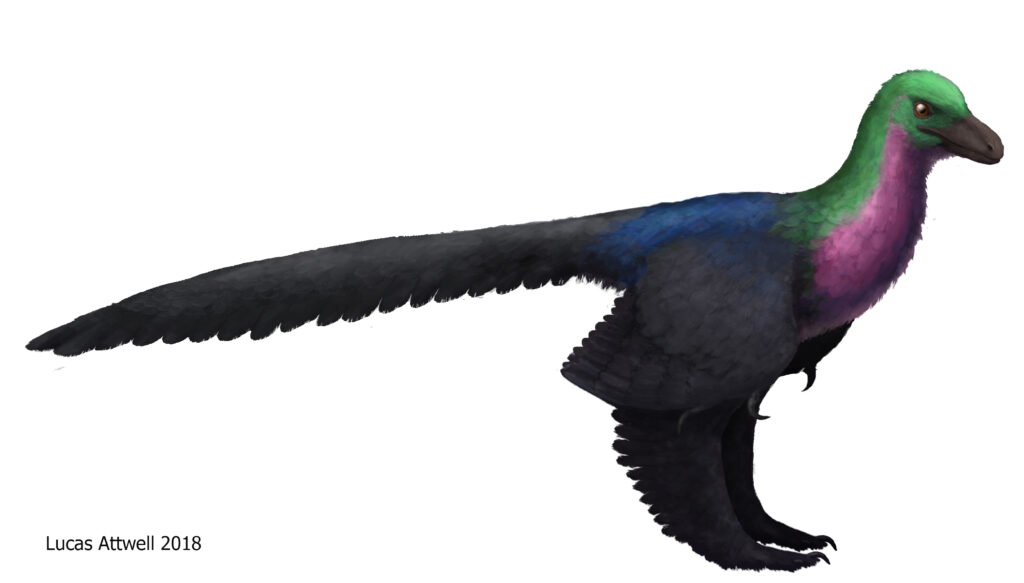
One of the more extraordinary discoveries is Caihong juji, an extinct species of dinosaur that lived during the Late Jurassic period, approximately 161 million years ago. It is known for its remarkable colorful plumage, leading to its popular nickname, “the rainbow dinosaur,” with a scientific name that translates to “rainbow with a big crest” in Mandarin Chinese.
When scientists examined the fossil, they found that its well-preserved remnants contained traces of pigment in its feathers. The team sampled 66 sites across the fossil, comparing the melanosomes they saw with melanosomes from modern bird feathers. On Caihong’s head, chest, and parts of its tail, the researchers saw melanosomes that were long, flat, and organized into sheets, patterns that most closely match the melanosomes in the iridescent throat feathers of hummingbirds.
Colorful plumage is used in modern birds to attract mates, and the rainbow feathers of Caihong might be a prehistoric version of a peacock’s iridescent tail. Caihong is the oldest known example of platelet-shaped melanosomes typically found in bright iridescent feathers. In other words, the flashy display behavior we associate with modern birds has roots that stretch back more than 160 million years.
Microraptor’s Iridescent Black: More Crow Than Lizard
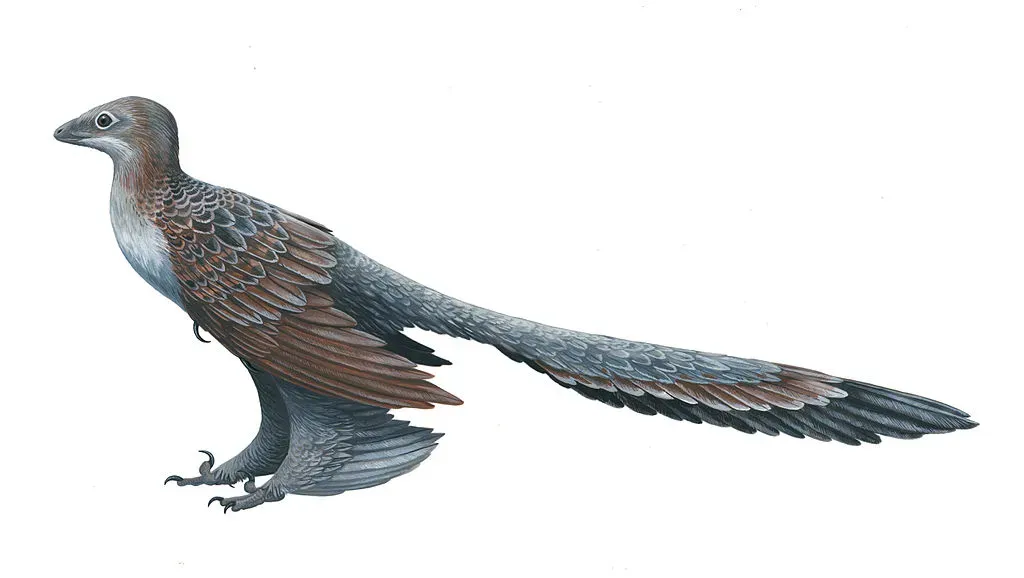
Evidence of iridescence was soon discovered in an actual non-bird dinosaur, a crow-size creature from China with wings on all four limbs, dubbed Microraptor, a primitive cousin to Jurassic Park’s Velociraptor. The movie had depicted Velociraptor with scaly skin, but scientists now know that both these dinosaurs were, in fact, covered in feathers.
In Microraptor, the preserved feathers contain long, sausage-shaped melanosomes arranged to bend light in eye-catching ways. Its plumage would have been black, with the same shiny sheen as a crow’s. What’s particularly interesting is what that color implies about behavior. Experts had presumed that Microraptor was nocturnal, based on the large size of its eye sockets. The discovery that it possessed iridescent plumage suggests otherwise, because in modern birds such coloration is typically found in species that are active in the daytime.
Camouflage Across Species: Color as Survival Strategy
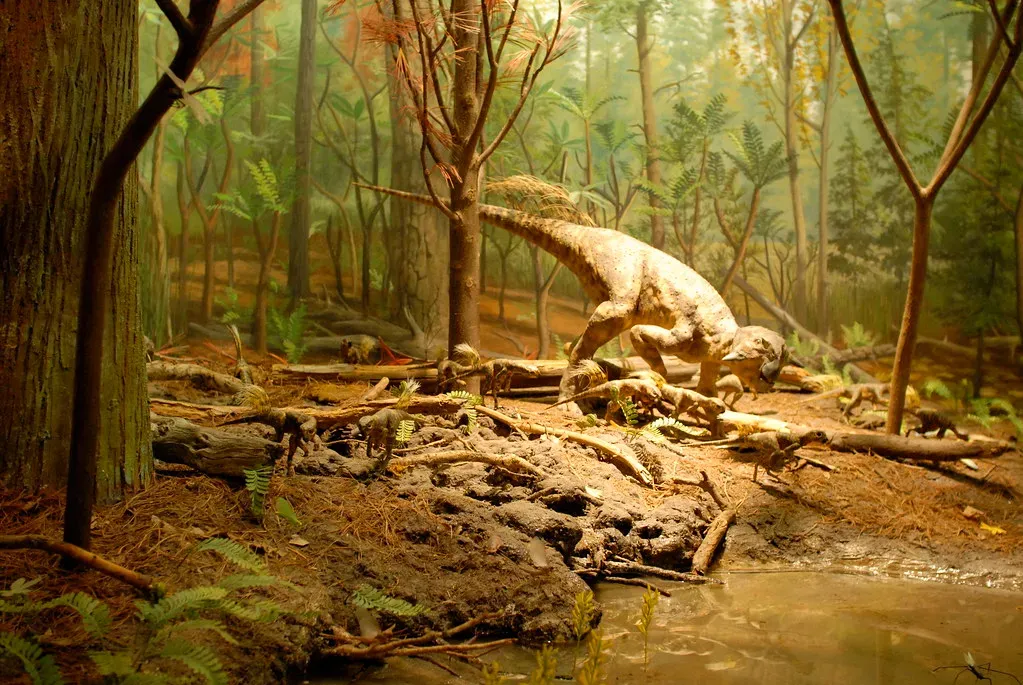
Analysis of the exquisitely preserved fossil remains of Psittacosaurus revealed one of the most elaborate dinosaur color patterns ever seen, including a brown back and a lighter belly. Modern-day antelope, fish, and other animals have similar dark-and-light zones, which confuse predators, but this was the first discovery of such markings on a dinosaur.
These studies suggest that Psittacosaurus inhabited a closed habitat such as a forest with a relatively dense canopy. The countershading pattern itself was the clue. Because the optimal countershading varies strongly with light environment, pigmentation patterns give clues to an animal’s habitat. In open habitats, where direct overhead sunshine dominates, a sharp dark-to-light color transition high up the body is evident, while in closed habitats under a forest canopy, diffuse illumination dominates and a smoother dorsoventral gradation is found. Color, in other words, can tell you what kind of world a dinosaur lived in.
Sauropods and Scaled Dinosaurs: Color Beyond the Feathered
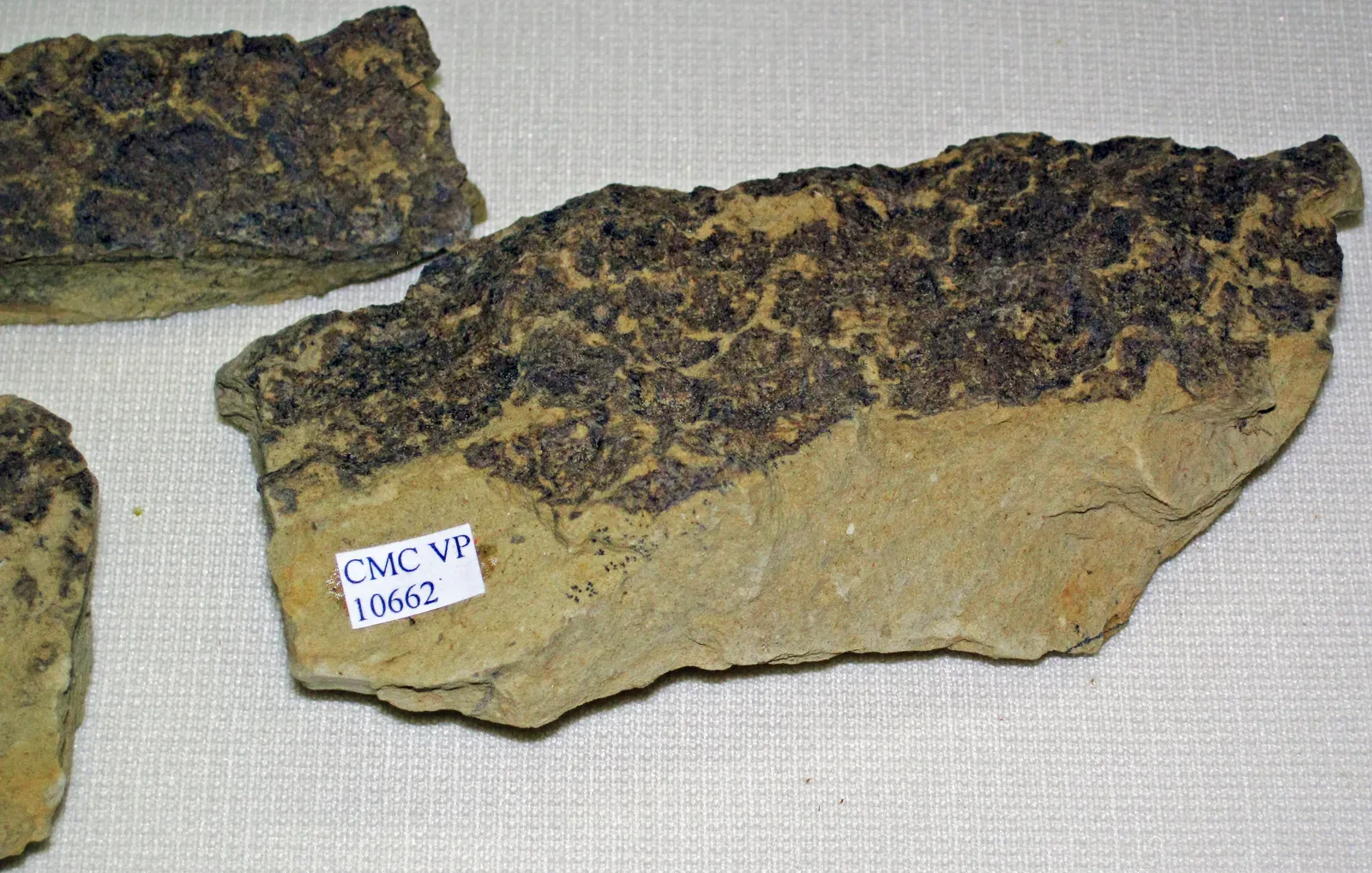
You might assume that color evidence is limited to feathered dinosaurs. The recent discovery involving Diplodocus suggests otherwise. Fossilized skin from a juvenile Diplodocus shows two distinct types of melanosomes, suggesting possible speckled color patterning. The melanosome sizes and shapes resemble those producing brown or dark hues in modern reptiles and birds, providing the first evidence of melanosome shape diversity in sauropod scales and indicating more complex coloration than previously recognized.
Fossil melanin and fossil melanosome organelles that produced melanin have made it possible to reconstruct dinosaur color patterns, evidencing fundamental but previously elusive behaviors like camouflage. The armored dinosaur Borealopelta adds another dimension to this. Researchers discovered that Borealopelta exhibited countershading, darker on top and lighter underneath, despite its massive size and formidable armor. This coloration pattern, typically associated with camouflage in smaller animals vulnerable to predation, suggests that even heavily armored dinosaurs faced significant predatory threats. The preservation of pigments in a large-bodied dinosaur demonstrates that color evidence is not limited to small, feathered species.
What the Colors Tell Us About Behavior and Evolution
Particularly significant is the evidence that iridescent and brilliant colors evolved in theropod dinosaurs long before the emergence of modern birds, suggesting sexual selection was a powerful force in dinosaur evolution. Countershading adaptations in various species demonstrate that predator-prey dynamics influenced coloration, even in armored species previously thought impervious to predation. The diverse pigmentation strategies now documented across multiple dinosaur families suggest that color vision was well-developed in these animals, requiring paleontologists to reconsider dinosaur sensory capabilities and social behaviors.
The bold coloring of Anchiornis probably helped to attract mates or served as some other kind of display, as occurs in flashily dressed modern birds. Color patterns may therefore provide a way to test behavioral hypotheses about a species using a different line of evidence than usual. That is a genuinely transformative idea. This type of analysis reveals the potential of the emerging field of fossil coloration. By reconstructing long-lost shades, paleontologists can detect and investigate ancient behaviors that have previously been hidden from view.
Conclusion: A Prehistoric World That Was Far More Vivid
![Conclusion: A Prehistoric World That Was Far More Vivid (did it myself based on [1],[2],[3],[4],[5],and [6], Public domain)](https://nvmwebsites-budwg5g9avh3epea.z03.azurefd.net/dinoworld/168570092481f9b1d9f0db35997b42f2.webp)
The picture that science has assembled over the past two decades is striking in its specificity. You now know that some dinosaurs wore raccoon masks. Others shimmered like hummingbirds. Some were rusty red and striped, while others carried speckled patterns across their scales. None of this was visible to any researcher just twenty years ago.
Current techniques primarily detect melanin-based pigments while missing others like carotenoids or structural colors, potentially underestimating the full spectrum of dinosaur coloration. That means the discoveries already made are likely just the beginning. The ancient world was not the drab place that decades of monochrome illustrations suggested. It was, in many places and for many species, genuinely brilliant. The more carefully we look, the more color we keep finding.