Researchers in Taiwan built a life-sized model of a brooding oviraptor dinosaur to explore ancient reproductive behaviors. The experiment revealed that these bird-like creatures from 70 million years ago relied on both their body heat and sunlight to incubate eggs in semi-open nests. Unlike modern birds, which maintain precise control over egg temperatures, oviraptors faced greater challenges that led to less efficient hatching processes. This discovery highlights an evolutionary step in how some dinosaurs cared for their young.
Recreating a Prehistoric Nursery
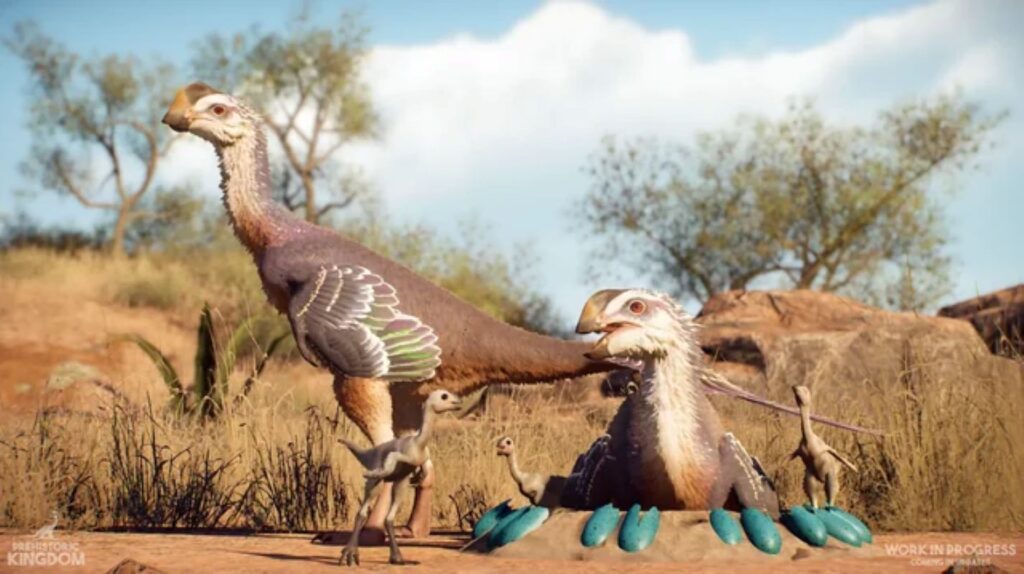
Recreating a Prehistoric Nursery (Image Credits: Reddit)
Scientists modeled their work after Heyuannia huangi, a 1.5-meter-long oviraptor that weighed about 20 kilograms and lived in what is now China during the Late Cretaceous. They constructed the adult dinosaur’s trunk from polystyrene foam and wood, adding layers of cotton, bubble paper, and cloth to simulate soft tissues. Eggs, molded from casting resin to mimic fossil specimens, formed double-ring clutches typical of oviraptor nests.
These nests remained semi-open and exposed to the air, unlike the fully covered setups of some modern birds. The team ran experiments under varying conditions to measure heat flow. First author Chun-Yu Su noted the challenge: “Part of the difficulty lies in reconstructing oviraptor incubation realistically… we invented the resin eggs to approximate real oviraptor eggs as best as we could.”
Uneven Heat and Asynchronous Hatching
Experiments demonstrated stark temperature differences within the clutches. In colder settings with the model adult present, eggs in the outer ring varied by up to 6°C, likely causing eggs to hatch at staggered times – a pattern known as asynchronous hatching. Warmer environments narrowed this gap to just 0.6°C, suggesting external factors played a key role.
Senior author Dr. Tzu-Ruei Yang explained the setup’s implications: “We show the difference in oviraptor hatching patterns was induced by the relative position of the incubating adult to the eggs.” The ring arrangement prevented the adult from contacting every egg directly, limiting uniform heat distribution. Thermometers placed throughout the clutch captured these gradients precisely.
Sunlight Steps In as Co-Incubator
The open nest design allowed sunlight to penetrate, acting as a supplemental heat source. In warmer conditions, solar warmth stabilized temperatures across the clutch more effectively than adult brooding alone could in the cold. Dr. Yang observed, “Since oviraptor clutches are open to the air, heat from the sun likely mattered much more than heat from the soil.”
- Open-air nests exposed eggs to direct sunlight, unlike buried reptile clutches.
- Sun provided a powerful boost, reducing outer-ring disparities.
- This co-incubation suited the dinosaurs’ environment but extended overall hatching times.
- Adult positioned in the center, brooding inward-facing eggs primarily.
Su added, “Moreover, we obtained an estimate of the incubation efficiency of oviraptors, which is much lower than that of modern birds.”
Key Differences from Modern Bird Brooding
Modern birds employ thermoregulatory contact incubation, or TCI, where parents sit fully on eggs to deliver consistent heat within a narrow range. Oviraptors fell short of these criteria due to their nest geometry.
| Aspect | Oviraptor Incubation | Modern Birds |
|---|---|---|
| Contact | Partial, center-focused | Full with all eggs |
| Heat Source | Adult + sun | Primarily adult |
| Efficiency | Lower, longer period | Higher, precise control |
| Nest Type | Semi-open rings | Covered, compact |
The study, published in Frontiers in Ecology and Evolution, bridges physics simulations and fossil evidence to quantify these distinctions. Oviraptors’ approach represented an adaptation as nests shifted from buried to exposed styles.
Evolutionary Insights and Modern Relevance
This hybrid method proved effective for oviraptorids in their subtropical habitats, though not superior to bird strategies. Dr. Yang emphasized context: “Modern birds aren’t ‘better’ at hatching eggs… Nothing is better or worse. It just depends on the environment.” Limitations include modern climate differences from the Late Cretaceous and specifics to the reconstructed nest.
The work inspires beyond paleontology. Yang concluded, “There are no dinosaur fossils in Taiwan, but that does not mean that we cannot do dinosaur studies.”
Key Takeaways:
- Oviraptors used sun and body heat together, achieving lower incubation efficiency.
- Temperature gaps of 6°C in cold led to staggered hatches; sun narrowed this in warmth.
- Nest rings prevented bird-like full brooding, marking an evolutionary transition.
Oviraptor parents remind us that reproductive success adapts to circumstances, not perfection. What do you think about these ancient solar nurseries? Tell us in the comments.