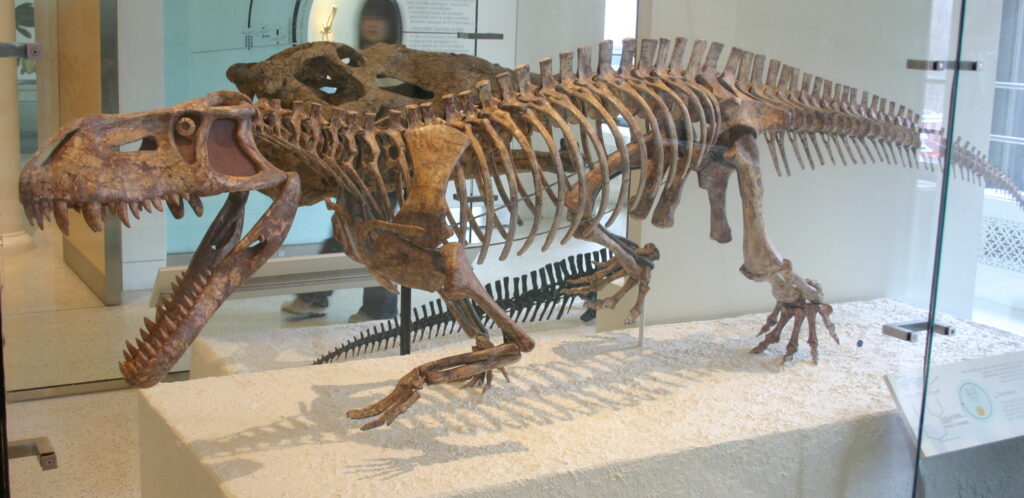
Fierce Hunters of the Triassic World (Image Credits: Wikimedia)
South Africa – Paleontologists have identified new fossil remains of a prestosuchid rauisuchian from the lower Elliot Formation, offering fresh insights into the predators that roamed the region during the Late Triassic. These discoveries mark a significant addition to the sparse record of large carnivorous archosaurs in southernmost Gondwana. Comparative anatomical studies confirmed the material’s affiliation with prestosuchids, a group known for their formidable builds and dominance in Triassic ecosystems.
Fierce Hunters of the Triassic World
Rauisuchians ranked among the top predators of the Triassic Period, thriving from the Early to Late Triassic before vanishing around 200 million years ago. These pseudosuchian archosaurs, more closely related to crocodilians than to dinosaurs, featured pillar-erect postures with legs positioned directly beneath their bodies for efficient movement. Many reached lengths of 4 to 6 meters, equipped with powerful jaws lined with sharp, serrated teeth.
Prestosuchids, a subgroup within the loricatan branch of rauisuchians, exemplified this predatory prowess. Known primarily from South American sites like Brazil and Argentina, genera such as Prestosuchus displayed robust skulls and armored backs covered in osteoderms. Their fossils now extend into southern Africa, hinting at wider Gondwanan dispersal.
The Lower Elliot Formation’s Hidden Fauna
The lower Elliot Formation, part of South Africa’s Karoo Supergroup, dates to the Norian-Rhaetian stages of the Late Triassic, roughly 220 to 205 million years ago. This unit consists of mudstones and sandstones deposited by meandering rivers in a semi-arid landscape. It preserves a diverse assemblage dominated by early sauropodomorph dinosaurs and cynodonts, but large carnivores remained elusive until recent reviews.
Prior to these findings, fragmentary archosaur remains hinted at rauisuchian presence, but definitive identifications proved challenging. The formation’s fauna, including traversodontids like Scalenodontoides macrodontes, reflects a transitional ecosystem just before the Triassic-Jurassic extinction.
Key Specimens and Anatomical Clues
Researchers examined multiple fossils from collections such as the Bernard Price Institute (BP) and others, revealing a modest diversity of rauisuchians. These marked the first confirmed body fossils of large carnivores from the lower Elliot, extending rauisuchian records to paleolatitudes around 50 degrees south.
| Specimen | Elements | Identification |
|---|---|---|
| BP/1/5302 | Right dentary fragment | Rauisuchia (possible rauisuchid affinity) |
| BP/1/5163 | Osteoderms, teeth, vertebrae, ribs | Rauisuchia (loricatan) |
| BP/1/8120 | Dentary fragments | Rauisuchia |
| SAM-PK-K383 | Right maxilla with teeth | Rauisuchia (possible rauisuchid) |
| NMQR 3554 | Right ilium | Poposauroidea |
Newer material builds on this foundation, with anatomical features aligning closely to prestosuchids through detailed comparisons. Such traits include specific dental serrations and bone textures unmatched by local dinosaurs or crocodylomorphs.
Biogeographic and Biostratigraphic Insights
These fossils represent the southernmost known rauisuchians, broadening their Late Triassic range across Gondwana. They correlate with faunas from North America’s Chinle Formation and Argentina’s Los Colorados Formation, yet the absence of aetosaurs and phytosaurs in South Africa suggests regional ecological differences.
- Rauisuchians filled apex predator roles alongside emerging dinosaurs.
- Their late survival near the Triassic-Jurassic boundary aids in dating continental strata.
- Extinction paved the way for theropod dominance in the Jurassic.
- Footprints like Brachychirotherium indicate active populations.
- Prestosuchid presence links South Africa to Brazilian relatives.
Climate shifts toward aridity in the Elliot Basin may have influenced these distributions.
Key Takeaways
- New prestosuchid fossils confirm rauisuchian diversity in southern Africa.
- Lower Elliot Formation yields first large carnivore body fossils.
- Findings extend biogeographic range and refine Triassic timelines.
These prestosuchid remains underscore the dynamic Late Triassic world, where crocodile-like giants coexisted with the ancestors of iconic dinosaurs. As research continues, further excavations promise to reveal more about this pivotal era. What do you think about these ancient predators? Tell us in the comments.