Researchers constructed a life-size dinosaur nest to unravel how oviraptor parents warmed their eggs around 70 million years ago. The innovative experiment combined physical models and heat sensors to test ancient incubation strategies. Results exposed a hybrid approach that relied on both parental body heat and sunlight, reshaping views on dinosaur reproduction.
Fossil Clues Spark a Modern Quest
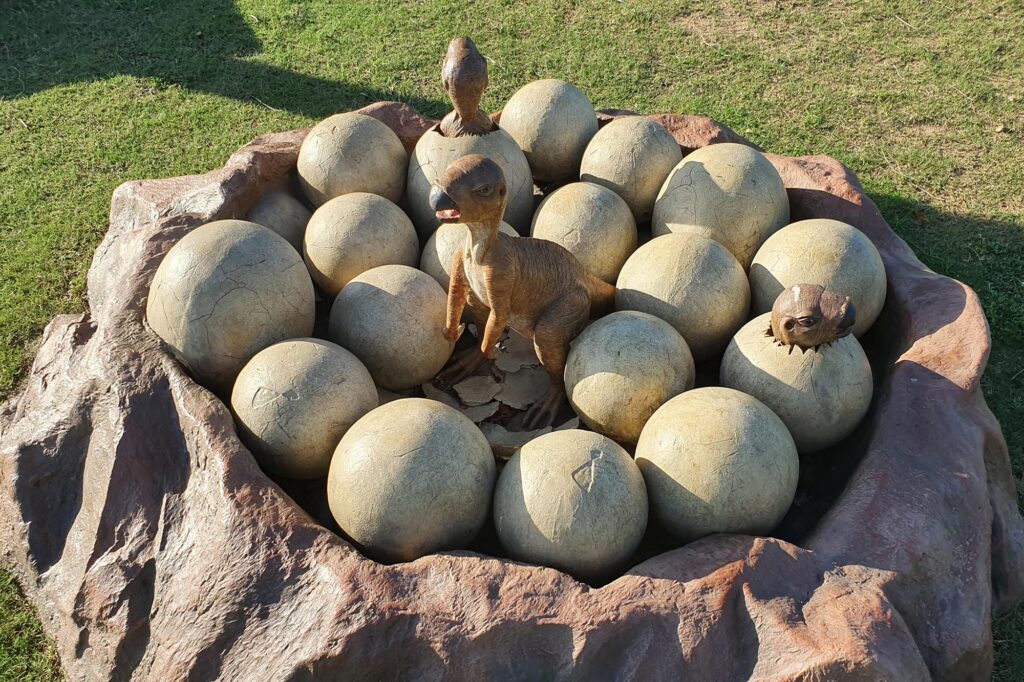
Fossil Clues Spark a Modern Quest (Image Credits: Facebook)
Fossils of oviraptor nests preserved eggs in distinctive double rings, arranged in semi-open clutches exposed to the air. These structures puzzled scientists because the layout prevented a parent from touching every egg directly. Heyuannia huangi, a 1.5-meter-long oviraptor species weighing about 20 kilograms, left behind such nests in what is now China during the Late Cretaceous period.
The ring design raised questions about heat distribution. Paleontologists wondered if these dinosaurs brooded like birds or depended more on environmental warmth. A team led by high school student Chun-Yu Su and senior author Tzu-Ruei Yang from Taiwan’s National Museum of Natural Science set out to answer through hands-on recreation.
From Foam to Flesh: Recreating the Nest
The researchers built a detailed model of Heyuannia huangi using polystyrene foam and a wooden frame for the torso. They added cotton, bubble wrap, and fabric to simulate soft tissues, along with a heating pad to mimic body heat. Artificial eggs, molded from casting resin to match fossil oviraptor eggs, contained thermometers to track temperatures precisely.
Two egg clutches formed double rings on a soil base, replicating fossil evidence. Experiments tested brooding postures outdoors under cold conditions averaging 18.9 degrees Celsius and warmer ones at 30.2 degrees Celsius. Heat transfer simulations complemented the physical trials, analyzing contact areas and temperature gradients.
Sensors measured variations every 20 minutes, revealing how the adult’s position affected inner and outer ring eggs. Contact occurred mainly with outer-ring eggs near the center, covering up to 12 square centimeters per egg.
Temperature Tales: What the Sensors Showed
In colder setups, outer-ring eggs near the adult’s core reached 25.7 to 30.3 degrees Celsius, while peripheral ones stayed cooler at 24.4 to 25.6 degrees Celsius. Inner-ring eggs varied from 23.7 to 28.5 degrees Celsius, with differences up to 6 degrees Celsius across the clutch. Warmer environments reduced gaps to about 0.6 degrees Celsius, as sunlight evened out heat.
Without the adult, sun-exposed eggs hit 42 degrees Celsius but fluctuated wildly by up to 18 degrees Celsius. The brooding posture stabilized extremes but introduced posture-induced variations leading to asynchronous hatching – eggs in the same nest emerging at different times.
- Core outer-ring eggs heated fastest in cold trials.
- Inner-ring eggs lacked direct contact, relying on conduction through soil and air.
- Solar radiation acted as a co-incubator in open nests.
- Incubation efficiency ranged from 26 to 65 percent, far below modern birds’ 84 percent.
- Temperature swings suggested longer hatching periods than birds experience.
Beyond Bird Brooding: A Unique Dinosaur Strategy
Oviraptors could not perform thermoregulatory contact incubation like birds, where parents touch all eggs uniformly. The ring arrangement blocked full access, forcing a partnership between limited body heat and environmental sources. “Oviraptors may not have been able to conduct TCI as modern birds do,” Su noted.
Unlike turtles burying eggs for soil warmth or crocodiles using ambient heat alone, oviraptors actively attended nests while harnessing sunlight. Yang explained, “Modern birds aren’t ‘better’ at hatching eggs. Instead, birds living today and oviraptors have a very different way of incubation… It just depends on the environment.” This hybrid method suited their shift to semi-open nests from buried ones, prioritizing protection without crushing eggs.
The findings, detailed in Frontiers in Ecology and Evolution, highlight how nest evolution shaped parenting. Asynchronous hatching emerged as a trait unique to oviraptorosaurs, contrasting with synchronous patterns in related dinosaurs like troodontids.
Key Takeaways
- Oviraptor nests demanded hybrid heat from parent and sun for viability.
- Posture created egg temperature gradients up to 6 degrees Celsius.
- Lower efficiency points to extended incubation times versus birds.
This experiment proves physical recreations can illuminate prehistoric behaviors even without local fossils. It invites further models to explore dinosaur reproduction across species. What surprises you most about oviraptor parenting? Share in the comments.