Santa Clara del Mar – Two tourists exploring the rugged coastal cliffs stumbled upon an extraordinary fossil during a routine beach walk. The discovery, a remarkably intact right femur from a Megatherium americanum, dates back roughly 400,000 years to the Pleistocene epoch. Specialists quickly intervened to rescue the specimen from imminent erosion by tides and wind, preserving a key piece of South American megafauna history. This find underscores the Pampas region’s enduring role as a treasure trove for paleontologists.
A Lucky Find on the Beach
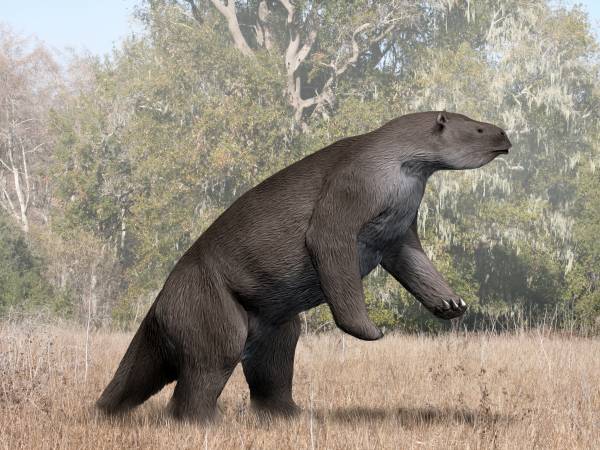
A Lucky Find on the Beach (Image Credits: Upload.wikimedia.org)
Mario Cianciola and Lumar Ávila González noticed an unusual orange sphere protruding from a cliff wall while strolling along the southern cliffs of Santa Clara del Mar. What appeared at first like a soccer-ball-sized rock turned out to be the exposed end of a massive bone. They photographed it and sought advice from a geologist friend, who urged them to contact local experts immediately.
The pair acted swiftly, complying with Argentina’s National Law for the Protection of Archaeological and Paleontological Heritage. Within days, a team arrived to extract the fossil before natural forces could destroy it. Tides had already begun to erode the site, highlighting the urgency of professional intervention.
Unveiling Megatherium americanum
The recovered bone measured 80 centimeters long and 50 centimeters wide, its orange hue resulting from iron oxides in ancient waterlogged soils. Paleontologists identified it as the right femur of Megatherium americanum, the largest known ground sloth and a dominant herbivore of South America’s Pleistocene landscapes. This species towered over modern animals, capable of reaching heights that dwarfed today’s largest mammals.
Experts noted the specimen’s exceptional preservation, including visible striations from muscle attachments. Such details promise new insights into the creature’s physiology. The bone stands out as one of the most complete examples from the southeastern Buenos Aires coast.
- Length: Up to 6 meters, including tail.
- Height: 3 meters on all fours; 4.5 meters standing on hind legs.
- Weight: 4,000 to 5,000 kilograms.
- Diet: Tough, abrasive vegetation, supplemented by volcanic ash during Andean uplift.
- Features: Enormous claws among the largest in the animal kingdom; teeth with open roots for continuous growth.
Swift Rescue by Local Experts
A coordinated effort involving students from the Tecnicatura Superior en Paleontología at ISFT Nº194 in Miramar and professionals from the Museo Municipal de Ciencias Naturales “Lorenzo Scaglia” in Mar del Plata secured the femur. Paleontologist Matías Taglioretti led the operation, describing it as “one of the most complete and best preserved of this species in the coastal region of the southeast of Buenos Aires.”
Taglioretti emphasized the fossil’s rarity. Néstor Toledo, from CONICET and Universidad Nacional de La Plata, will analyze it further for musculature reconstruction. Nearby pelvic remains were spotted but left in place due to collapse risks; heavy machinery may be needed later. The team acted on a Monday following the Saturday discovery, racing against the sea’s relentless advance.
Windows into the Pleistocene Pampas
This discovery bolsters understanding of the Pampas ecosystems 400,000 years ago. Megatherium roamed vast plains, shaping vegetation with its foraging habits. Fossils like this one help reconstruct ancient food webs and environmental conditions.
The site’s geological context – humid sediments rich in iron – preserved the bone uniquely. Similar finds in nearby areas, such as Camet Norte in 2023 and Mar Chiquita, confirm the coast’s paleontological richness. Erosion continually exposes new specimens, but also threatens them.
Next Steps for the Fossil
Currently at the Museo Scaglia’s paleontology lab, the femur undergoes cleaning and preparation. Detailed studies will follow, focusing on anatomical details. Eventually, it heads to the Museo de Ciencias Naturales Pachamama in Santa Clara del Mar for public display.
Public engagement remains key. Exhibits will educate visitors on megafauna extinction around 12,000 years ago and the Pampas’ prehistoric legacy.
Key Takeaways
- The femur’s pristine condition offers rare muscle data for Megatherium studies.
- Tourist vigilance and expert response prevented loss to erosion.
- Buenos Aires coast continues to reveal Pleistocene secrets.
This serendipitous find reminds us that history lurks just beneath the surface, waiting for curious eyes. As research progresses, it may reshape views of ancient South America. What do you think about this prehistoric giant? Tell us in the comments.