East and Central Africa – Researchers harnessed open-access satellite imagery to locate hard-to-reach breeding sites of critically endangered Rüppell’s vultures by detecting the white stains their droppings leave on cliff faces.
A Species on the Brink
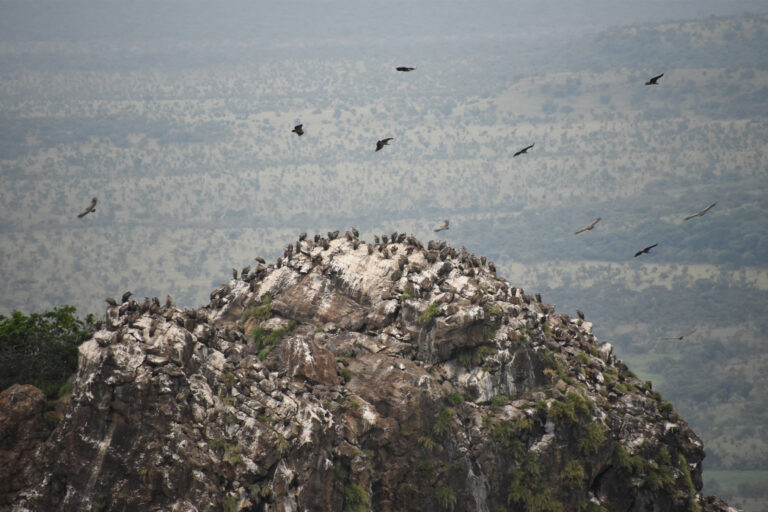
A Species on the Brink (Image Credits: Imgs.mongabay.com)
Rüppell’s vulture populations plunged by more than 90% over the past four decades, leaving conservationists racing to safeguard the survivors. These massive birds, known for soaring at extreme heights, nest in large colonies on remote cliffs across a sprawling range that spans West, Central, and East Africa. Traditional surveys proved challenging due to vast distances, rugged terrain, and security issues in some regions.
Locating active breeding colonies became essential. Without precise maps, protective efforts remained scattered and inefficient. A Bulgarian ornithologist led a team that changed this dynamic through innovative remote analysis.
Whitewash: The Unexpected Beacon
Ivaylo Angelov scanned over 6 million square kilometers using Google Earth imagery, targeting cliffs taller than 20 meters and cross-referencing old bird records. The key indicator emerged below the nests: accumulations of droppings, or “whitewash,” created bright white patterns visible from orbit. This method marked the first large-scale use of satellites to map a raptor’s breeding distribution.
“I love geography, I love travel, and it was an absolute joy for me to zoom in and check all these incredible mountains,” Angelov recalled. “I had the feeling that I’m there.” The process took weeks but yielded 232 potential sites, many previously unknown.
Major Finds in Conflict Zones and Beyond
The search covered seven countries: Chad, Central African Republic, Sudan, South Sudan, Ethiopia, Eritrea, and Somalia. Sudan, South Sudan, and Chad hosted the bulk of discoveries, including 36 potential colonies near Sudan’s Jebel Marra mountains. Unexpected sites appeared in the Central African Republic and western Eritrea.
Only 21 locations fell within protected areas, highlighting vulnerability. In South Sudan’s Boma region, aerial surveys by African Parks confirmed five sites and revealed smaller nests overlooked remotely. “The fact that [Angelov] was finding them from the satellite imagery was really interesting, and it felt quite nice to be able to verify that,” said conservation manager Megan Claase.
- Sudan: Numerous colonies, including near Kassala and Jebel Marra.
- South Sudan: Verified hotspots around Boma National Park.
- Chad: Key sites amid high poisoning rates.
- Ethiopia: Fewer detections due to shadowed cliffs.
Persistent Threats Demand Urgent Action
Poisoning topped the dangers, with pesticide-tainted carcasses killing vultures that fed on them. Farmers targeted predators like hyenas; poachers sought heads for West African charms. In Chad, Sahara Conservation recovered 111 Rüppell’s vulture carcasses in six months last year, most headless.
Even park-nesting birds roamed far. One tagged individual flew 3,600 kilometers round-trip from South Sudan to Chad. “As soon as they do what vultures do and spend most of their time outside of protected areas, they are exposed to the threats,” Claase noted. Ground visits remain crucial, as old whitewash lingers after abandonment.
This technique holds promise for other cliff-nesters, like Griffon vultures in Arabia or Indian vultures in Gujarat. “The first critical step is to know where the key colonies are,” Angelov emphasized. “You cannot protect a species unless you know where it lives.
Key Takeaways
- Satellite imagery identified 232 potential Rüppell’s vulture colonies across 6 million sq km.
- Ground surveys validated the method but stressed the need for on-site checks.
- With populations down 90%, targeted protection could reverse declines.
Satellite eyes from above offer a lifeline for these scavenging sentinels of Africa’s ecosystems. What role should technology play in future wildlife rescues? Tell us in the comments.