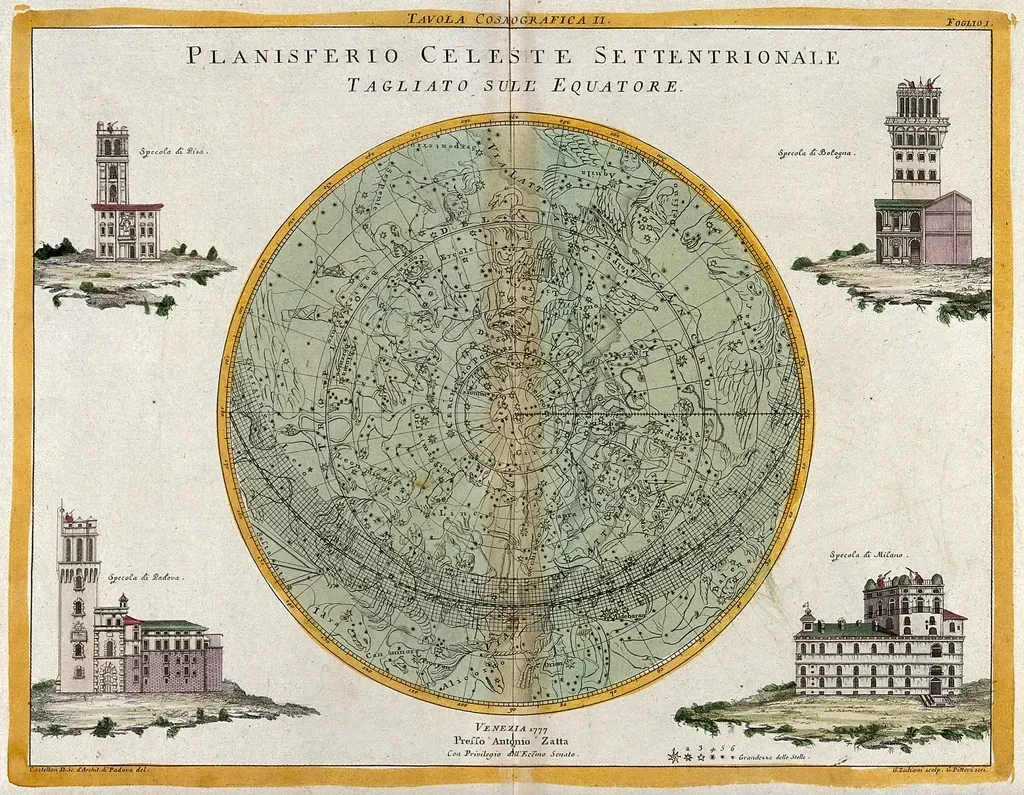
Picture ancient scrolls covered with dust, layers of text piled on top of each other like a cosmic version of geological strata. Somewhere beneath all those words, prayers, and religious texts lay something extraordinary. A map of the heavens that was supposed to be lost forever. Recently, researchers recovered fragments of what might be humanity’s oldest systematic attempt at charting the night sky, hidden beneath centuries of erased and rewritten pages. Using technology that sounds more like science fiction than archaeology, they’ve managed to bring back coordinates of stars plotted more than two thousand years ago.
It’s hard to say for sure, yet this discovery doesn’t just add another entry to the history books. It transforms our understanding of how ancient people saw their universe and raises fascinating questions about the knowledge that might still be buried in overlooked manuscripts around the globe. So let’s dive into the story of how scientists brought back a star map that history had literally tried to erase.
The Father of Astronomy and His Lost Masterpiece
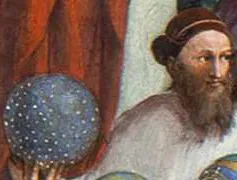
Around 2,150 years ago, Hipparchus not only figured out how equinoxes occur, invented a scale of stellar magnitude, observed planets, discovered a nova, and made cosmic predictions that were eerily accurate, yet he also created what is thought to be the first star catalog to ever exist. Think about that for a moment. This Greek astronomer working in the second century BCE managed all these achievements without any modern equipment, just his observations, mathematical prowess, and rudimentary tools.
Then it was lost. For centuries, historians knew about Hipparchus’s star catalog only through references in later texts. What remained of the catalog was hidden symbolism that first surfaced on a statue of Atlas shouldering the world, known as the Farnese Atlas, this Roman copy of a Greek original eternally carries Earth as his burden at the Archaeological Museum in Naples, Italy, where on the marble planet are glyphs and lines that may have been copied from one of several sky globes Hipparchus made in his time. The actual written catalog? Vanished.
A Manuscript That Refused to Stay Buried
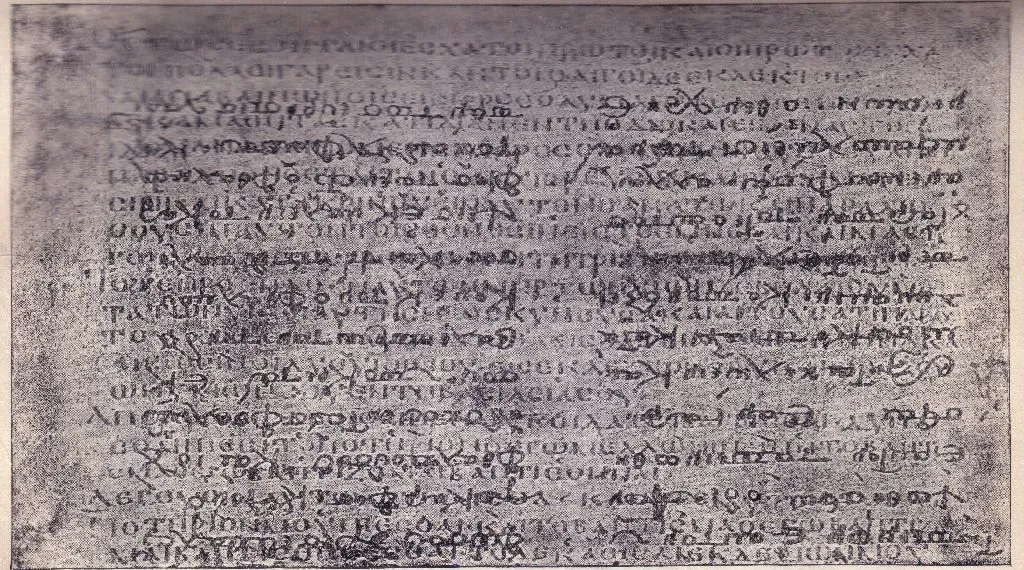
A palimpsest manuscript is one that has been erased and written over multiple times, and because parchment made from animal skins was expensive, it was often reused, with old scripts erased and eclipsed by new ones. Let’s be real, parchment wasn’t cheap back in the day. Parchment was incredibly expensive in the Middle Ages, one book could require a whole herd of sheep, so monks at Saint Catherine’s Monastery, the world’s oldest continuously inhabited Christian monastery located in the Sinai Desert in Egypt, often recycled materials.
More star coordinates in the fabled catalog have been discovered in another palimpsest manuscript, the Codex Climaci Rescriptus, first created by Christian monks in Egypt during the 5th or 6th century C.E., some of the Codex’s pages were written over as many as six times in the following 200 years. Imagine the layers of history compressed onto those fragile pages. Religious texts covering scientific observations, prayers hiding astronomical coordinates. It wouldn’t be until 2022 that anything else from the early astronomer’s star catalog would surface, this time as erasures on an ancient manuscript.
Technology That Sees Through Time
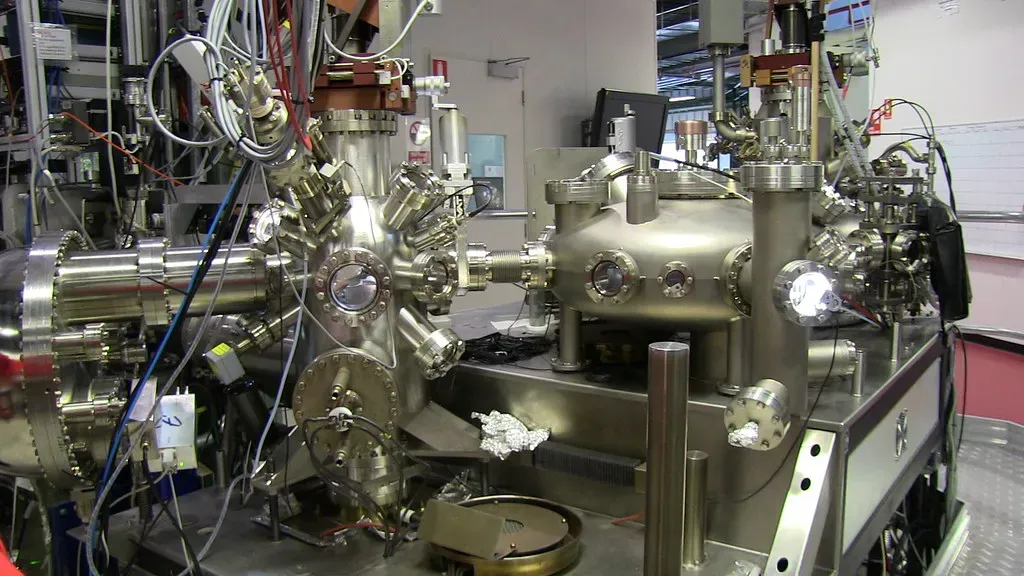
Researchers using a synchrotron at the SLAC National Accelerator Laboratory have been able to recover pieces of the Hipparchus star catalog that had been overwritten, and the synchrotron uses X-rays from agitated electrons to literally shed light on erased text from an ancient palimpsest manuscript. Here’s the thing about this technology, it’s borderline miraculous. A synchrotron is a type of particle accelerator that uses electric and magnetic fields to excite electrons until they are moving at the speed of light and leaving behind intense X-ray beams.
The precision required for this work is staggering. Preventing damage meant radiation needed to be kept at low levels, with X-ray pulses lasting only about ten milliseconds, and keeping targeted areas of the parchment no wider than a human hair. For the pages to stay intact as they made their way to SLAC from the Museum of the Bible in Washington, D.C., they traveled in cases that were controlled for humidity, and could only be carried by hand, because the parchment is so ancient and fragile. You’re essentially trying to read something that’s been scraped off, covered over, and nearly destroyed by time itself.
Reading Invisible Ink From Ancient Greece
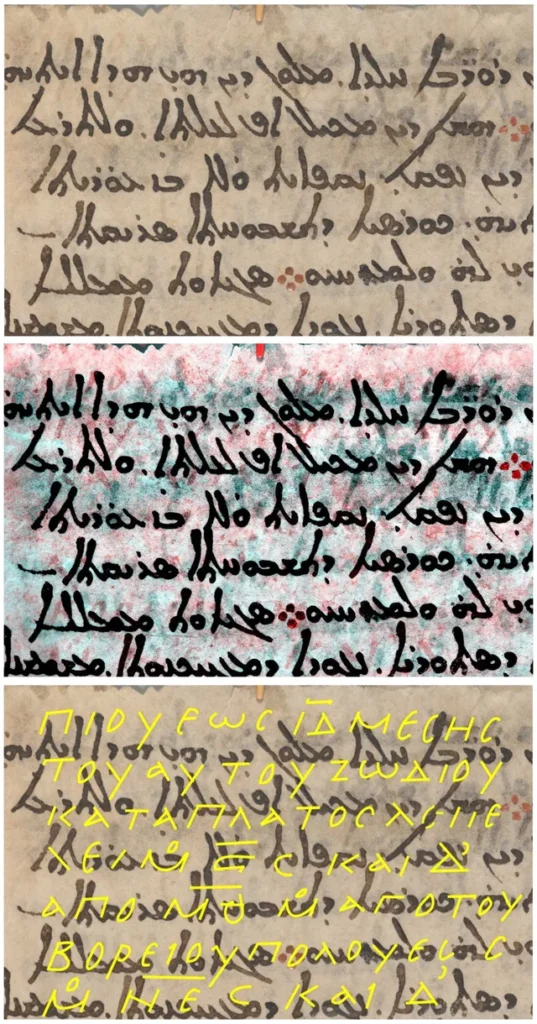
Seeing past so many layers is possible because different types of ink with distinct chemical compositions were used on the parchment, and by adjusting the X-ray beam to detect specific elements, the researchers were able to identify traces of writing no longer visible to the naked eye. Think of it like having a special pair of glasses that can separate out different wavelengths of light to reveal what your eyes alone cannot see. Because the ink used to transcribe Hipparchus’ star map was high in calcium, the synchrotron could see it.
When the team used the synchrotron to scan 11 pages of the manuscript late in the day, lines of ancient Greek that had barely appeared as smudges before were showing up on the monitor. By Wednesday morning, the team had already identified the word for “Aquarius” and descriptions of “bright” stars within that constellation. Honestly, I can only imagine the excitement in that lab when those ancient words materialized on their screens after being hidden for nearly two millennia.
Why This Discovery Changes Everything
Led by archaeologist and translator Victor Gysembergh of Sorbonne University in Paris, France, a team of researchers at the SLAC National Accelerator Laboratory used X-rays generated by the facility’s synchrotron to see past layers of ink that had been scratched off or otherwise erased, allowing them to decipher the original writing that indicated star coordinates from the Hipparchus catalog. The importance here goes beyond just finding an old document. What has surfaced from Hipparchus’ star catalog can now be used to infer how ancient astronomers without telescopes were able to map the cosmos so precisely.
Such observations shift over time as the Earth wobbles on its axis in a phenomenon known as procession, which means it’s possible to determine when these observations would have been made, in roughly 129 BCE, and that’s not far off from when Hipparchus was believed to have been conducting his work, between 190 and 120 BCE. The coordinates themselves serve as time stamps. Historians debated for years whether the Roman astronomer Ptolemy had plagiarized Hipparchus’ star catalog, yet by comparing the new data from the SLAC scans with Ptolemy’s preserved records, they can now prove that Ptolemy did not simply copy the work.
The Precision of Naked Eye Astronomy

Because telescopes were not yet invented, he would have used less useful surveying tools such as a dioptra sighting tube or a model of objects in the sky called an armillary sphere or spherical astrolabe. It’s genuinely mind blowing when you think about it. The page-long passage gives measurements in degrees for the constellation Corona Borealis, with coordinates for the stars on all four edges. With nothing more than the human eye and simple measuring instruments, Hipparchus achieved a level of accuracy that rivals what you might expect from much more advanced tools.
Hipparchus’s catalogue, one of the earliest successful attempts to chart the heavens, lists the positions of 850 stars across the sky with a precision of about one degree, and he was able to attain this precision exclusively with naked-eye observations and the few instruments available at the time. Early studies suggest that Hipparchus was actually more accurate in his observations than the later astronomer. That’s quite something considering Ptolemy came along roughly three centuries later and presumably had access to better resources and accumulated knowledge.
What Lies Ahead for Lost Knowledge
The recovered text represents only a fraction of what Hipparchus originally compiled. There are still countless palimpsests scattered across libraries and monasteries worldwide, each potentially hiding layers of erased knowledge beneath their visible text. These pages are part of a larger 200-page codex, and while this specific set of pages is held in Washington, D.C., other parts of the manuscript are scattered globally. That means more fragments might still be out there waiting to be discovered.
The researcher said he’s been waiting four years for this experiment, which followed his earlier publications on the manuscript, stating he is at the peak of his excitement right now because of this new scan that we started, line after line of text showing up in ancient Greek from the astronomical manuscript. The technology to reveal these hidden texts continues to improve. Future scans might uncover even more coordinates, giving us an increasingly complete picture of how Hipparchus and his contemporaries understood the cosmos. Who knows what other scientific treasures are hiding beneath medieval prayers and religious texts, just waiting for the right technology to bring them back to light?
What do you think about this remarkable journey from ancient stargazing to cutting edge particle physics, all to recover knowledge that was nearly lost forever? It makes you wonder what else might be hiding in plain sight.