Northeastern Brazil — Scientists recently described a peculiar fossil from a dry riverbed near the Amazon rainforest, shedding new light on early vertebrate evolution. The specimen, dating to 275 million years ago during the early Permian period, belonged to Tanyka amnicola, a stem tetrapod with a dramatically twisted lower jaw and teeth oriented sideways. This creature persisted on the supercontinent Gondwana long after its relatives vanished, challenging assumptions about diets and survival in ancient ecosystems.
Puzzling Jaws Emerge from Isolation
Puzzling Jaws Emerge from Isolation (Image Credits: Reddit)
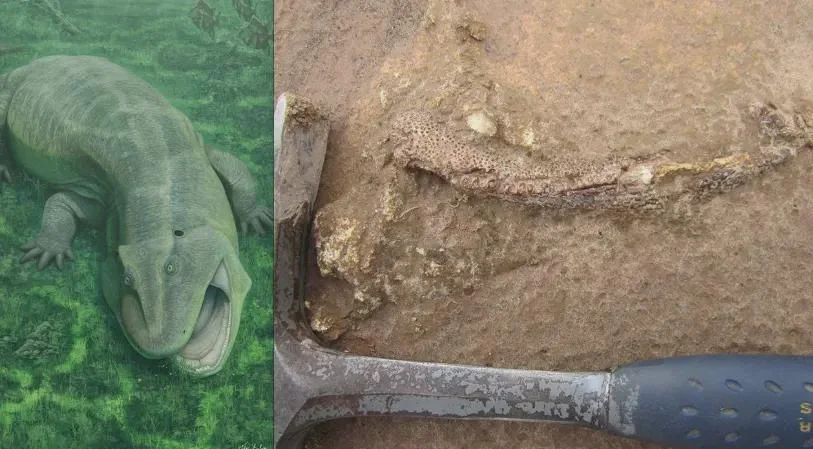
Paleontologists first encountered the fossils during fieldwork in the Pedra de Fogo Formation. They recovered nine isolated lower jawbones, each measuring about 15 centimeters long. At first, the twisted structure baffled the team, who wondered if it resulted from deformation.
Lead author Jason Pardo, from the Field Museum, recalled the frustration. “The jaw has this weird twist that drove us crazy trying to figure it out,” he said. “We were scratching our heads over this for years, wondering if it was some kind of deformation.” Yet, the consistent feature across well-preserved examples confirmed it as a natural trait. No skulls or body fossils accompanied the jaws, leaving the full anatomy speculative but distinctive.
Unraveling the Jaw’s Bizarre Mechanics
The lower jaw of Tanyka amnicola twisted outward from back to front. Main teeth projected sideways rather than upward, while the inner surface rotated toward what would have been the mouth’s roof. This area bristled with tiny denticles, resembling a cheese grater.
Researchers inferred that the upper jaw mirrored this setup. During feeding, denticles likely rasped against each other, shredding tough material. Pardo explained, “The teeth would have been rasping against each other, in a way that’s going to create a relatively unique way of feeding.” Such an arrangement set Tanyka apart from typical tetrapods, whose teeth opposed for slicing or basic grinding.
- Twisted lower jaw with outward-projecting teeth.
- Upward-facing inner surface lined with denticles.
- Rasping mechanism for processing food.
- No associated skull, limiting body reconstructions.
A Herbivore Among Carnivores
Evidence points to a plant-based diet, unusual for stem tetrapods. Most relatives hunted meat, but Tanyka‘s denticles suited grinding vegetation or hard invertebrate shells. Co-author Juan Carlos Cisneros noted, “Based on its teeth, we think that Tanyka was a herbivore, and that it ate plants at least some of the time.”
The creature likely inhabited lakes or slow rivers, inferred from surrounding sediments. Its body may have resembled a salamander with an elongated snout, reaching up to 3 feet in length. This aquatic lifestyle aligned with Gondwana’s early Permian environments, hotter and drier than northern regions.
Relic of a Bygone Era in Gondwana
Tanyka amnicola belonged to stem tetrapods, an ancient group that predated the split into modern lineages: one for reptiles, birds, and mammals; another for amphibians. By the Permian, this stem had largely faded, making Tanyka a survivor. Pardo likened it to a platypus: “It was a living fossil in its time.”
The Pedra de Fogo Formation offers rare glimpses into Gondwana’s fauna. Co-author Ken Angielczyk highlighted its value: “It is one of the only windows we have into Gondwana’s animals during the early Permian Period.” The find reveals how southern supercontinent species endured the Carboniferous rainforest collapse, unlike northern counterparts. It underscores diverse feeding strategies and community structures in isolated ecosystems.
| Feature | Tanyka amnicola | Typical Stem Tetrapods |
|---|---|---|
| Jaw Structure | Twisted with sideways teeth | Straight, upward-facing teeth |
| Diet | Plants (grinding) | Meat (slicing) |
| Survival Era | Early Permian | Mostly pre-Permian |
Key Takeaways
- Tanyka pushed herbivory back in tetrapod history, with specialized rasping jaws.
- As a Permian “living fossil,” it highlights Gondwana’s unique evolutionary paths.
- Rare fossils from Brazil fill critical gaps in early vertebrate ecology.
This discovery, detailed in Proceedings of the Royal Society B, reshapes views on ancient adaptations. It reminds us that evolution’s experiments often linger in unexpected places. What surprises might the next fossil reveal about our prehistoric past? Share your thoughts in the comments.