South Africa – Paleontologists unveiled a striking fossil discovery from the Karoo Basin that reshapes understanding of ancient predators. The nearly complete skull of a new gorgonopsian species, named Jirahgorgon ceto, emerged from the lower Abrahamskraal Formation in the middle Permian period. This find, dating to the Wordian stage around 265 million years ago, reveals that large-bodied hunters with specialized features prowled the landscape far earlier than previously thought.
A Skull That Defies Expectations
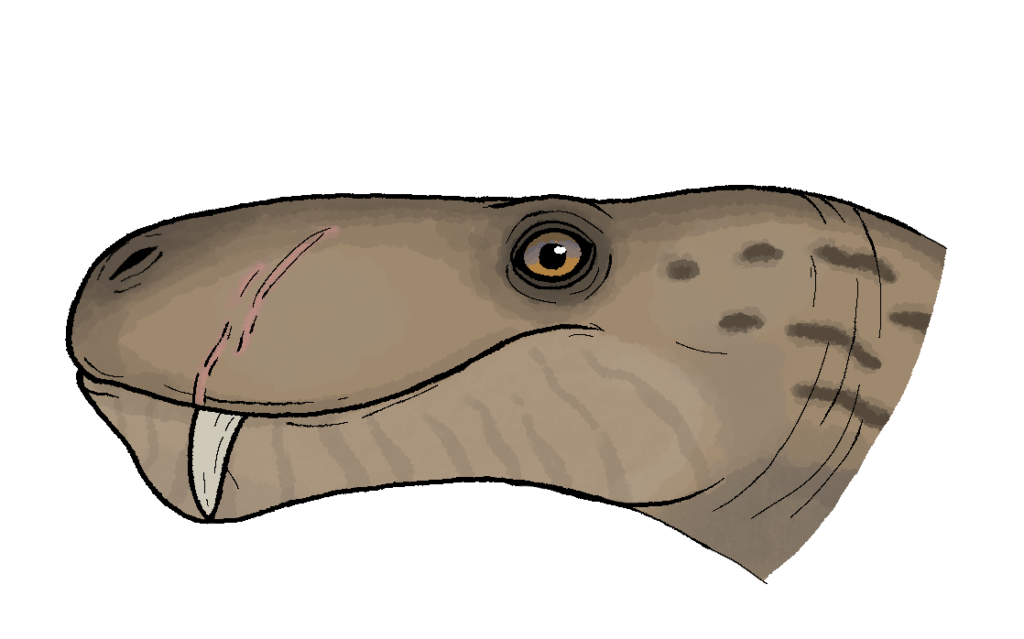
A Skull That Defies Expectations (Image Credits: Wikimedia)
Researchers encountered specimen BP/1/8260, a well-preserved cranium complete with its lower jaw, during fieldwork in the southwest Karoo Basin. This fossil stood out immediately due to its robust build and unusual proportions. Unlike the smaller, more delicate gorgonopsians known from earlier records, this one suggested a creature rivaling the giants of later Permian times.
Zanildo Macungo and colleagues detailed the specimen in a study published in The Anatomical Record. The skull displayed a transversely narrow snout, compact orbital and temporal openings, prominent V-shaped palatine bosses, and a vertically oriented occiput. These traits set it apart from all previously documented gorgonopsians, prompting the establishment of a new genus and species.
Unique Anatomy Signals Early Might
Jirahgorgon ceto combined features reminiscent of later rubidgeine gorgonopsians, known for their powerful builds. Its cranial proportions hinted at a large body size, with saber-like canines likely adapted for slashing prey. The vertical occiput and overall robustness indicated enhanced biting strength, suited for tackling sizable herbivores in Permian ecosystems.[4]
Etymologically, the name honors Sifelani Jirah, connected to the discovery, paired with “gorgon” for its fearsome kin, and “ceto” after the mythological mother of the Gorgons. Such naming underscores the creature’s mythical prowess as an early apex predator among therapsids, the mammal-line synapsids. The Tapinocephalus Assemblage Zone, where it resided, marked a pivotal time when these predators began dominating terrestrial food webs.
Phylogeny Rewritten: A New Family Emerges
Phylogenetic analysis placed Jirahgorgon ceto in a novel clade alongside Phorcys dubei, christened Phorcyidae. This family stood unique among basal African gorgonopsians for blending advanced cranial traits. The grouping challenged assumptions that robust forms only evolved later, in the Wuchiapingian stage.
Key distinguishing features included:
- Transversely narrow snout for precise strikes.
- Smaller eye and temporal fenestrae, suggesting a focus on jaw power over speed.
- V-shaped palatine bosses enhancing bite force.
- Vertical occiput, akin to more derived predators.
- Rubidgeine-like proportions indicating substantial size.
These elements positioned Phorcyidae as pioneers of large-body plans in the Wordian, expanding the known diversity of middle Permian theriodonts.
Shifting Views on Body Size Evolution
Analyses of basal skull lengths across gorgonopsians showed body size increases occurred earlier and more frequently than believed. While evolution followed a largely random Brownian motion model over time, shared ancestry structured the patterns. Jirahgorgon ceto exemplified how robust morphotypes arose independently multiple times within the group.
Prior views held that gorgonopsians remained small carnivores until late Permian diversification. This discovery overturned that narrative, proving large apex predators filled top niches in the middle Permian. The lower Abrahamskraal Formation now emerges as a vital site for tracing theriodont radiations, including precursors to mammals.
Here’s a quick comparison of evolutionary stages:
| Stage | Gorgonopsian Traits | Examples |
|---|---|---|
| Wordian (Middle Permian) | Early large-bodied forms | Jirahgorgon ceto, Phorcys dubei |
| Wuchiapingian (Late Permian) | Diversified giants | Rubidgeines |
Broader Impact on Permian Paleontology
The middle Permian stood as a turning point for therapsid evolution, with gorgonopsians stepping into roles as specialized hunters. Jirahgorgon ceto highlighted the Karoo’s role in preserving these transitions. Future excavations may uncover more relatives, refining the family tree further.
- Jirahgorgon ceto pushes large gorgonopsian origins to the Wordian stage.
- New family Phorcyidae features advanced cranial adaptations.
- Body size evolved independently, defying linear progression models.
This breakthrough not only complicates gorgonopsian history but also enriches our picture of Permian ecosystems. What do you think this means for mammal evolution? Tell us in the comments.