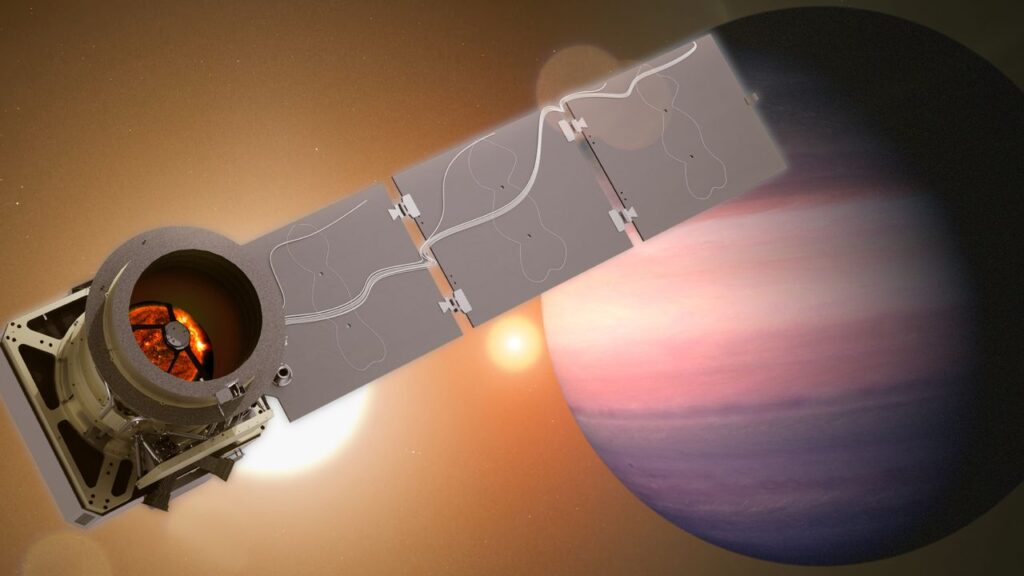
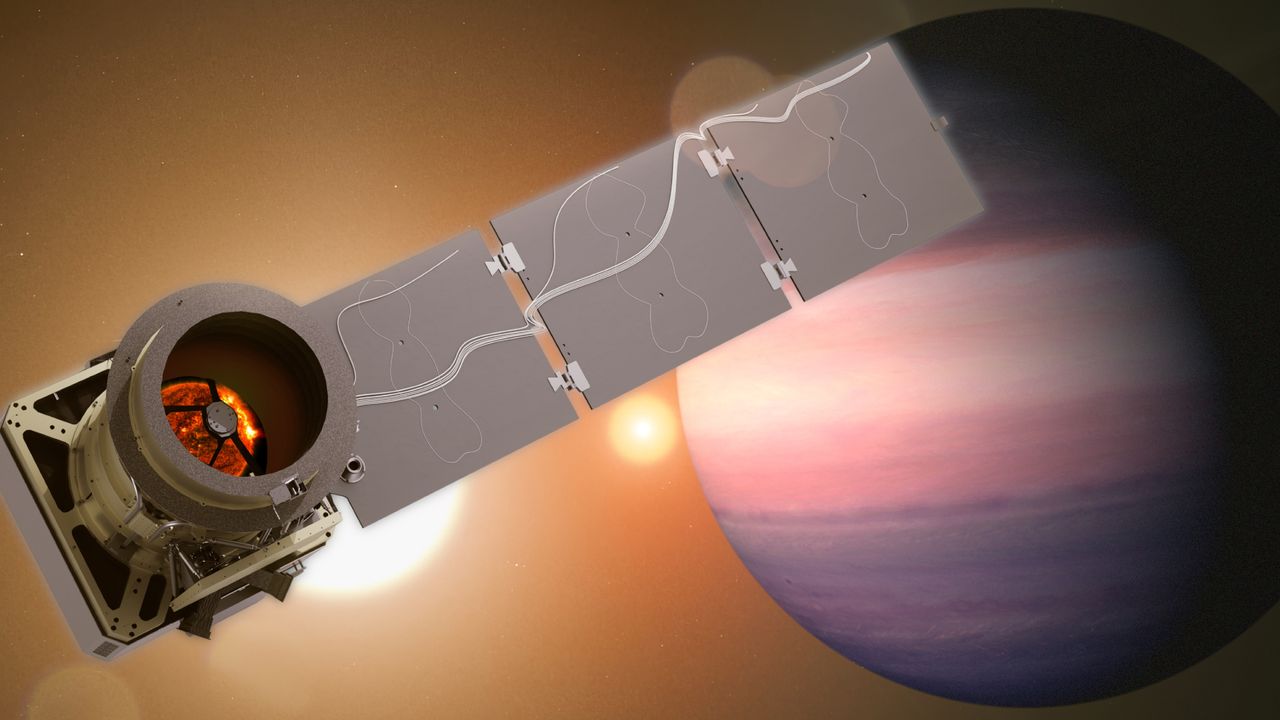
A Glimpse into Pandora’s Design and Purpose (Image Credits: Cdn.mos.cms.futurecdn.net)
Vandenberg Space Force Base, California – SpaceX stands ready to send NASA’s Pandora satellite skyward on Sunday, advancing humanity’s understanding of worlds beyond our solar system.
A Glimpse into Pandora’s Design and Purpose
The Pandora mission represents a compact yet powerful tool in NASA’s arsenal for exoplanet research. This small satellite, roughly the size of a refrigerator, features a specialized aluminum telescope designed to analyze light passing through planetary atmospheres during transits. Engineers completed its integration with the spacecraft bus last year, paving the way for this pivotal launch.
Once in orbit, Pandora will target at least 20 known exoplanets over its one-year operational phase. By observing these distant systems, the satellite aims to disentangle atmospheric signals from stellar interference, such as starspots that can obscure planetary data. This capability addresses a longstanding challenge in exoplanet studies, where host stars often dominate observations.
The mission’s focus on transiting exoplanets – those that pass in front of their stars from Earth’s viewpoint – allows for precise measurements of atmospheric composition. Scientists anticipate insights into hazes, clouds, and potential water vapor, elements crucial for assessing planetary habitability.
The Science of Untangling Cosmic Signals
Exoplanet atmospheres hold clues to the diversity of life-supporting environments across the galaxy, but observing them requires overcoming stellar noise. Pandora employs advanced spectroscopy to capture how starlight filters through a planet’s atmosphere during a transit, revealing absorption lines from gases like oxygen or methane.
This approach builds on data from telescopes like the James Webb Space Telescope, but Pandora’s dedicated orbit and instrumentation provide broader, more frequent coverage. In a sun-synchronous low Earth orbit, the satellite will maintain consistent viewing conditions, enabling repeated observations of multiple targets without the scheduling constraints of larger observatories.
Key to its success is the mission’s emphasis on host star variability. By simultaneously studying the stars’ own atmospheres and surface features, Pandora will refine models that predict how these elements affect exoplanet readings. Such refinements could guide future missions seeking biosignatures – indicators of life – in alien skies.
SpaceX’s Falcon 9: A Reliable Ride to Orbit
SpaceX’s Falcon 9 rocket will serve as the launch vehicle, carrying Pandora as part of a rideshare mission from Vandenberg. Liftoff is scheduled for 8:19 a.m. ET on January 11, with the satellite deploying shortly after reaching its target altitude.
This partnership, selected by NASA last year, underscores the commercial provider’s growing role in scientific launches. The Falcon 9’s proven track record ensures efficient delivery to the precise orbit needed for Pandora’s observations, minimizing risks to the delicate payload.
- Proven reusability: The first-stage booster has flown multiple times, reducing costs and environmental impact.
- Payload capacity: Ample room for Pandora alongside other small satellites on this mission.
- Precision deployment: Ensures the satellite achieves its sun-synchronous path for optimal science gathering.
- Real-time tracking: Live streams available via SpaceX and NASA channels for public viewing.
Looking Ahead: Pandora’s Impact on Exoplanet Research
As Pandora prepares for its journey, expectations run high for contributions to broader astronomical goals. The data it collects will help prioritize targets for deeper investigations by flagship telescopes, potentially identifying promising candidates for habitable worlds.
Over the coming year, mission controllers at NASA’s Goddard Space Flight Center will monitor the satellite’s performance, adjusting as needed to maximize its observational window. Early results could emerge within months, offering fresh perspectives on atmospheric dynamics in systems hundreds of light-years away.
The launch also highlights NASA’s strategy of leveraging small satellites for cost-effective science. With a budget under $20 million, Pandora demonstrates how innovative, focused missions can yield outsized returns in understanding our cosmic neighborhood.
Key Takeaways
- Pandora will observe at least 20 exoplanets, focusing on atmospheric separation from stellar effects.
- Launch on SpaceX Falcon 9 from Vandenberg on January 11 at 8:19 a.m. ET.
- One-year mission to enhance data for future telescopes like James Webb.
Pandora’s voyage promises to illuminate the hidden layers of distant planets, reminding us of the vast possibilities in the search for extraterrestrial life. As this satellite embarks on its quest, it invites us to ponder the universe’s untold stories. What excites you most about this mission? Share your thoughts in the comments below.