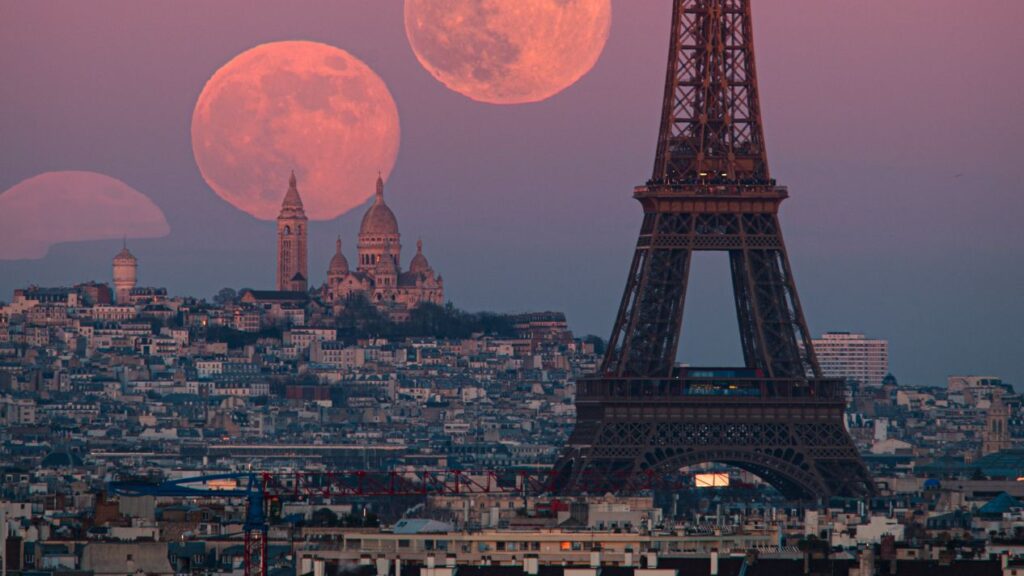
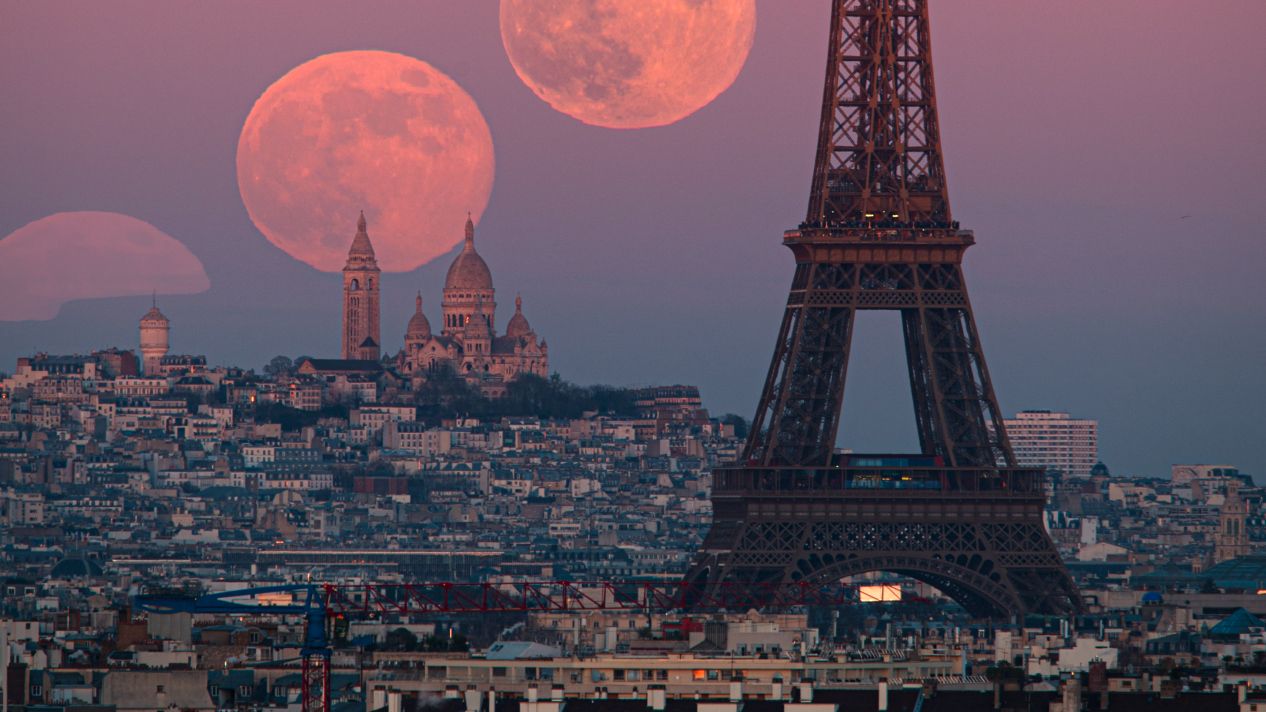
Paris – The first full moon of 2026, known as the Wolf Moon, rose behind the Eiffel Tower on January 3, offering a rare and striking alignment with the city’s iconic landmarks.
A Celestial Setup Spotted in Advance
A Celestial Setup Spotted in Advance (Image Credits: Cdn.mos.cms.futurecdn.net)
Photographer Martin Giraud anticipated the event well before it unfolded. He used a planning application to identify the precise alignment of the rising supermoon with the Eiffel Tower and the Sacré-Cœur Basilica. Clear skies prevailed despite morning snow and biting cold, allowing the moment to materialize perfectly.
Giraud shared his preparation process in an email statement. “Before the new year, I noticed on my planning app that the first full moon of the year, also a supermoon, would align perfectly with the Eiffel Tower and the Sacré-Cœur Basilica from a spot I had previously scouted,” he explained. “Despite the cold and the snow in the morning, the weather forecast for Paris announced a completely cloudless sky, so I decided to give it a try.”
This foresight turned an ordinary evening into an extraordinary astronomical display visible from a vantage point several kilometers from the landmarks.
The Legacy of the Wolf Moon
January’s full moon earned its evocative name from traditions among Native American tribes. They associated it with wolves howling amid winter’s harsh scarcity, when packs grew bolder in search of food. Other cultures offered similar monikers, reflecting the season’s challenges.
The moon reached peak illumination on January 3 at 5:03 a.m. EST, marking the start of 2026’s lunar cycle. Observers across time zones witnessed its glow dominating the night sky.
- Wolf Moon: Linked to howling predators in winter.
- Snow Moon: Nodding to heavy January snowfall.
- Hunger Moon: Highlighting lean times before spring.
- Cold Moon: Capturing the month’s frigid temperatures.
- Disting Moon: From Old English winter festivals.
Why This Wolf Moon Stood Out as a Supermoon
This particular Wolf Moon coincided closely with perigee, the moon’s nearest point to Earth in its elliptical orbit. Such proximity rendered it a supermoon, appearing up to 14 percent larger and 30 percent brighter than a typical full moon at apogee.
From Paris, the moon’s enlarged disk created an illusion of soaring scale against the distant Eiffel Tower, roughly 6.3 kilometers away, and the Sacré-Cœur Basilica at 11.1 kilometers. The effect amplified the drama of its ascent through the pastel sunset hues.
Astronomers noted this as one of the year’s standout supermoons, drawing skywatchers to horizons worldwide.
Atmospheric Magic and Lunar Secrets Revealed
Rayleigh scattering played a starring role in the scene. This optical phenomenon, caused by Earth’s atmosphere dispersing shorter blue wavelengths, bathed the low-horizon moon in warm orange-yellow tones. The effect intensified as the moon climbed, gradually shedding its vivid color.
Observers discerned dark patches on the lunar surface, the maria or “seas.” These vast basaltic plains formed billions of years ago when lava flooded ancient impact basins. Near the horizon, the moon’s shape appeared subtly distorted, a common refraction artifact.
Giraud employed a Canon 6D camera paired with a Samyang 150-600mm telephoto lens set at 500mm and ISO 100. He composited multiple frames to trace the moon’s path, preserving intricate surface details.
Key Takeaways
- January 3, 2026, delivered 2026’s first supermoon, the Wolf Moon.
- Rare alignment framed the moon against Paris’ Eiffel Tower and Sacré-Cœur.
- Rayleigh scattering and lunar maria added layers of visual wonder.
This convergence of lunar orbit, clear weather, and urban icons served as a potent reminder of astronomy’s accessibility. Even in a bustling metropolis, the cosmos offers moments of awe. What captured your attention during this Wolf Moon? Share your thoughts in the comments.