Bar Harbor, Maine – Scientists have determined that Tyrannosaurus rex dashed across prehistoric landscapes on its tiptoes, adopting a gait akin to modern birds that allowed for greater agility and speed.
Fossil Tracks Expose a Delicate Step
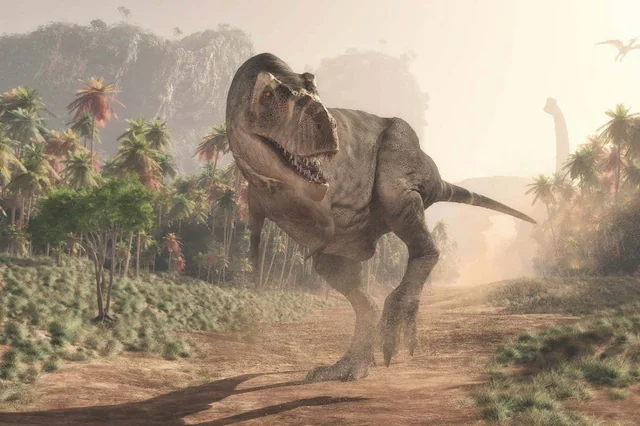
Fossil Tracks Expose a Delicate Step (Image Credits: Reddit)
Deepest pressure marks in ancient tyrannosaur footprints fell under the toes, not the heels, signaling a toe-first landing pattern. Researchers examined ichnofossils attributed to these massive predators and found patterns consistent with bird-like force distribution.
Adrian Boeye, an undergraduate biomechanics student at the College of the Atlantic, led the analysis. His team noted that prior depictions often showed T. rex thudding heel-first, like an elephant. Yet evidence pointed to a more refined motion, with the front of the foot striking ground first.
This discovery reframes the 10-ton behemoth as less of a ponderous stomper and more of a poised hunter.
Anatomy and Models Unlock the Gait
The study scrutinized four well-preserved T. rex specimens, including MOR 555 and FMNH PR 2081. Precise measurements captured leg lengths from 2.56 to 3.77 meters and hip heights around 2.5 to 3.15 meters in a crouched posture.
Three foot-strike models emerged: rear-foot (heel-like), mid-foot, and distal-foot (toe-first). Equations from prior research, such as Alexander’s 1976 formula, calculated speeds and stride frequencies for each. Toe-first strikes produced the highest values, validated against ostrich and human data.
| Foot-Strike Model | Avg. Speed Increase vs. Rear-Foot | Stride Frequency Effect |
|---|---|---|
| Rear-Foot Strike | Baseline | Lowest |
| Mid-Foot Strike | Moderate | Intermediate |
| Toe-First (Distal) | ~20% | 6-8% higher |
Boosted Speeds and Avian Ties
Toe-walking yielded speeds of 5 to 11 meters per second, or 11 to 25 miles per hour—about 20 percent faster than flat-footed estimates. Smaller juveniles might have hit 11.4 meters per second, outpacing Usain Bolt over short distances.
The pattern mirrored large ground birds like ostriches, which sprint at 43 miles per hour using short, rapid strides. T. rex shared compliant limbs and high stride frequencies, traits linking it to avian descendants.
- Short relative stride lengths (2.0-3.0 times hip height)
- Increased step cadence for acceleration
- Reduced ground contact time for efficiency
- Shock absorption on rough terrain
“Even the iconic T. rex was quite birdlike,” said University of Edinburgh paleontologist Steve Brusatte. “It would have been something like an eight-ton chicken clucking about in the barnyard.”
Reshaping Prehistoric Portrayals
Mr. Boeye and colleagues suggested older theropods likely tiptoed long before T. rex appeared 68 million years ago. Trackways and arctometatarsal feet supported this across the group.
Museums and films may soon adjust T. rex poses from rigid stomps to crouched, springy stances. The findings, published in Royal Society Open Science, marked the first quantitative look at foot-strike impacts on tyrannosaur gait.
Key Takeaways
- T. rex favored toe-first strikes, boosting speed by up to 20 percent.
- Bird-like traits included high stride frequency and short steps.
- Evidence from fossils and models challenges lumbering stereotypes.
This bird-inspired agility underscores T. rex’s prowess as an apex hunter. How might this change your view of the dinosaur king? Share in the comments.