Colorado — A massive young bull elk dangled helplessly from an abandoned climbing rope on a frozen mountainside, his antlers locked in a deadly snare after a night of futile struggle. Freezing temperatures and slick ice amplified the danger for the roughly 700-pound animal, who teetered on the edge of exhaustion. Ice climbers stumbled upon the scene early one morning and rallied with Colorado Parks and Wildlife officers for a tense, coordinated rescue that unfolded over several hours.
A Desperate Struggle Comes to Light
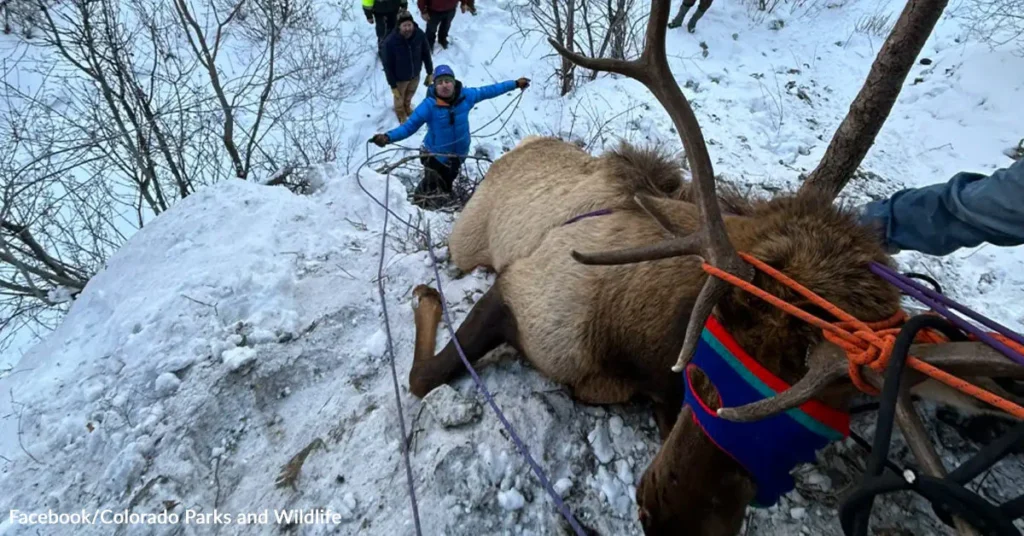
A Desperate Struggle Comes to Light (Image Credits: Facebook)
Three ice climbers preparing for their day’s adventure made a shocking discovery around 7 a.m. high on the steep slope. The young bull, just over two years old, had somehow snagged his antlers in the rope, which tightened with every twist and pull. Overnight in the biting cold, he hung suspended, his massive frame battered by the elements and unstable terrain.
The climbers immediately recognized the gravity of the situation. Without hesitation, they contacted authorities, setting the rescue in motion. Their expertise in such harsh environments would soon prove invaluable.
Experts Assemble Amid Rising Risks
Colorado Parks and Wildlife officers arrived by 9 a.m., led by a skilled team including Lucas Martin, Alyssa Meier, Paul Rivera, and Anna Markey. Southwest Region public information officer John Livingston later highlighted the climbers’ crucial role. “The climbers used their knowledge of ropes, pulley systems and anchors to assist the rescue,” Livingston noted.
The group assessed the elk’s precarious position. At around 700 pounds—substantially heavy though not yet fully grown, as mature bulls can reach 1,100 pounds—any misstep risked injury to the animal or rescuers. Freezing conditions and the icy, unstable slope demanded precision and speed.
Step-by-Step Liberation from the Trap
The team opted for a careful strategy to minimize harm. First, they tranquilized the elk to calm him and prevent panicked movements that could worsen his predicament or cause slips on the ice.
With the animal sedated, rescuers approached and meticulously cut the rope strand by strand from his antlers. This delicate work required steady hands amid the chill and exposure.
Even freed from the rope, the elk remained stranded on the sheer incline. Climbers and officers then collaborated on a lowering operation, employing ropes, pulley systems, and anchors to guide his body to firmer ground below.
- Spot the elk and alert authorities at 7 a.m.
- Assess site upon team arrival at 9 a.m.
- Administer tranquilizer for safety.
- Cut away the entangled rope carefully.
- Lower the elk using climbing gear.
- Reverse the sedative and monitor recovery.
Recovery and a Swift Return to the Wild
By 11 a.m., the elk rested on stable terrain. The team administered a reversal agent to the tranquilizer. Within minutes, he stirred, rose to his feet, and bounded into the nearby woods, apparently unharmed.
The operation showcased seamless integration between recreational climbers and professional wildlife staff. Challenges like the animal’s size, the overnight ordeal, and environmental hazards tested their resolve, yet teamwork prevailed.
Key Takeaways
- Alert climbers’ prompt call enabled a timely response, turning a potential tragedy into success.
- Tranquilization and specialized gear proved essential for safe handling on treacherous ice.
- Collaboration between civilians and experts underscores community roles in wildlife protection.
This rescue serves as a powerful reminder of human compassion in the face of nature’s unforgiving challenges. The elk’s freedom highlights how quick action and shared skills can make all the difference. What do you think about such acts of heroism? Tell us in the comments.