Thailand – Marine scientists have delivered the most detailed nationwide evaluation of coral reefs yet, confirming a shift toward simpler structures amid repeated bleaching episodes.
Survey Scale Sets New Standard
Survey Scale Sets New Standard (Image Credits: Imgs.mongabay.com)
Researchers from the Aow Thai Marine Ecology Center and Thailand’s Marine and Coastal Resources Research Center conducted surveys across 115 sites in eight provinces from 2022 to early 2024. They examined 99 nearshore fringing reefs and 16 offshore pinnacles, covering 17 kilometers of reef at depths between 4 and 20 meters.
This effort captured a snapshot just before the 2024 global bleaching event fully impacted Thai waters. Previous assessments remained localized and sporadic, leaving gaps in understanding reef dynamics. The data now serve as a vital baseline for tracking changes over time.
Rahul Mehrotra, research director at the Aow Thai Marine Ecology Center and a study co-author, emphasized the value of this mapping. “Having this map of what corals are represented across the region gives us a starting point for conservation,” he stated.
Branching Corals Fade, Boulders Dominate
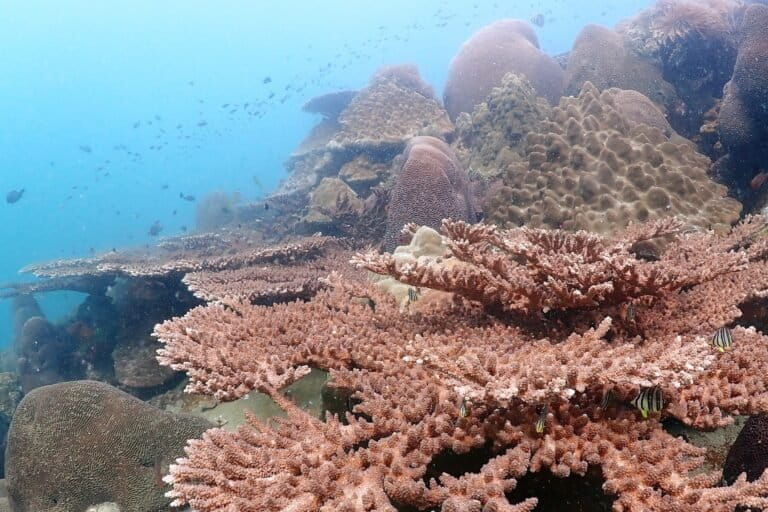
Staghorn and branching corals, including vulnerable Acropora species, appeared far less frequently than in earlier records. Fire corals from the Millepora genus vanished from many Gulf of Thailand sites where they once thrived. In contrast, Porites boulder corals, known for heat tolerance, now dominate both coasts.
This transition reflects responses to mass bleaching in 1998, 2010, 2016, and 2024, when extreme heat caused corals to expel symbiotic algae. The 2024 event struck up to 80% of corals in some areas, though recovery occurred in parts.
Such shifts homogenize reefs, reducing nooks and crannies essential for fish and invertebrates. “The moment we start to lose species, it has major knock-on consequences for the biodiversity on the reef,” Mehrotra noted.
Regional and Depth Patterns Emerge
Coral cover averaged higher in the Gulf of Thailand at 54%, compared to 35% in the Andaman Sea. Coverage peaked at shallow depths, reaching 52% at 5 meters versus 29% at 20 meters.
| Region | Average Coral Cover |
|---|---|
| Gulf of Thailand | 54% |
| Andaman Sea | 35% |
These differences challenge assumptions about the Andaman’s pristine status and highlight overlooked Gulf resilience, possibly from adaptation to nutrient loads and sedimentation. Porites dominance persisted since 1980s surveys, but its share grew post-bleaching.
Broader Impacts and Conservation Calls
Thailand’s reefs, home to over 300 species, underpin tourism worth one-fifth of GDP, fisheries, and coastal defense. Simplified structures threaten habitats, fish stocks, and ecosystem services.
Niphon Phongsuwan, a veteran researcher, warned of risks in homogenized reefs. “When only one or two species dominate the entire area, [reefs] become more vulnerable to unforeseen threats,” he said.[1]
- Expand marine protected areas.
- Cut fishing, tourism, and pollution pressures.
- Boost monitoring and restoration via sexual reproduction for diversity.
- Preserve connectivity with mangroves and seagrasses.
Key Takeaways
- Reefs homogenize toward Porites, eroding complexity.
- Gulf shows higher cover; shallows host richest corals.
- Baseline aids proactive strategies against future bleaching.
With this foundation, Thailand stands better equipped to safeguard its reefs. Proactive restoration and policy shifts could preserve these ecosystems for generations. What steps should prioritize next? Share your thoughts in the comments.