The ancient world housed many fascinating creatures, but few capture the imagination quite like Therizinosaurus, often dubbed “the dinosaur with the chainsaw jaw” – although this nickname is a misnomer that we’ll clarify. This Late Cretaceous herbivore boasted some of the most unusual adaptations in dinosaur history, most notably its enormous claws that resembled massive scythes. Despite being one of the most distinctive dinosaurs ever discovered, Therizinosaurus remains shrouded in mystery, with paleontologists still piecing together its unique evolutionary story. Through fossilized fragments and comparative analysis, scientists have reconstructed a bizarre, almost chimeric creature that defied typical dinosaur categorization. Let’s explore the fascinating story of this prehistoric oddity and uncover why it continues to captivate dinosaur enthusiasts worldwide.
Origins of the Chainsaw Nickname – A Common Misconception

The “chainsaw jaw” nickname represents a significant misconception about Therizinosaurus that has persisted in popular culture. Contrary to this dramatic title, Therizinosaurus didn’t possess any specialized jaw adaptations resembling a chainsaw. The confusion likely stems from conflation with its most distinctive feature – the enormous claws on its forelimbs, which could reach over three feet (approximately one meter) in length. These scythe-like appendages were extensions of the dinosaur’s hands, not its mouth. Interestingly, despite these fearsome-looking weapons, Therizinosaurus had a relatively small head with a beak-like mouth structure adapted for a plant-based diet. This disparity between popular perception and scientific understanding highlights how dinosaurs are often sensationalized in ways that don’t reflect their actual biology.
Discovery and Naming – Piecing Together a Prehistoric Puzzle

The story of Therizinosaurus begins in 1948 during a joint Soviet-Mongolian expedition to the Gobi Desert in southern Mongolia. The initial discovery was remarkably limited – just a few gigantic claws and fragmentary forelimb elements. These unusual remains puzzled paleontologists so thoroughly that the creature was initially misidentified as a giant turtle. Soviet paleontologist Evgeny Maleev formally named the genus in 1954, giving it the name Therizinosaurus cheloniformis, with the genus name translating to “scythe lizard” and the species name meaning “turtle-formed.” This nomenclature reflects the early confusion about the creature’s identity. It wasn’t until decades later, with additional fossil discoveries of related species, that scientists began to understand Therizinosaurus as a highly specialized theropod dinosaur. The fragmentary nature of Therizinosaurus fossils means that many aspects of its appearance remain theoretical, based on more complete remains of related species.
The Imposing Physical Appearance of Therizinosaurus

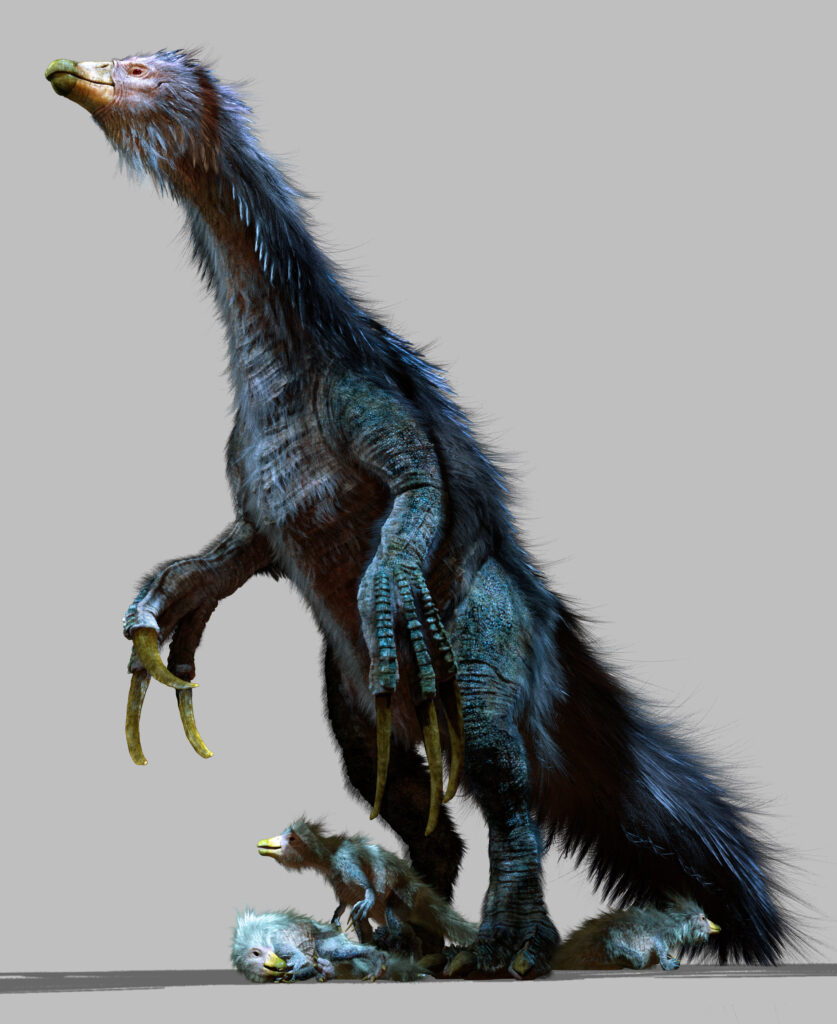
Therizinosaurus stands as one of the most unusual-looking dinosaurs ever to walk the Earth, with a body plan that seems almost contradictory. This massive creature reached lengths of up to 33 feet (10 meters) and likely weighed around 5 tons – dimensions comparable to the famous Tyrannosaurus rex. Its neck was notably long and slender, leading to a relatively small head with a keratinous beak similar to modern birds. The dinosaur’s torso was broad and rotund, supported by sturdy hind limbs that ended in four-toed feet. Most striking were its forelimbs, which featured extraordinarily long arms ending in three digits each bearing massive, scythe-like claws measuring up to 3.3 feet (1 meter) in length – the longest claws of any known animal in history. The body was likely covered with primitive feathers, similar to those found on related therizinosaurs, giving this imposing beast a somewhat shaggy appearance that contrasts with traditional scaly dinosaur depictions.
The True Purpose of Those Massive Claws

The enormous claws that define Therizinosaurus present one of paleontology’s most intriguing functional puzzles. Despite their fearsome appearance, these massive scythe-like appendages were not weapons of predation as one might initially assume. Paleontologists believe these claws served multiple practical purposes in the dinosaur’s herbivorous lifestyle. The primary function was likely pulling down branches and foliage from tall trees, essentially functioning as biological pruning hooks to access vegetation beyond the reach of other herbivores. These claws might also have been used to rake through dense underbrush to expose edible plants, much like how modern giant pandas use their specialized sixth “thumb.” Additionally, the claws could have served a defensive purpose, presenting a formidable deterrent to the large predators of the Late Cretaceous period. Some researchers have even suggested they might have played a role in mating displays or competition between males, similar to how modern peacocks use their elaborate feathers.
Evolutionary Oddity: From Predator to Plant-Eater

Therizinosaurus belongs to one of dinosaur evolution’s most fascinating stories of dietary transformation. Despite its plant-eating lifestyle, this unusual dinosaur was classified as a theropod – the predominantly carnivorous group that includes famous predators like Velociraptor and T. rex. Therizinosaurs represent a remarkable evolutionary reversal, with ancestors that were standard meat-eating theropods but gradually evolved to exploit plant resources in their environment. This transition is evident in several anatomical features beyond just their diet. Their wide, barrel-shaped bodies accommodated larger digestive systems necessary for processing plant matter. Their necks became longer to reach vegetation, while their heads became smaller with beaked mouths ideal for cropping plants. Their once-deadly claws evolved from killing tools into specialized plant-gathering implements. This dramatic evolutionary shift makes therizinosaurs one of the most striking examples of adaptive radiation in dinosaur history, demonstrating how evolutionary pressures can transform body plans and ecological niches.
The Habitat and Environment of Therizinosaurus

Therizinosaurus inhabited what is now the Gobi Desert in Mongolia during the Late Cretaceous period, approximately 70 million years ago. However, the environment during that time bore little resemblance to today’s arid desert landscape. Paleoenvironmental reconstructions suggest Therizinosaurus lived in a diverse ecosystem characterized by floodplains, riparian forests along rivers, and open woodlands. The climate was generally warm but seasonal, with distinct wet and dry periods throughout the year. These conditions supported diverse vegetation, including conifers, ginkgoes, cycads, and various ferns that would have provided ample food resources for large herbivores. Therizinosaurus shared this environment with other notable dinosaur species, including the infamous predator Tarbosaurus (a close relative of T. rex), the ostrich-like Gallimimus, various armored ankylosaurs, and several species of horned ceratopsians. This rich ecological setting likely influenced the evolution of Therizinosaurus’s specialized feeding adaptations, allowing it to exploit specific plant resources that were inaccessible to other herbivores in the same habitat.
Reproductive Biology and Growth Patterns

While direct evidence of Therizinosaurus reproduction remains elusive due to the fragmentary nature of discovered fossils, paleontologists can make educated inferences based on related theropods and other therizinosaurs. Like other dinosaurs, Therizinosaurus likely laid eggs, probably in ground nests that may have been arranged in circular patterns similar to those found for other theropods. Based on growth patterns observed in related species, young Therizinosaurus individuals would have hatched relatively undeveloped, potentially requiring parental care during their vulnerable early stages. Growth was likely rapid during juvenile phases before slowing as the animal approached adult size, a pattern consistent across many dinosaur groups. Intriguingly, the massive claws that define adult Therizinosaurus may have been proportionally smaller in juveniles, gradually developing to their impressive adult size as the animal matured. This developmental trajectory suggests young Therizinosaurus individuals might have utilized different feeding strategies than adults, potentially focusing on lower vegetation before developing the reach and strength to access higher foliage.
Social Behavior: Loners or Herd Animals?

The social dynamics of Therizinosaurus remain largely speculative, as no definitive evidence of group behavior has been discovered in the fossil record. However, paleontologists can draw reasonable conclusions based on ecological factors and comparisons with related dinosaurs. Some evidence suggests therizinosaurs may have engaged in at least occasional social behavior, potentially forming loose herds or family groups. This hypothesis is supported by the behavior of many modern herbivores that gain protection from predators through group living. The massive size of adult Therizinosaurus would have provided considerable protection from most predators, potentially reducing the necessity for constant herding behavior. Their specialized feeding adaptations might have also influenced social structure, as individuals could have spread out to exploit different vegetation zones within their habitat. Interestingly, if they did form groups, the enormous claws would have required significant spacing between individuals to avoid injuring one another, potentially resulting in looser aggregations than seen in other herbivorous dinosaurs.
Therizinosaurus in Popular Culture

Despite its relatively recent scientific description and incomplete fossil record, Therizinosaurus has captured the public imagination and secured a prominent place in dinosaur popular culture. The dinosaur’s most notable mainstream appearance came in the 2022 film “Jurassic World Dominion,” where it was depicted with reasonable anatomical accuracy, including its distinctive claws and feathered covering. Various documentary series, including BBC’s “Planet Dinosaur” and Apple TV’s “Prehistoric Planet,” have featured Therizinosaurus, helping to introduce this unusual dinosaur to broader audiences. The creature has also become a staple in dinosaur-themed video games, appearing in titles such as “Ark: Survival Evolved” and “Jurassic World Evolution,” where players can interact with virtual recreations. Toy manufacturers have produced numerous Therizinosaurus models, typically emphasizing its dramatic claws and unusual body shape. This cultural presence has helped correct some misconceptions about the dinosaur, gradually replacing the inaccurate “chainsaw jaw” concept with a more scientifically sound understanding of this fascinating prehistoric creature.
Scientific Debates and Unanswered Questions

Despite decades of study, Therizinosaurus continues to present numerous unresolved questions that spark debate among paleontologists. One persistent controversy concerns the exact positioning and posture of those iconic claws, with some researchers suggesting they curved inward toward the body while others propose they pointed more downward or outward. The extent and distribution of feathers on Therizinosaurus remains speculative, with limited direct evidence but strong indications from related species that they possessed at least some feathery covering. Questions about the dinosaur’s metabolic rate also persist, with ongoing debates about whether it had an endothermic (warm-blooded) metabolism like modern birds or something intermediate. Additionally, the specific ecological niche it occupied within its ecosystem remains under investigation, with uncertainties about exactly which plants constituted its primary diet. Perhaps most fundamentally, the evolutionary pathway that led to such an unusual body plan continues to invite scientific investigation, as researchers work to understand the selective pressures that produced such extraordinary adaptations.
Relatives of Therizinosaurus: The Therizinosaur Family

Therizinosaurus belonged to a distinctive family of dinosaurs called Therizinosauridae, which itself was part of the larger group Therizinosauria. This unusual dinosaur clade included several fascinating relatives that help contextualize Therizinosaurus itself. Nothronychus, discovered in North America, represents one of the best-studied therizinosaurs due to more complete fossil remains, providing valuable insights into the anatomy of its more fragmentary cousin. Erlikosaurus, another Mongolian therizinosaur, is known from excellent skull material that has helped scientists understand the feeding adaptations of these animals. Beipiaosaurus, found in China, provided groundbreaking evidence of feathers in this group, preserving impressions of primitive, filamentous feather-like structures. Falcarius, one of the earliest and most primitive members of the group discovered in Utah, offers a crucial evolutionary link, showing features intermediate between typical carnivorous theropods and the more specialized plant-eating therizinosaurs. These related species, taken together, help paleontologists reconstruct the evolutionary history and biological capabilities of Therizinosaurus itself, contextualizing its extreme adaptations within a broader evolutionary trajectory.
Extinction: Why Did Therizinosaurus Disappear?

The extinction of Therizinosaurus coincided with the broader Cretaceous-Paleogene (K-Pg) extinction event approximately 66 million years ago, which eliminated all non-avian dinosaurs along with approximately 75% of all species on Earth. This catastrophic event is widely attributed to the impact of a massive asteroid in what is now the Yucatán Peninsula in Mexico, though some scientists argue that additional factors, such as increased volcanic activity, may have contributed to the extinction. Therizinosaurus, despite its impressive size and specialized adaptations, would have been particularly vulnerable to the aftermath of such a catastrophic event. The impact would have triggered global wildfires, acid rain, and a prolonged “impact winter” as dust and debris blocked sunlight, dramatically reducing plant productivity worldwide. As a large-bodied herbivore with high caloric requirements, Therizinosaurus would have quickly faced food shortages as plant communities collapsed. Additionally, its specialized feeding adaptations, which had evolved to exploit specific plant resources, may have limited its dietary flexibility during this crisis period, further compromising its survival prospects in a rapidly changing post-impact world.
Modern Scientific Methods Revealing New Insights
Contemporary paleontological techniques are continuously enhancing our understanding of Therizinosaurus, providing insights that were impossible just decades ago. Digital reconstruction and 3D modeling have allowed scientists to test hypotheses about posture, movement capabilities, and claw function through biomechanical analyses. Comparative studies using CT scanning of related therizinosaur fossils have revealed details about brain structure and sensory capabilities that can be extrapolated to Therizinosaurus itself. Paleontologists are also employing isotope analysis of fossil bone material to determine dietary patterns and habitat preferences with greater precision. Microscopic examination of bone histology (internal structure) from therizinosaurs provides information about growth rates and life history strategies. Revolutionary advances in ancient DNA extraction, while not yet successful with dinosaurs as old as Therizinosaurus, continue to push the boundaries of what might be possible in the future. These sophisticated methodologies, combined with new fossil discoveries, continue to refine our image of this extraordinary dinosaur, gradually replacing speculation with evidence-based reconstructions and giving us an increasingly accurate picture of one of nature’s most unusual evolutionary experiments.
Conclusion: The Enduring Fascination of the “Scythe Lizard”

Therizinosaurus stands as a testament to the extraordinary diversity and adaptability of dinosaurs, challenging our preconceptions about these ancient creatures. Far from the “chainsaw jaw” of popular misconception, this remarkable herbivore represented an evolutionary experiment in specialized plant consumption, with adaptations that remain unparalleled in the fossil record. Its massive claws, bizarre body proportions, and evolutionary trajectory from predator to plant-eater make it one of paleontology’s most intriguing subjects. As scientific methods continue to advance, our understanding of Therizinosaurus will undoubtedly evolve, potentially answering long-standing questions about its biology and behavior. Yet even with incomplete knowledge, this dinosaur’s story captivates because it demonstrates nature’s capacity for producing truly unexpected solutions to evolutionary challenges. The “scythe lizard” reminds us that the reality of prehistoric life often surpasses our imagination, with actual adaptations more remarkable than any fictional creation could be. In this way, Therizinosaurus continues to inspire wonder, not just about what was, but about the boundless possibilities of evolutionary processes across Earth’s dynamic history.