Most people think of the fossil record as a purely scientific domain, something that belongs to paleontologists in field hats, not to the history of human civilization. The truth turns out to be considerably more layered. For tens of thousands of years before any European set foot in the Americas, North American tribes were finding, interpreting, trading, and weaving ancient bones into the fabric of their cultures. The fossil record doesn’t just document prehistoric animals. It reflects the lives, movements, and knowledge of the continent’s earliest peoples.
The story of the first peoples of the Americas is a testament to human adaptability, ingenuity, and perseverance. It reminds us that our understanding of the past is always evolving, shaped by scientific inquiry, archaeological discovery, and the enduring wisdom embedded in Indigenous cultures. What follows is a look at what the bones, footprints, and buried tools have quietly revealed about a chapter of North American history that science is only beginning to fully appreciate.
The Footprints That Rewrote the Timeline
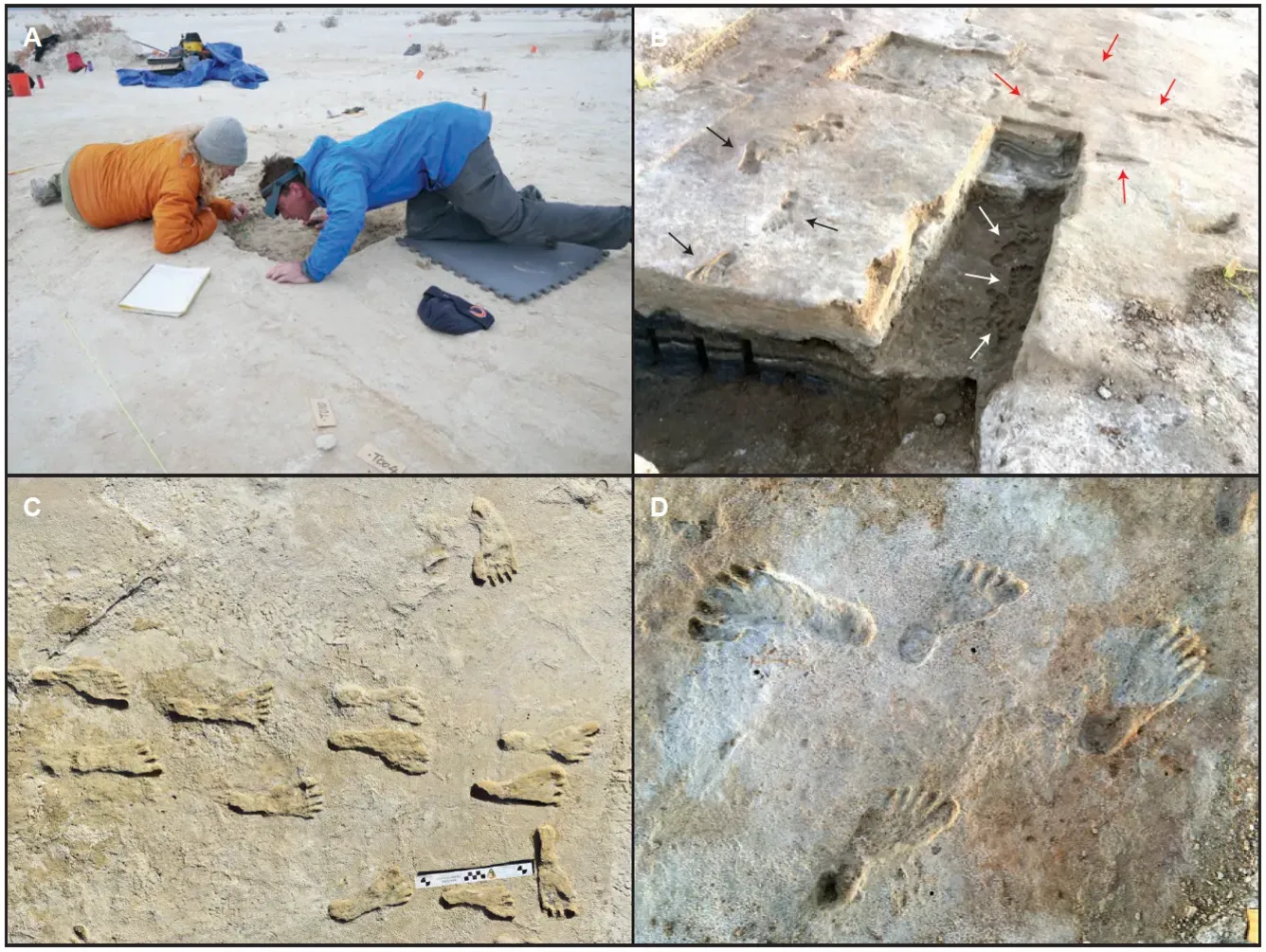
Of all the discoveries to shake up our understanding of when people first arrived in North America, a set of preserved footprints in New Mexico may be the most striking. A group of fossilized footprints was preserved on the shore of an ancient lake in what is today White Sands National Park, New Mexico. Some of the footprints were made in a layer of ancient sediment containing the seeds of an aquatic plant, organic remains that could be carbon-dated, and research revealed they were made between 21,000 and 23,000 years ago.
The footprints, most likely made by groups of children and teenagers, suggest that people arrived in this area much earlier than previously thought, at a time when massive ice sheets probably completely blocked access from the north. Human footprints provide unequivocal evidence of presence and also of behavior, which makes this site particularly valuable. You’re not just seeing evidence of survival. You’re catching a glimpse of actual human activity, play, and movement, frozen in ancient mud.
Before Clovis: The Pre-Clovis Puzzle
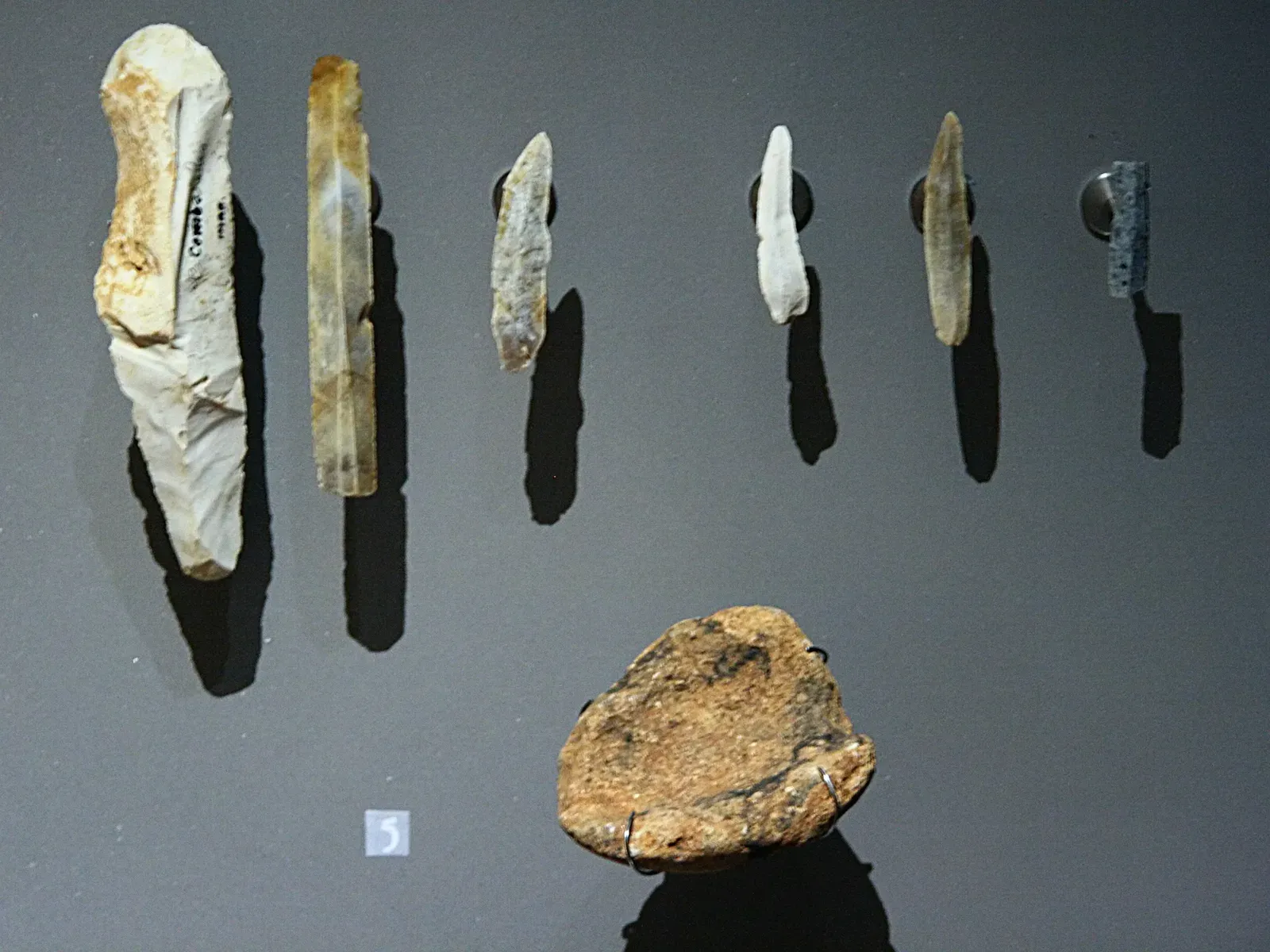
For a large portion of the 20th century, the best answers to questions about earliest human settlement were largely based on stone spearpoints named after a site where they were found near Clovis, New Mexico. That model held for decades. Then the evidence started to crack. Over the past few decades, a growing tide of archaeological discoveries, coupled with advances in genetics and climate modeling, has systematically dismantled the “Clovis First” monopoly.
Numerous claims of earlier human presence began to challenge the Clovis first model beginning in the 1990s, culminating in significant discoveries at Monte Verde, Chile, dating back 14,500 years. At Oregon’s Paisley Caves, fossilized human feces date back 14,300 years. In Texas, at Buttermilk Creek Complex, stone tool fragments date back 15,500 years. Each of these sites points to people being on the continent well before the Clovis culture appeared. The map of human arrival is not a single bold line anymore. It’s a cluster of overlapping threads.
The Clovis People and Their Remarkable Tools
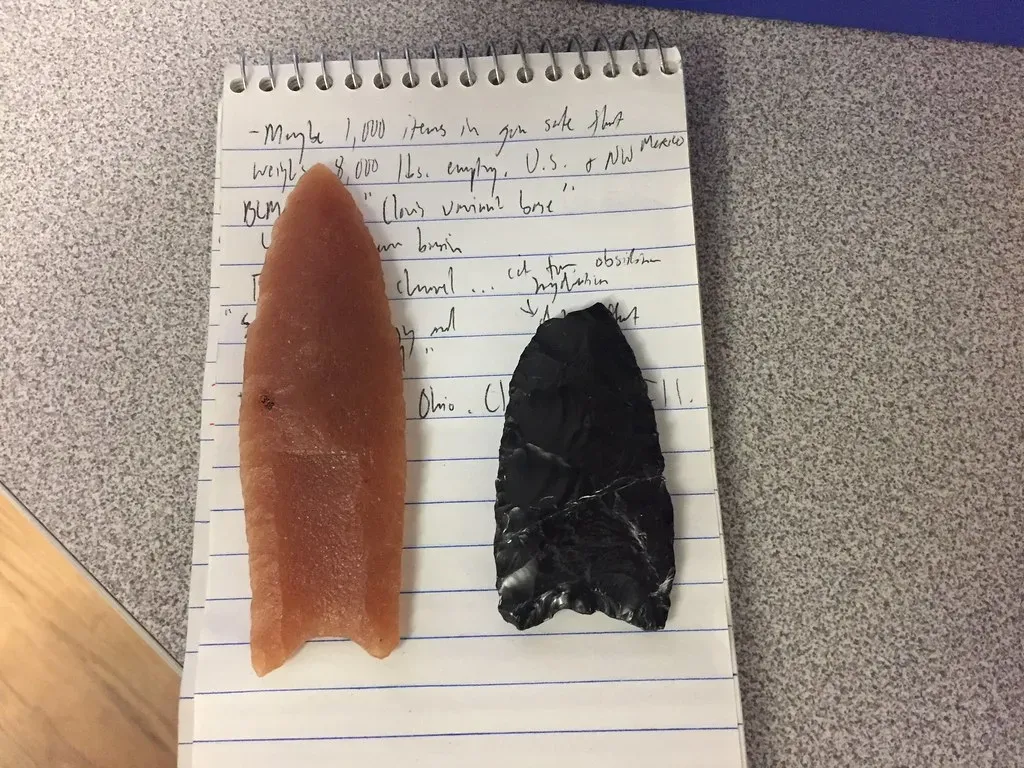
What is known about the Clovis people comes from the remains they left behind, including bone and ivory tools such as scrapers, drills, blades, and distinctive leaf-shaped, fluted spear points called Clovis points. These four-inch-long projectile points, carefully chipped from flint, jasper, chert, and obsidian, have concave grooves down each side, sharp edges, and a lance-shaped tip. They were, by any measure, precision instruments. Clovis hunter-gatherers are characterized as “high-technology foragers” who utilized sophisticated technology to maintain access to resources while being highly mobile, and in many Clovis localities, the stone tools found at a site were hundreds of kilometers away from the source stone outcrop.
More than 10,000 Clovis points have been discovered, scattered in 1,500 locations throughout most of North America, with Clovis points, or something similar, turning up as far south as Venezuela. The sheer spread of these tools tells you something important about how these people moved. As Clovis people settled into different ecological zones, the culture split into separate groups, each adapting to its own separate environment, and the end of Clovis marked the beginning of the enormous social, cultural and linguistic diversity that characterized the next 10,000 years.
When Tribes Were the First Fossil Hunters
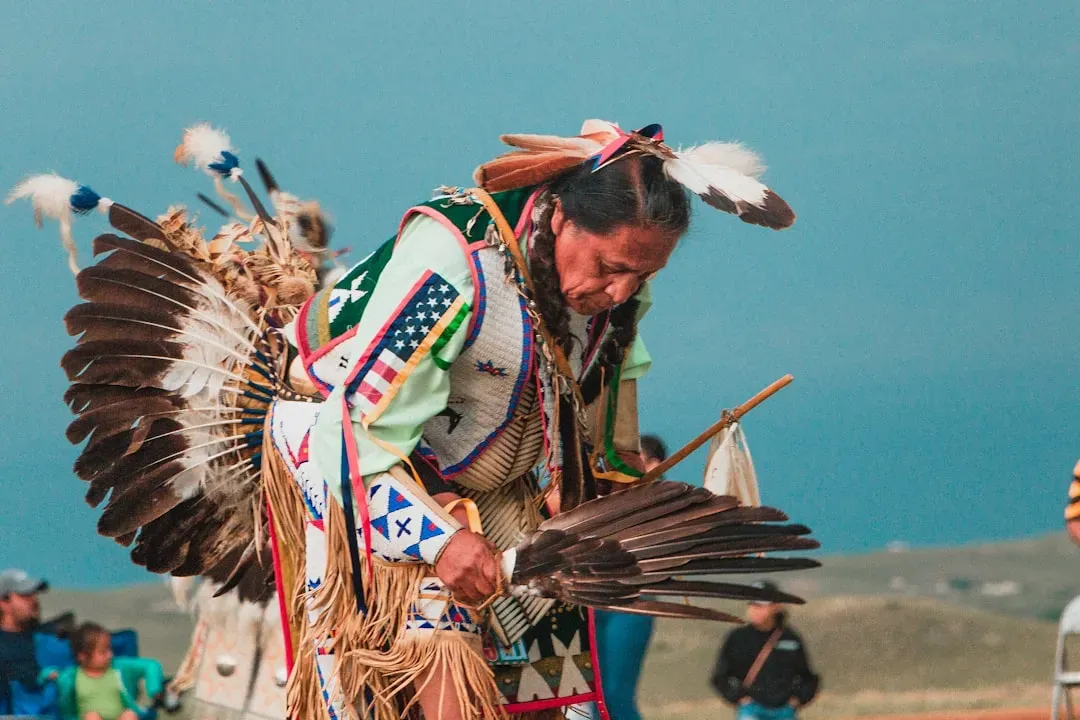
Native peoples were the first discoverers of the remains and tracks of dinosaurs on this continent and, in some instances, it was they who brought the bones, teeth, and tracks to the attention of people of European descent living here. As early as the late 17th century, they tried to describe to whites the giant monsters that once inhabited the earth, but they were not often believed. This is a significant piece of history that gets overlooked. Long before formal paleontology existed as a discipline, Indigenous communities were doing the observing. Decades before paleontology’s formal establishment, Black and Native Americans discovered and correctly identified millennia-old fossils.
In 1739, a group of French soldiers and Abenaki hunters camped at “Big Bone Lick” along the Ohio River in Kentucky. When the Abenaki men returned from a hunt with not only fresh meat but also huge fossilized bones, tusks, and teeth, the French were fascinated and eventually sent some of these specimens to France. The Lenape, Shawnee, and other Native groups had known about this site for many years as an area rich with game, and as a site for collecting much-needed salt. The fossil site was already well-known to local tribes. Europeans simply caught up later.
Oral Traditions That Carried Scientific Knowledge
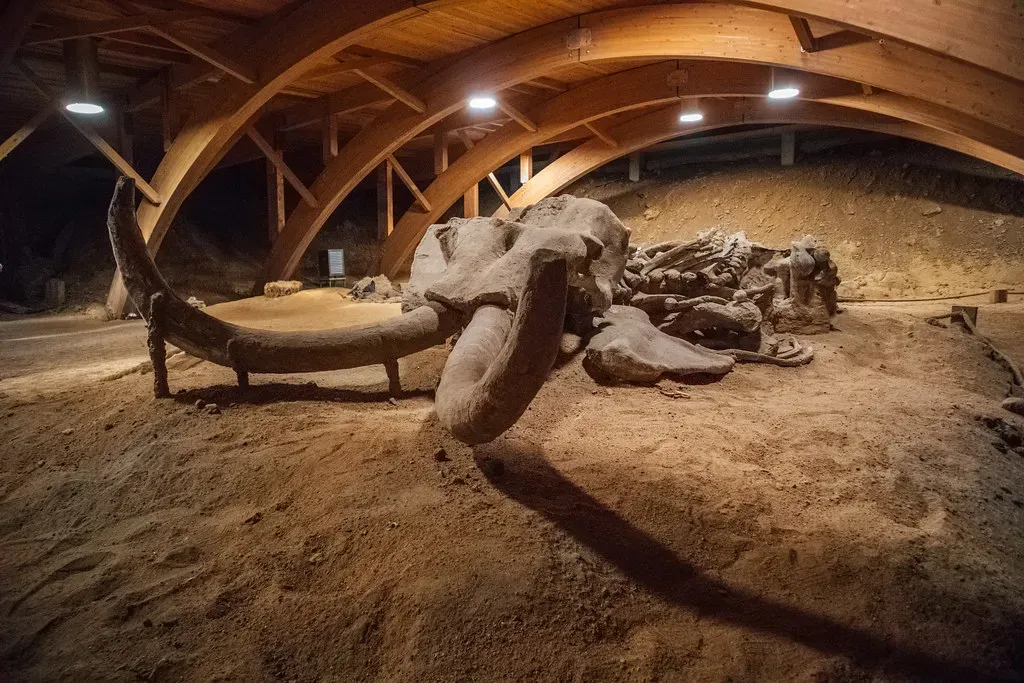
Centuries before Europeans arrived, native inhabitants of the Americas understood that the land had once been teeming with massive creatures that ruled the earth, water, and sky. Their distant ancestors had lived alongside mammoths and mastodons, giant sloths, saber-toothed tigers, and giant bison, extinct animals that lived on in Native oral histories backed up by fossils. This wasn’t mythology disconnected from reality. In perceptive creation stories, tribes visualized the remains of extinct mammoths, dinosaurs, pterosaurs, and marine creatures as Monster Bears, Giant Lizards, Thunder Birds, and Water Monsters, and their insights, some so sophisticated that they anticipate modern scientific theories, were passed down in oral histories over many centuries.
Zuni, Navajo, Apache, and Hopi creation stories all cover a vast timeframe. The Zuni, for instance, describe volcanic eruptions that dried out primeval oceans full of monsters and giant lizards that were eventually replaced by huge mammals. Native Americans also posited that megafauna like giant beavers and bison had shrunk to their present sizes over time, and they came up with these explanations long before European scientists had any comprehension of deep time. That kind of environmental reasoning, preserved across generations, deserves far more credit than it has traditionally received.
The Kennewick Man and What Bones Can Reveal
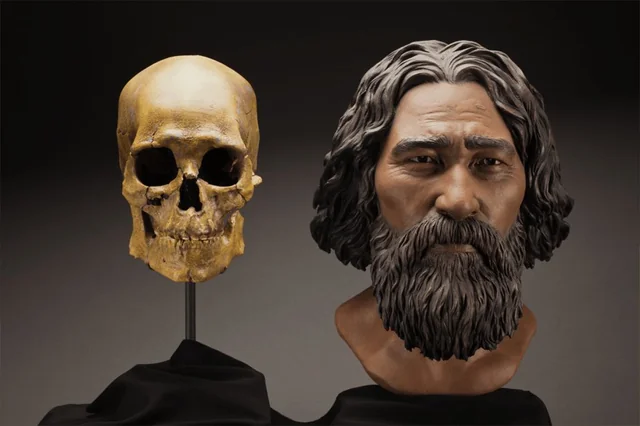
Kennewick Man, or Ancient One, was a Native American man who lived during the early Holocene whose skeletal remains were found in 1996 washed out on a bank of the Columbia River near Kennewick, Washington. The discovery was accidental and immediately controversial. Measurements of carbon, nitrogen, and oxygen isotope ratios in the bone collagen indicate that the man lived almost exclusively on a diet of marine mammals for the last 20 or so years of his life, and that the water he drank was glacial melt. The closest marine coastal environment where this water could have been found during his lifetime was in Alaska, which, combined with the location of the find, led to the conclusion that the individual led a highly mobile, water-borne lifestyle centered on the northern coast.
Genetic studies in 2015 determined that he was related to local Native Americans by ancestry, and in 2016, his body was returned to the indigenous tribes of the Columbia Basin. Although this discovery told scientists much about prehistoric Native Americans, including that his diet and lifestyle could be determined from his bones, the local indigenous tribes of the Columbia Basin felt very upset by his disturbance. The Kennewick Man case opened a broader conversation about who has the right to study ancient remains, and who carries the responsibility of honoring them.
Tribal Lands, Fossil Rights, and the Modern Reckoning
Paleontologists with armed escorts stole fossils from Native American lands during the Bone Wars of 1877 to 1892, as the tribes, the same ones whose fossil myths contributed to paleontology’s formation, were being driven from their homes. That history casts a long shadow. Today, the ownership and management of fossils found on tribal lands remains legally complex. Unfortunately, fossils are not covered under the Native American Graves Protection and Repatriation Act, which requires museums and other organizations to return Native American cultural items, including human remains, funerary objects, sacred objects, and objects of cultural patrimony, to descendants or tribes.
Some tribes have begun addressing this gap on their own terms. The Standing Rock Sioux Tribe is the first in the nation to create its own paleontology code that sets out rules for fossil collection on its land. The code defines a fossil and says that the Standing Rock Sioux Tribe is the owner of all fossils found on its land, “no matter what.” The tribe has more than 10,000 fossils that require cataloging, and this work will continue over the next few years. It’s a practical and principled response to a problem that formal science has been slow to resolve.
Conclusion: A Story Still Being Excavated
The fossil record of North America is, in many ways, the oldest library on the continent. Its entries aren’t written in words. They’re pressed into sediment, encoded in bone, and carried across generations in the stories that Indigenous peoples have always told. What archaeology and paleontology keep discovering is that these two sources of knowledge, the scientific and the oral, often point toward the same truths.
Traditional knowledge and Western science offer multiple lines of evidence about the first people to populate North America. Archaeological and genetic evidence show that people have been here at least 23,000 years and as long as 30,000 years, underscoring American Indians’ oral history that their ancestors lived on these lands from time immemorial. The hidden chapter isn’t really hidden at all. It was being told all along. We’re only just learning how to listen to it properly.