Northern Patagonia, Argentina – A meticulously preserved skeleton unearthed from desert sands has introduced scientists to Alnashetri cerropoliciensis, one of the smallest non-avian dinosaurs known from South America.
A Breakthrough in La Buitrera
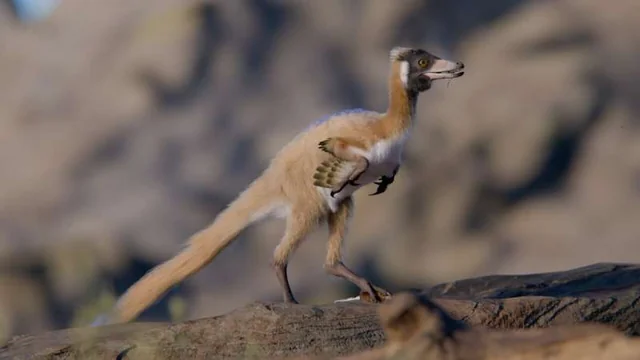
A Breakthrough in La Buitrera (Image Credits: Unsplash)
Paleontologists discovered the nearly complete specimen, nicknamed “Alna,” in 2014 at the La Buitrera site in Río Negro Province. The fossil emerged from sandstone layers dating back 95 million years to the Cretaceous Period. Researchers spent the next decade meticulously preparing the fragile bones to map its anatomy accurately.
This find marked a significant advance over earlier fragmentary remains of the species uncovered in 2004. The site’s reputation for yielding exquisite Cretaceous fossils, including small vertebrates like early snakes and saber-toothed mammals, made it an ideal location for such a revelation. Alna’s rapid burial under a sand dune preserved her bones in lifelike positions, enabling detailed histological analysis.
Dimensions of a Featherweight Hunter
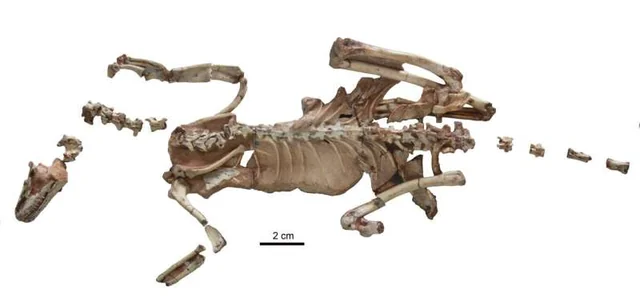
Alnashetri measured about 70 centimeters long, mostly tail, and weighed roughly 0.7 kilograms – lighter than a chicken and comparable to a crow. The adult female reached this size by age four, as confirmed by microscopic bone studies revealing lines of arrested growth.
Her slender legs suited dune traversal in the Kokorkom Desert, known locally as the “desert of the bones.” Numerous strong, pointy teeth suggested a diet of small prey, including lizards, snakes, mammals, and invertebrates, unlike later relatives specialized for insects. Long arms and a rooster-like build hinted at agility, though flight remained impossible.
- Stubby yet powerful forelimbs for grasping.
- Gracile hindlimbs for speed across sands.
- Lightly built skull with Velociraptor-like dentition.
- Potentially feathered body, based on related species.
- Long tail for balance, akin to other carnivorous theropods.
Rewriting Alvarezsauroid Evolution
Alnashetri belonged to the alvarezsauroids, a theropod group long puzzling due to fragmented South American records compared to Asian finds. This skeleton positioned her as a basal member, challenging notions of progressive miniaturization and dietary shifts toward ant-eating.
Phylogenetic studies indicated a Pangaean origin, with continental drift shaping their spread rather than ocean crossings. Peter Makovicky, lead author from the University of Minnesota, described the fossil as a “paleontological Rosetta Stone” for interpreting scrappy remains and tracing body size stasis within a narrow range.
Sebastián Apesteguía, a co-author from Argentina’s CONICET, noted the exquisite histological detail, underscoring repeated size reductions in the lineage without early insect specialization.
Small Fry Amid Southern Giants
Patagonia hosted colossal dinosaurs like the eight-ton Giganotosaurus alongside this diminutive resident, highlighting ecosystem diversity. La Buitrera has produced other small wonders, such as the dinosaur Buitreraptor and reptile Priosphenodon, painting a fuller picture beyond megafauna.
Alnashetri demonstrated that the “age of southern giants” brimmed with biodiversity, filling niches overlooked in popular depictions. Her discovery affirmed alvarezsauroids’ early global presence during Pangaea’s fragmentation.
Key Takeaways
- Alnashetri weighed under 0.9 kg, rivaling global tiniest dinosaurs.
- The fossil provides a baseline for alvarezsauroid anatomy and evolution.
- Patagonia’s La Buitrera site continues to yield critical small vertebrate fossils.
This exquisite find not only spotlights a overlooked predator but also urges reevaluation of dinosaur miniaturization narratives. What role did such tiny hunters play in Cretaceous food webs? Share your thoughts in the comments.