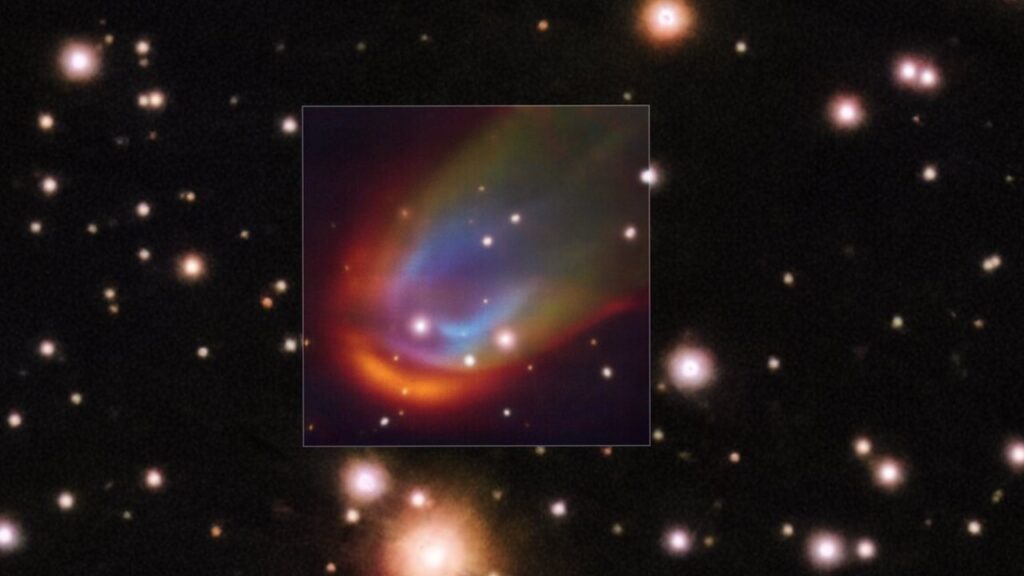
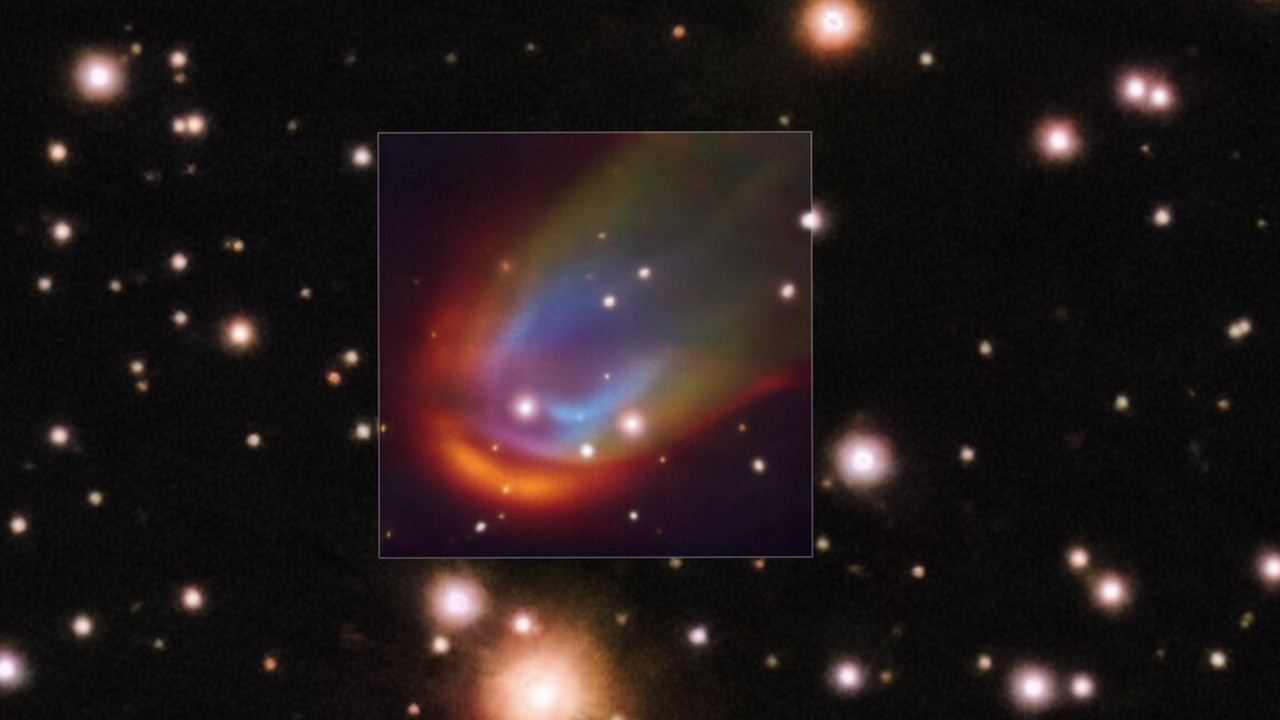
The Surprising Observation (Image Credits: Cdn.mos.cms.futurecdn.net)
Astronomers have uncovered a peculiar shockwave encircling a long-extinct white dwarf, prompting fresh questions about the remnants of stellar life.
The Surprising Observation
Researchers using the European Southern Observatory’s Very Large Telescope detected this anomalous feature during routine observations of binary star systems.
The white dwarf, a dense core left after a star exhausts its fuel, sits in a close orbit with a companion star that feeds it material over time.
What caught the team’s attention was a persistent bow shock – a wave formed by gas colliding with surrounding space – unlike any previously documented around such objects.
This structure has endured for over a thousand years, defying models that predict short-lived phenomena in these environments.
The discovery emerged from data analysis that revealed faint emissions in the ultraviolet spectrum, highlighting the shockwave’s subtle presence.
Unraveling the White Dwarf’s Secrets
White dwarfs typically cool quietly after their explosive youth, but this one shows signs of active interaction with its surroundings.
The absence of an accretion disk, usually present when material spirals toward the star, makes the shockwave even more intriguing.
Instead, the white dwarf’s powerful magnetic field appears to channel incoming gas, creating magnetic funnels that propel outflows at high speeds.
These outflows slam into interstellar medium, generating the observed shock, which glows faintly due to heated particles.
Lead researcher Dr. Noel Castro Segura described the find as groundbreaking, noting it challenges preconceived notions of post-supernova behavior.
Previous studies focused on disk-dominated systems, but this case points to magnetism as a key driver in energy dissipation.
Implications for Cosmic Evolution
This revelation could bridge gaps between observed binary star populations and theoretical predictions.
Astronomers have long noted discrepancies in how quickly these systems evolve, with simulations underestimating energy losses.
The shockwave suggests an additional mechanism for shedding energy, potentially linked to the white dwarf’s intense magnetic activity.
Such processes might explain why certain white dwarfs appear younger or more energetic than expected.
Further observations could refine models of galactic star formation, influencing our understanding of the universe’s stellar lifecycle.
Key Features of the Phenomenon
The shockwave’s characteristics set it apart from typical cosmic events.
- It forms without a visible accretion disk, relying on magnetic channeling of material.
- The structure persists steadily, indicating continuous outflows over centuries.
- Ultraviolet imaging from the VLT revealed its arc-like shape, spanning light-years.
- Magnetic fields, estimated at billions of times Earth’s, sculpt the gas flows.
- No similar bow shocks have been imaged around isolated white dwarfs before.
These elements combine to create a stable yet dynamic feature, observable only with advanced telescopes.
Key Takeaways
- The discovery highlights magnetism’s overlooked role in white dwarf accretion.
- It resolves puzzles in binary star evolution models.
- Future studies may uncover more such hidden structures in the cosmos.
As astronomers probe deeper into this cosmic enigma, the shockwave around the dead star stands as a testament to the universe’s enduring surprises. What secrets might other stellar remnants hold? Share your thoughts in the comments below.