Alberta, Canada – A nearly complete skull unearthed in 1936 from the upper Dinosaur Park Formation has prompted scientists to establish a new genus for the ceratopsian dinosaur once known as Chasmosaurus russelli. Researchers recently re-examined the holotype specimen, CMNFV 8800, revealing unique anatomical traits that set it apart from its former genus mates. This reclassification highlights how fresh preparation and modern analysis continue to refine our understanding of Late Cretaceous diversity in western Canada.
A Skull Long Overlooked Finds New Eyes
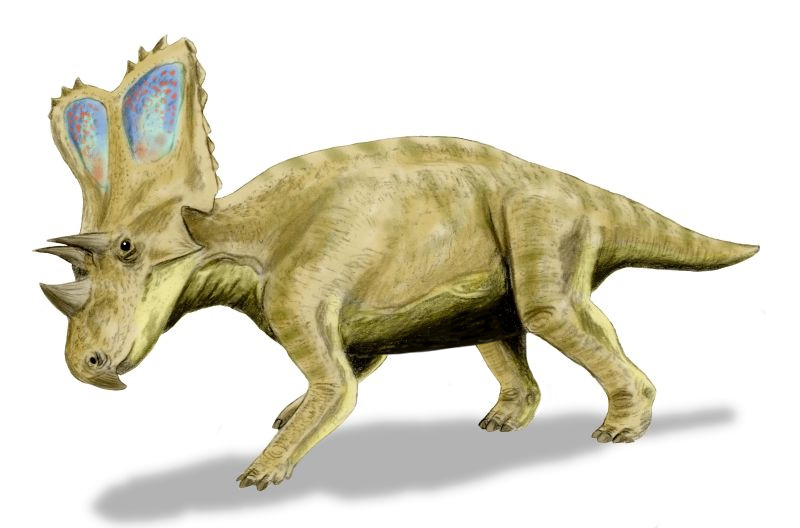
A Skull Long Overlooked Finds New Eyes (Image Credits: Wikimedia)
Loris Shano Russell discovered the fossil near Onefour, southeast of Manyberries, during fieldwork in 1936. Charles Mortram Sternberg formally described it in 1940 as Chasmosaurus russelli, honoring Russell, and assigned a few additional specimens as paratypes. For decades, the taxon persisted amid debates over its relationships within Chasmosaurinae, the group of large horned dinosaurs with expansive frills.
Stratigraphic revisions later placed the holotype higher in the formation, about 1.5 million years younger than many Chasmosaurus specimens from Dinosaur Provincial Park. This temporal gap, combined with anatomical mismatches, fueled questions. A team led by Robert B. Holmes, Jordan C. Mallon, Michael J. Ryan, and David C. Evans revisited the specimen, meticulously removing obscuring plaster to uncover details previously hidden.
Unique Traits Emerge from Preparation
The skull measures roughly 94 centimeters long, rivaling the largest Chasmosaurus examples. Its premaxilla features a spatulate posteroventral process that remains broad rather than tapering, fully covering the nasal bone beneath the naris – a departure from Chasmosaurus. The narial strut tilts posteriorly, and the endonarial process appears subrectangular.
Frill ornamentation stands out most dramatically. Eight episquamosals line the squamosal edge, with bases lengthening posteriorly until reversing for the final one – an autapomorphy unseen elsewhere in chasmosaurines. The first two epiparietals, ep1 and ep2, fuse into dome-shaped structures rooted on the posterior bar’s dorsal surface, nearly meeting at the midline within a deep embayment. This creates an arched, M-shaped outline unlike the fan-shaped frills of Chasmosaurus.
- Spatulate premaxilla process, non-tapering.
- Posteriorly tilted narial strut.
- Episquamosal bases: progressive lengthening then reversal.
- Fused, dome-shaped ep1 and ep2 on posterior bar.
- Frill wider anteriorly than posteriorly in dorsal view.
- Deep parietal fenestrae and arched posterior bar.
Challenging Ties to Chasmosaurus and Southern Cousins
Chasmosaurus specimens typically exhibit triangular epiparietals oriented posteriorly and episquamosals of subequal size or larger toward the rear. Cryptarcus deviates with its rectangular frill profile, straight squamosal margins, and restricted antorbital buttress confined to the palpebral bone. Postorbital horncores appear as broad stumps, possibly resorbed in maturity or due to pathology, much like some centrosaurines.
Yet parallels exist with the “Pentaceratops clade” from the American Southwest – Utahceratops, Agujaceratops, and Pentaceratops itself. Shared traits include the anteriorly widened frill, profound midline embayment, and midline-proximate ep1. Researchers propose Cryptarcus as a potential migrant from these southern populations or a northern lineage where such features evolved convergently.
| Feature | Cryptarcus | Chasmosaurus | Pentaceratops-like |
|---|---|---|---|
| Frill shape | Anteriorly wider | Fan-shaped, posteriorly wider | Anteriorly wider |
| Epiparietals | Dome-shaped, fused ep1/ep2 | Triangular | Nearly midline-touching |
| Premaxilla process | Spatulate | Tapering | Variable |
Phylogenetic Puzzle and Broader Implications
Analysis of an updated matrix yielded three topologies: one allying Cryptarcus nearer Chasmosaurus, another toward the Pentaceratops group, and a third unresolved. No scenario supported a straight-line evolution from Cryptarcus through Pentaceratops to Terminocavus, countering recent hypotheses. Only one additional specimen, a partial parietal (TMP 2013.019.0038), remains confidently referred; others prove chimeric or indeterminate.
This split underscores rapid evolution in the Dinosaur Park Formation, where species turned over every 300,000 to 600,000 years. Cryptarcus likely roamed as a rhino-sized herbivore around 75 million years ago, browsing in a floodplain teeming with relatives like Chasmosaurus belli.
Key Takeaways
- Cryptarcus russelli gen. et comb. nov. honors its “hidden” history and arched frill.
- Holotype re-preparation exposed autapomorphies disqualifying it from Chasmosaurus.
- Uncertain affinities suggest migration or convergence across North America.
The establishment of Cryptarcus not only clarifies ceratopsian taxonomy but also enriches the tapestry of Campanian dinosaurs. As tools like CT scanning and refined matrices evolve, more “hidden” genera may surface from museum shelves. What other secrets lie in Alberta’s fossil beds? Tell us in the comments.