
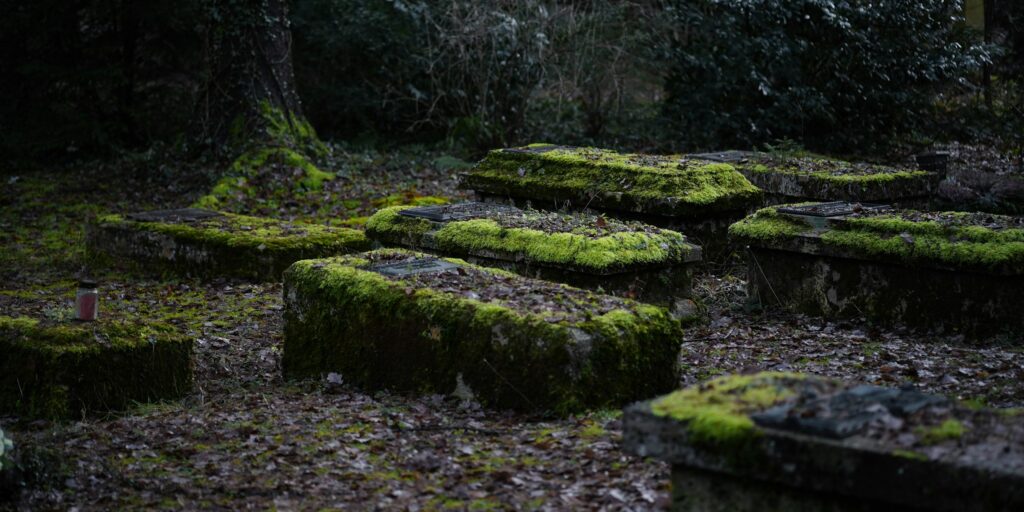
Walk through any old American cemetery and you’ll notice something right away: the gravestones are not just stone anymore. They’re covered, softened, and sometimes almost swallowed by living things. Moss, lichen, tiny trees, even neon-green algae – it can look hauntingly beautiful and quietly unsettling at the same time.
I still remember the first time I ran my hand over a 1800s marble headstone and felt it crumble slightly under my fingers. The name was almost gone, but the stone was alive with color and texture. That moment completely changed how I saw graveyards: not as static monuments, but as slow-motion battlegrounds between stone and life.
Across the United States, from foggy New England churchyards to sunburned Southwestern burial grounds, certain organisms show up again and again. They tell stories about air pollution, climate, local wildlife, and time itself. Here are 14 of the most common (and surprising) – what they are, why they show up, and what they’re doing to the memories carved in stone.
#1: Crustose Lichens – Nature’s Painted Patina
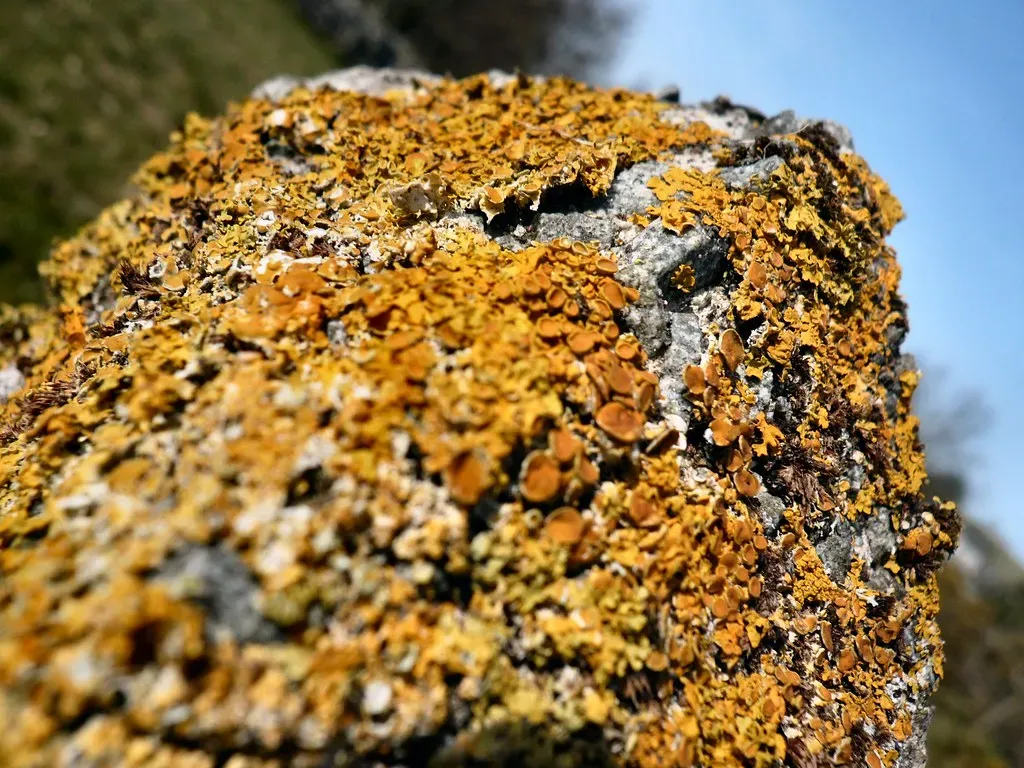
Those flat, paint-like patches that look almost fused into the stone? That’s usually crustose lichen, one of the most common things you’ll see on old gravestones. It often shows up as pale gray, white, yellow, or orange “crusts” that look like someone dabbed the stone with a sponge and let it dry forever. You can’t peel it off easily, because it grows right into the surface.
Lichens are actually a partnership between a fungus and a photosynthetic partner (usually algae). The fungus does the heavy lifting for structure and attachment, while the algae handles sunlight and energy. Together, they colonize bare, tough surfaces that most other life ignores – like granite, sandstone, slate, and marble. In a way, every lichen-covered gravestone is a quiet science lesson about cooperation.
Over time, crustose lichens do more than change the color of the stone. Their fungal filaments creep into microscopic cracks, and their chemical by-products can slowly break down minerals. On softer stones, like old marble, that means the inscription can fade faster. So while they look like a soft patina, they’re also very slowly eating the monument they live on.
- Flat, tightly attached, “painted-on” look
- Common colors: white, gray, orange, yellow
- Can contribute to long-term erosion of soft stone
#2: Foliose Lichens – Leafy Rosettes on Stone
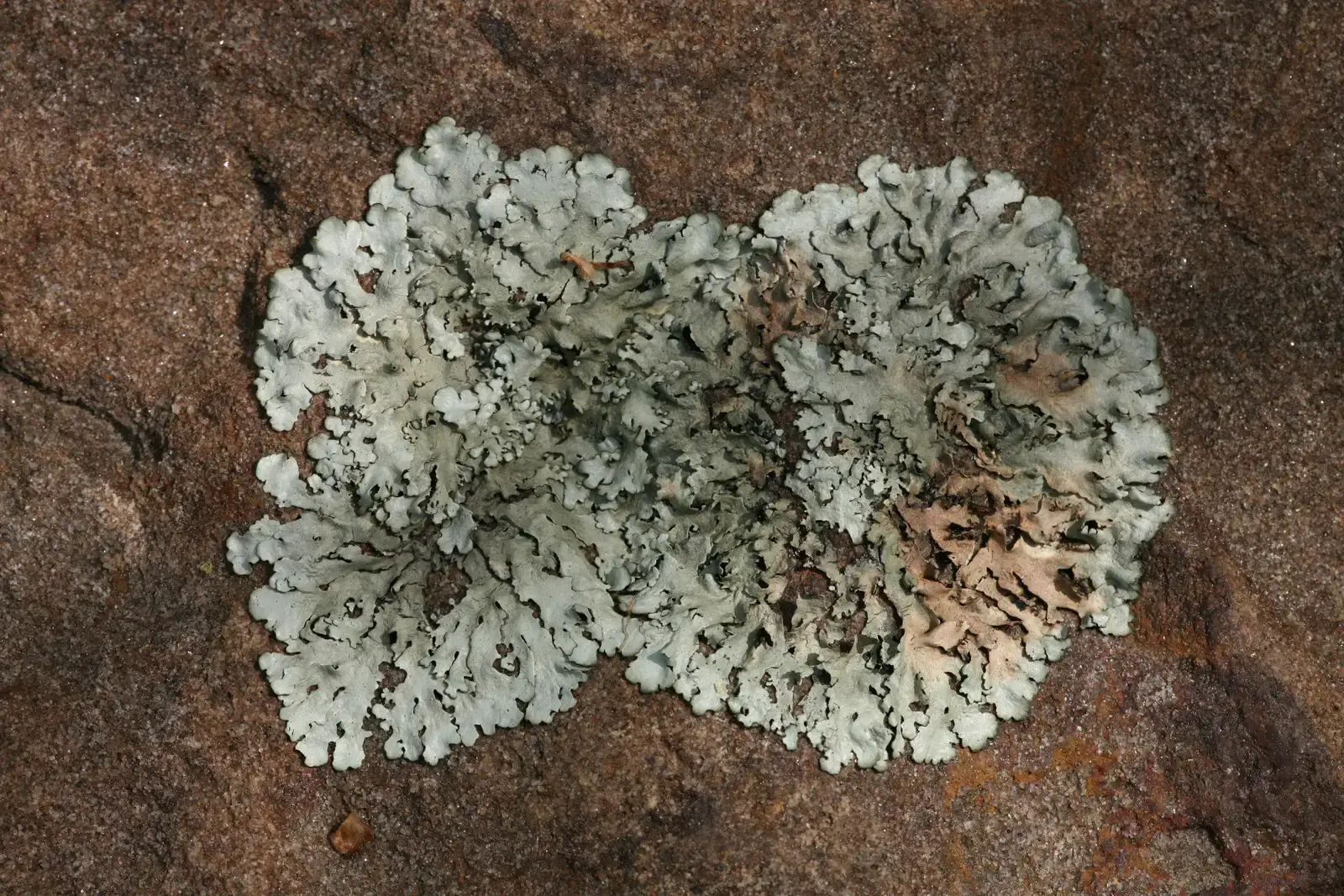
In contrast to crustose lichens, foliose lichens look a bit like tiny, curled leaves plastered to the gravestone. They form rosettes or irregular patches with lobed, leafy edges that can lift slightly from the surface. You might see them as pale green, sage, gray, or sometimes even bluish or brownish clumps hugging the stone.
Because they’re thicker and more three-dimensional, foliose lichens catch the eye more easily than their crust-like cousins. They tend to favor surfaces that aren’t too exposed to harsh abrasion, so you’ll often find them on the shaded sides of stones, under overhanging edges, or in older cemeteries where maintenance is minimal. They love a bit of moisture and relatively clean air.
Foliose lichens also trap dust and organic particles, which can build up into a thin layer of soil right on the stone. That mini soil crust can then host other organisms like mosses or tiny seedlings. So when you see lush gravestones that look like they’re wearing a greenish collar or halo of growth, foliose lichens are often part of the pioneer crew that made that possible.
#3: Fruticose Lichens – Tiny Forests in Miniature
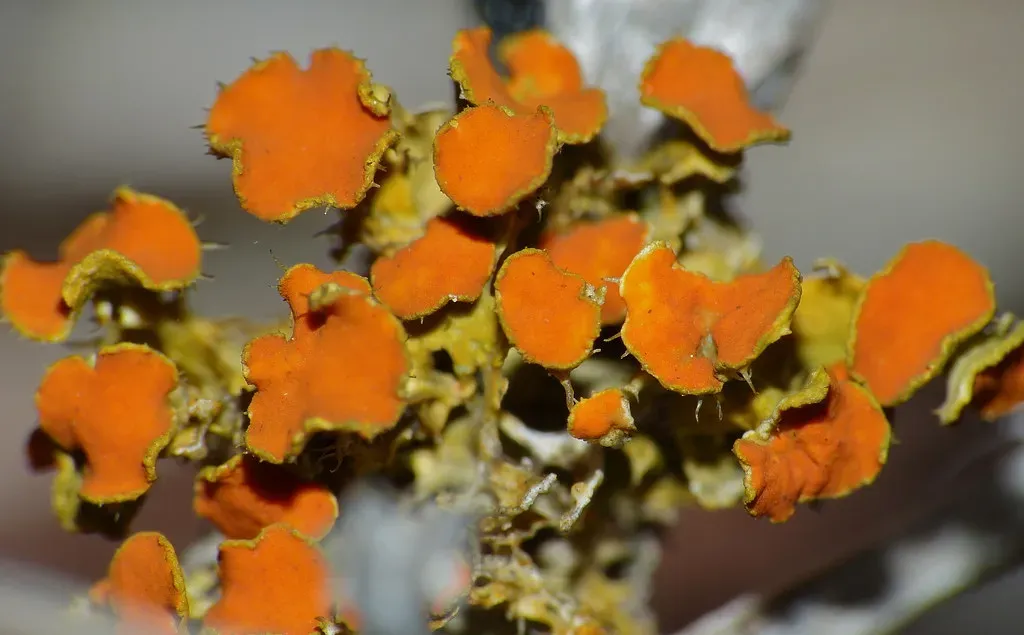
Fruticose lichens are the show-offs of the lichen world. Instead of lying flat, they grow as branching, shrubby tufts that look like tiny coral reefs or miniature shrubs. On gravestones, they might appear as small, bushy clusters sticking up from the surface, often in pale green, gray, or yellowish tones.
These lichens tend to prefer rougher stone, where their tiny attachment points can anchor more easily. You’re more likely to see them in older, less disturbed sections of cemeteries, especially in regions with cleaner air and somewhat consistent moisture, like parts of the Northeast, Pacific Northwest, or higher elevations in the Appalachians.
What fascinates many people is how outsized their presence feels. A gravestone covered in fruticose lichens can look like a world in miniature, with little “trees” and “bushes” rising from an ancient landscape. They can be ecologically important too, housing tiny invertebrates and contributing nitrogen to the immediate microenvironment.
- Three-dimensional, branching or shrubby forms
- Often a sign of relatively clean air and stable surfaces
- Create microhabitats for insects and microbes
#4: Mosses – Velvet Carpets on Forgotten Names
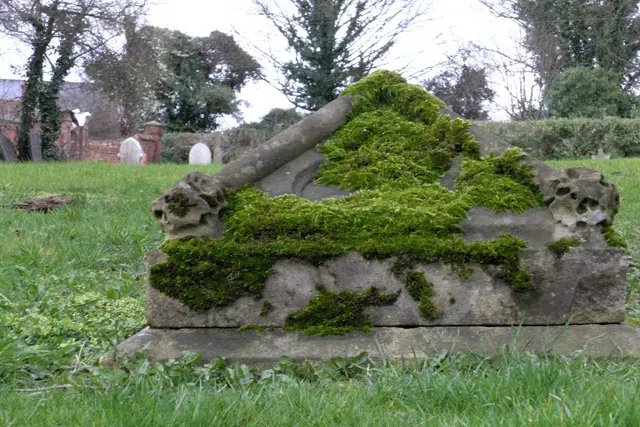
Moss is probably the most instantly recognizable life form on old gravestones. It shows up as soft, cushiony mats or tufts, often glowing green after rain or in shaded corners. Mosses love moisture, so you’ll see them thriving in damper climates, on north-facing stone surfaces, and near the base where water runs down and collects.
Unlike lichens, mosses are simple plants. They do not have true roots, but they anchor to stone with tiny hair-like structures and pull in water directly through their leaves. On porous stones like sandstone, the combination of moisture and moss can be a slow disaster for inscriptions. The constant dampness softens the stone while the moss’s rhizoids work farther into the pores and cracks.
I’ve seen 19th-century marble markers where the only legible part of the inscription was the piece that stayed too dry for moss to colonize. It’s a bittersweet trade-off: moss makes a stone look peaceful and almost cozy, but it can also round off the crisp carving over decades. Still, as a habitat, it’s a magnet for springtails, tiny spiders, and other micro-critters that turn the grave into a living neighborhood.
- Thrives in shade and constant moisture
- Softens surface details over time
- Provides shelter for small invertebrates
#5: Algae – Ghostly Green Films and Black Streaks
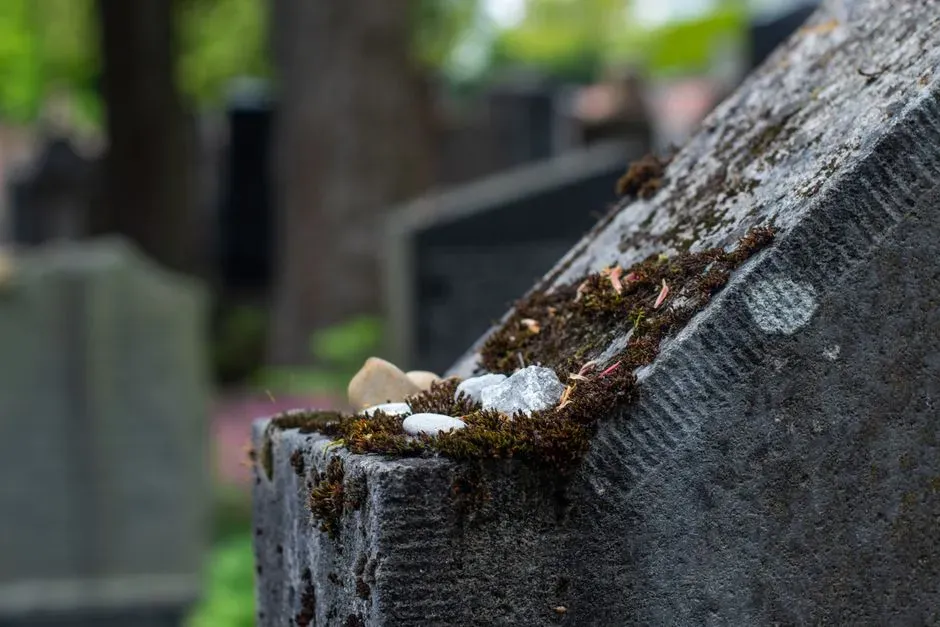
Algae on gravestones usually does not announce itself loudly – it creeps in as a faint green film or dark smear that you might mistake for simple dirt. In humid or rainy regions, especially in the Southeast and parts of the Midwest, headstones can develop a uniform green cast on their shaded sides. This is often a mixture of microscopic green algae species taking advantage of moisture and minimal competition.
On lighter stones like marble and limestone, algae can turn inscriptions murky and hard to read, especially when combined with soot or dust from the air. Some gravestones in polluted urban areas end up with a grimy layer that’s actually a mix of algae, bacteria, fungi, and trapped pollution particles – a kind of biological grime that responds more to weather conditions than to simple aging.
In very wet places, you may also notice darker, almost blackish streaks or patches that look like old water damage. Those can be pigmented algae or cyanobacteria, organisms that produce protective dark compounds to shield themselves from strong sunlight. They might not dig into the stone as aggressively as some lichens, but they can still contribute to both staining and surface weakening over time.
#6: Black Molds and Sooty Biofilms – The Cemetery Smog Record
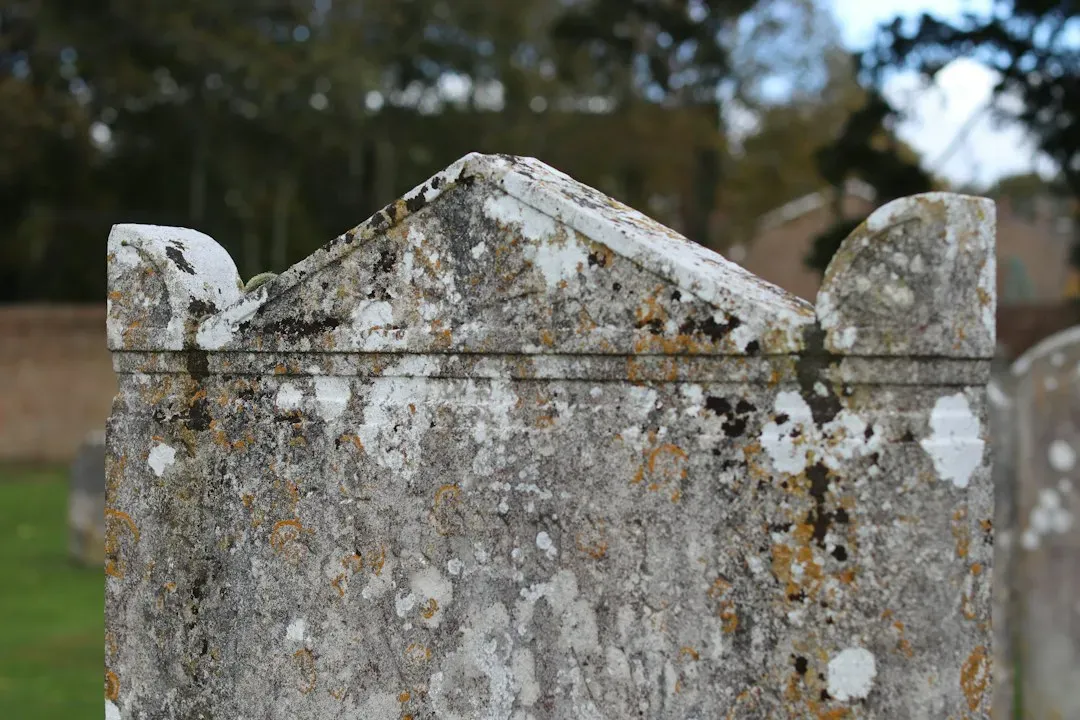
Some of the black, sooty coatings on old gravestones are not just dirt or carbon deposits; they’re alive. Black molds and mixed microbial films can grow on stone surfaces where moisture, nutrients, and air pollution come together. Older urban cemeteries, especially those near industrial zones or busy roads, are prime spots for these grim coatings.
These organisms can be surprisingly resilient. Their dark pigments help protect them from ultraviolet radiation, and they can survive long dry spells. When rain returns, they reactivate, feeding on whatever organic material lands on the stone – bird droppings, decaying leaves, pollen, pollutants. Over decades, they can etch into softer stones and permanently stain harder ones.
In a way, these black films are like biological air-quality archives. Stones that once gleamed white can turn patchy gray or nearly charcoal-colored, reflecting a history of soot, exhaust, and changing urban environments. Cleaning them is not trivial either; aggressive scrubbing or harsh chemicals can do more harm to the stone than the biofilm ever did.
- Often associated with polluted or urban environments
- Can permanently darken light-colored stones
- Difficult to remove without damaging the stone
#7: Fungi and Slimy Biofilms – The Wet-Weather Invaders
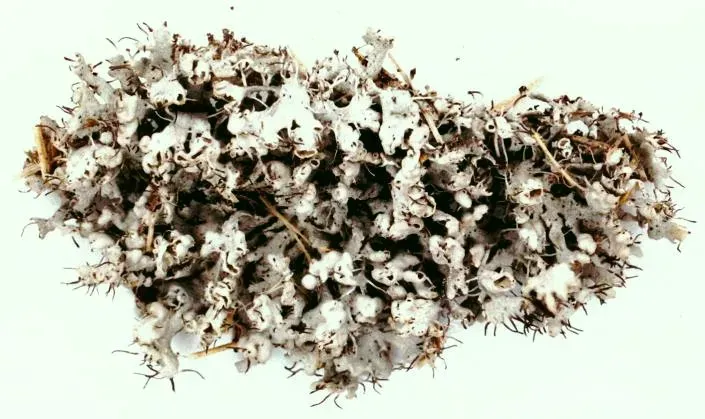
After heavy rain, some gravestones develop a faintly slick, almost greasy feel. That sensation is often due to biofilms: thin, slimy layers made up of bacteria, fungi, and algae living together in a shared matrix. They tend to appear on smoother stones or on horizontal surfaces that hold water just long enough for the film to build.
Certain fungi within these films can produce organic acids and dark pigments, which contribute to staining and chemical weathering of stone. While they are not as visually dramatic as moss or lichen, their impact can be significant over many wet–dry cycles. In very damp climates or in shady cemetery corners, these slimy films may be a constant presence, returning repeatedly even after cleaning attempts.
What makes them tricky is the speed of colonization. While lichens might take years to form visible patches, a microbial film can be noticeable after a few rainy weeks. In newer cemeteries, you can almost watch the transition: first a clean stone, then a slight sheen, then faint discoloration as the biofilm community matures.
#8: Seedlings and Saplings – Trees Growing Out of Stone
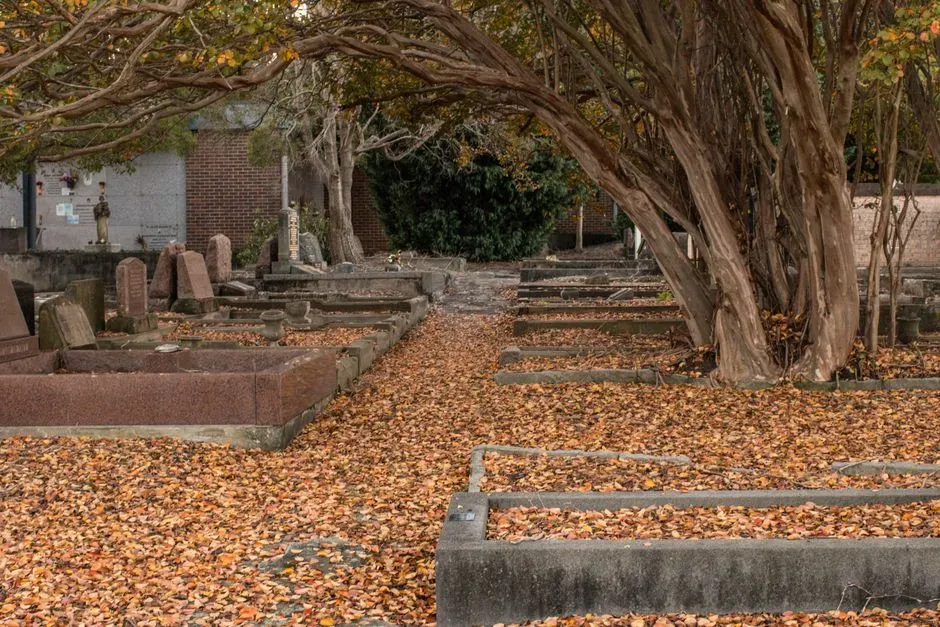
Every now and then, you’ll see something that feels almost impossible: a small tree growing out of a crack in a headstone, or a sturdy sapling wedged between a gravestone and its base. Those little plants usually start as seeds dropped by birds or blown by the wind, lodged into tiny crevices where dust and organic debris have accumulated.
Common culprits include maples, oaks, elms, and various fast-growing weeds or shrubs. Once the roots find the smallest bit of moisture and crumbly material, they begin to pry the crack wider. Over years, the expanding root system can split stones, topple markers, or push entire monuments out of alignment. It’s slow-motion vandalism carried out by nature instead of people.
I’ve walked through neglected cemeteries where a sapling had effectively become part of the monument, its trunk wrapped around the stone like a stubborn hug. It is hard not to admire the tenacity of the tree, yet at the same time, you realize it is literally tearing apart a piece of someone’s history. That tension between life’s insistence and our attempt to leave something permanent is part of what makes old graveyards so emotionally charged.
- Seeds arrive via wind, birds, and small animals
- Roots exploit micro-cracks and trapped soil
- Can physically break, tilt, or dismantle stones over decades
#9: Grass and Groundcover – The Slow Encroachment
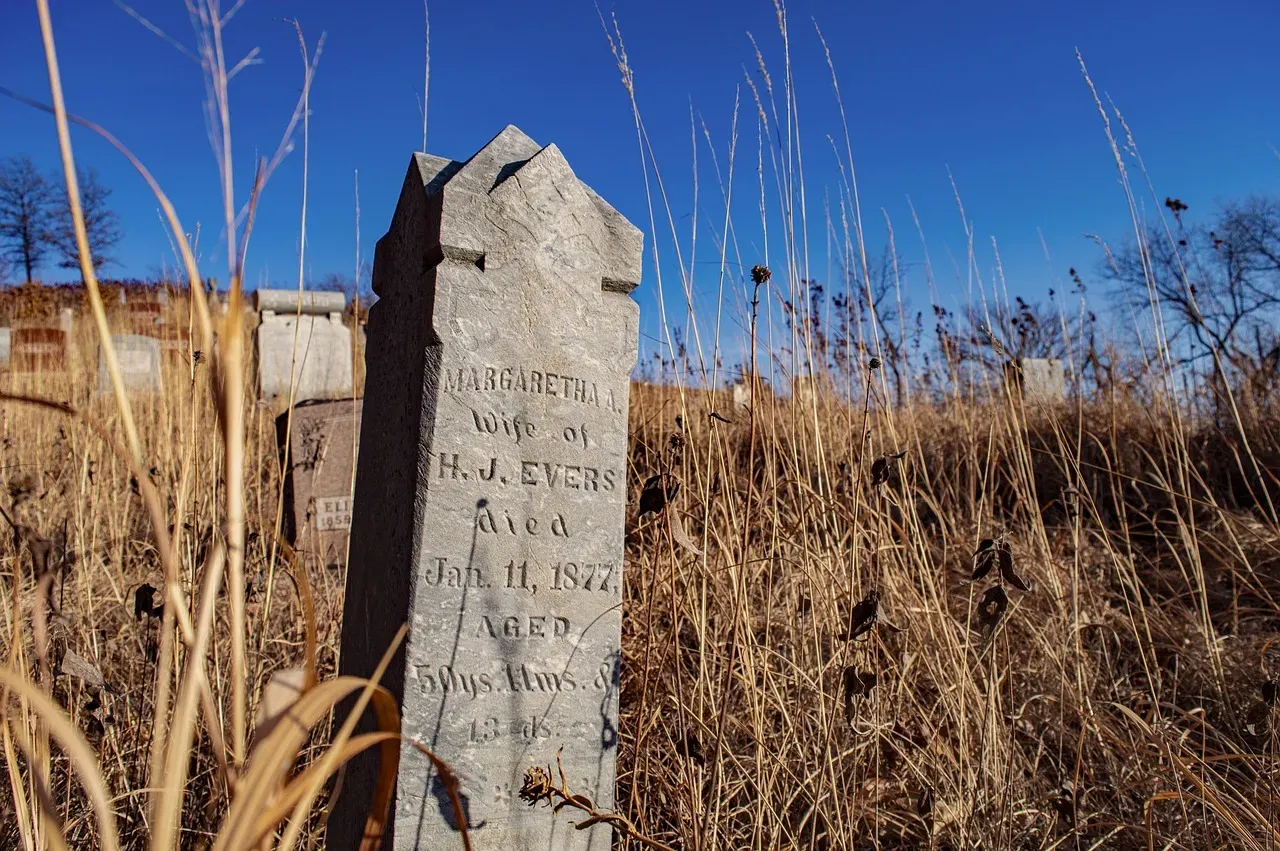
In many American cemeteries, especially smaller rural ones, the boundary between lawn and grave marker is not clear. Grass creeps up around bases, covers fallen stones, and in some cases grows right over flat markers until they all but disappear. This is not a dramatic invasion; it’s the quiet, daily work of roots, rhizomes, and mower clippings.
Groundcover plants such as creeping thyme, ivy, or vinca sometimes get planted intentionally to make maintenance easier or to “beautify” older sections. Left unchecked, these species can spread over stones, trapping moisture and debris against the surface. They soften the appearance of the graveyard, making it feel like an overgrown garden rather than a formal memorial ground.
But the trade-off is real. Roots can work their way into joints, foundations, and cracks, destabilizing monuments. Leaf litter and constant shade from dense groundcover can also encourage more moss, algae, and fungal growth on the stones themselves. So while a carpet of green looks peaceful, it can help erase the sharp lines and clear names people once carved to be seen.
#10: Ivy and Climbing Vines – Romantic or Ruthless?
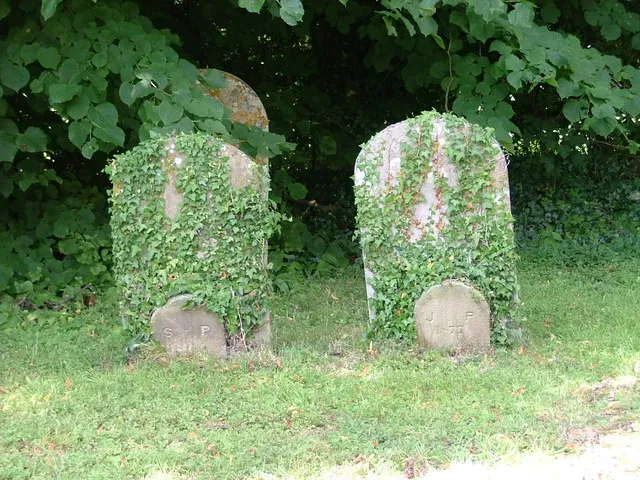
Climbing ivy wrapping itself around an old gravestone is one of those classic, movie-ready images. In reality, it’s both beautiful and destructive. Ivy and similar vines cling to stone with tiny rootlets or adhesive pads that anchor into microscopic irregularities. Over time, these points of attachment can widen into cracks, especially on stones that are already weathered.
Vines shade the surface, locking in moisture and creating a pocket of humidity beneath the leaves. That microclimate is perfect for additional growth of mosses, lichens, and fungi on the stone. When ivy is eventually removed, it can leave behind discoloration, residual roots, and even ripped-away surface material that takes bits of the inscription with it.
I’ve seen family members argue in front of an ivy-draped stone: one person seeing it as romantic and dignified, the other seeing it as an emergency. Honestly, they are both right. Ivy can look stunning… right up until it pulls a fragile headstone down, or hides the name so completely that the person beneath effectively vanishes from view.
- Attaches via rootlets that can penetrate weakened stone
- Creates a damp microclimate under the foliage
- Removal often risks additional damage to the surface
#11: Liverworts and Tiny Bryophytes – The Damp-Loving Specialists
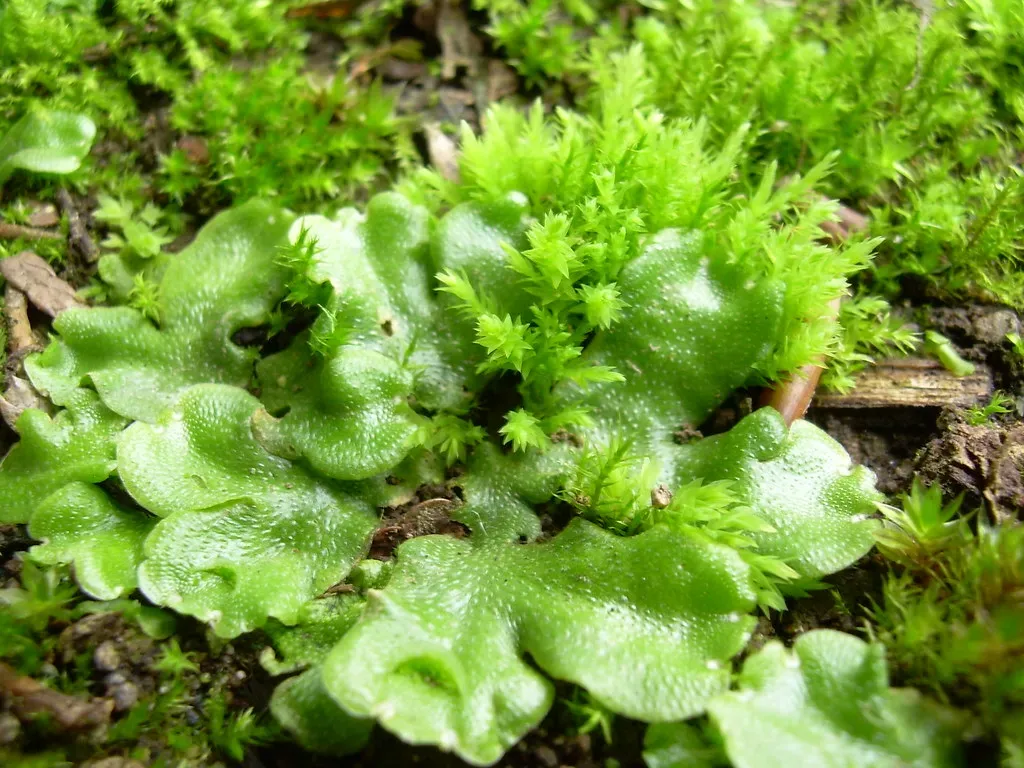
Beyond the obvious mosses, there are other tiny plants that quietly colonize old gravestones: liverworts and related bryophytes. These often appear as very low, flat, greenish or sometimes reddish patches that look almost like a thin, wet carpet or scaly film. They are especially common in consistently damp, shaded spots, like the bases of stones in rainy regions or near leaky spigots and drains.
Liverworts are even more moisture-dependent than many mosses. They thrive where water lingers on the stone surface, using it both to hydrate and to spread spores. In the process, they trap organic particles and fine sediments, which builds up a fragile layer of proto-soil. That layer then invites even more growth – sometimes turning the base of a stone into a saturated, living mat.
Because these plants lie so flat and stay so small, most visitors never even notice them. But they can accelerate the erosion process on softer stones simply by keeping surfaces wetter for longer. In cemeteries with frequent watering or poor drainage, they are a subtle but persistent signal that the water regime is out of balance.
#12: Bacteria and Microbial Stains – Invisible Engineers
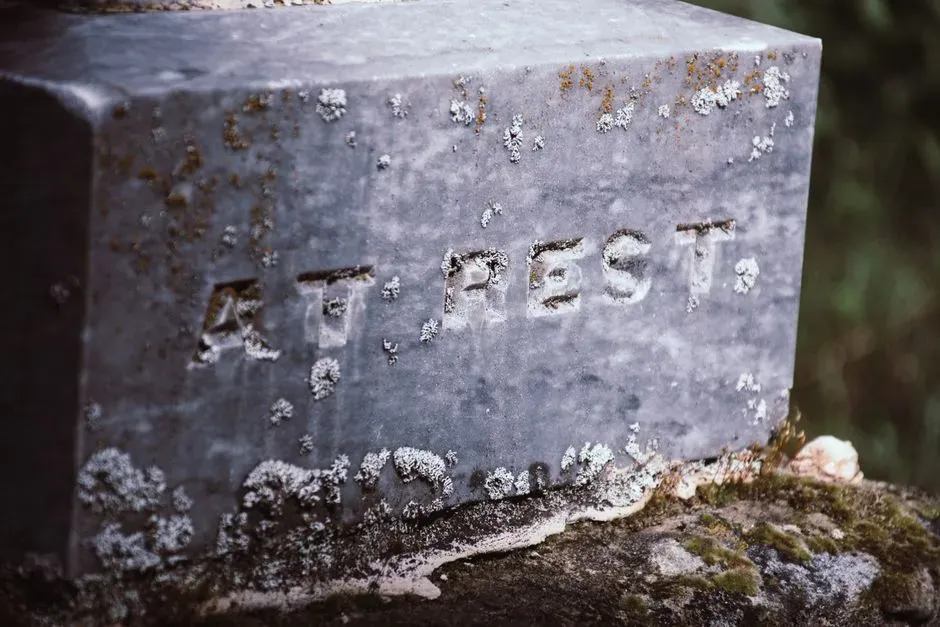
Some of the strangest discolorations on gravestones are caused by bacteria you’ll never see directly. Iron-oxidizing bacteria, for instance, can create brownish or rusty staining when they metabolize iron in the stone or in water running over it. Other bacterial communities can generate reddish, orange, or even faint violet tones, depending on the minerals and environmental conditions.
These microbes form part of complex biofilms, not unlike the ones you might see on river rocks or damp concrete. On gravestones, they usually appear where water flows regularly: under metal fixtures, around rusty flower stand bases, or along channels where rain drains off the top. Over time, their metabolic products can alter the chemistry of the stone surface and encourage further biological colonization.
We tend to think of bacteria only in the context of disease, but here they are more like invisible engineers, changing color and texture in ways that can be surprisingly artistic. Unfortunately, what looks like a delicate watercolor stain can be a sign that the stone’s outer layers are chemically breaking down faster than they should.
- Cause colorful staining linked to mineral metabolism
- Flourish in areas with consistent water flow
- Contribute to chemical weathering at the microscopic level
#13: Airborne Spores, Pollen, and Dust – The Quiet Coating
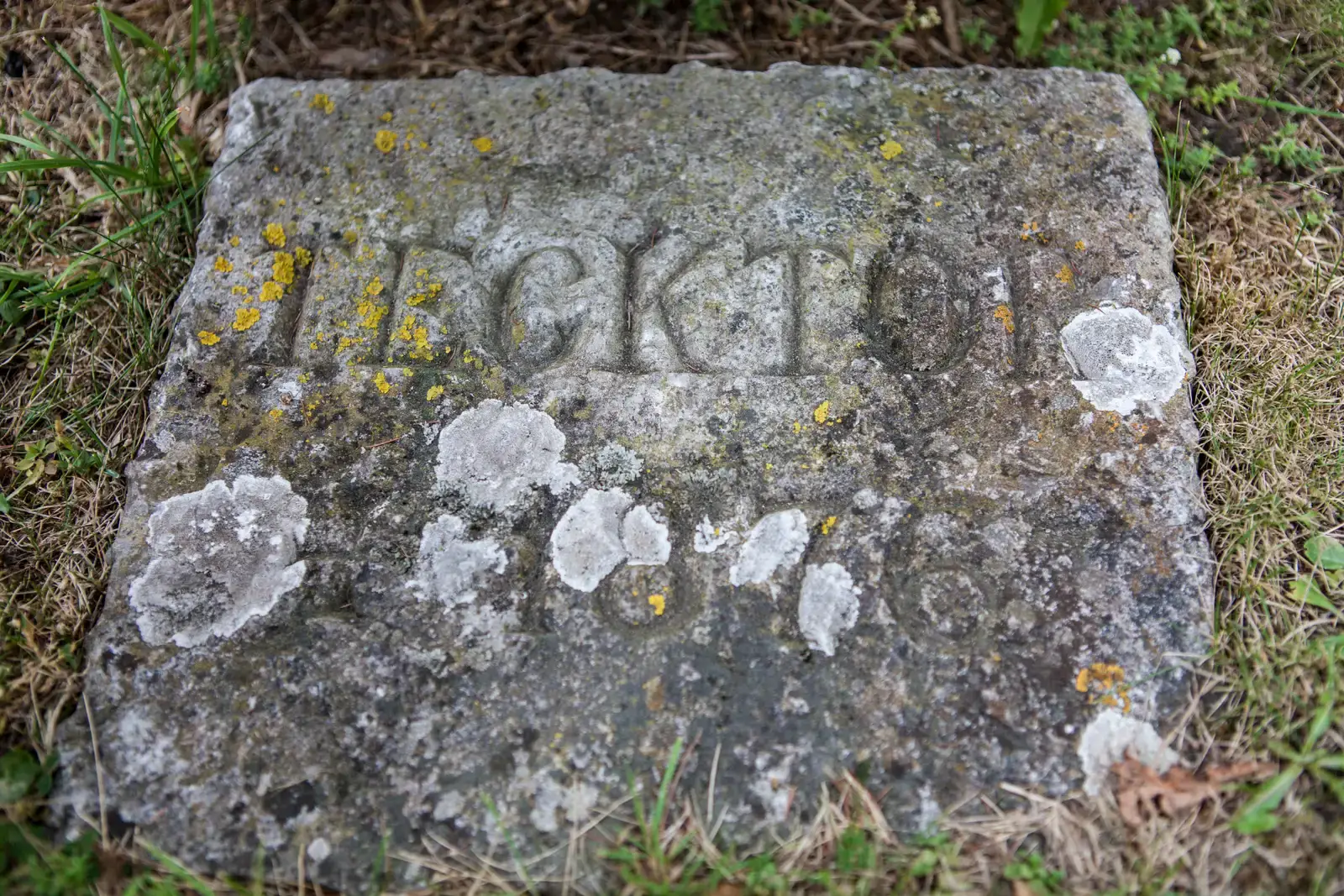
Not everything “growing” on a gravestone is truly alive and rooted there. A lot of what you see, especially during certain seasons, is a coating of airborne material that has landed and stuck: pollen grains, fungal spores, fine dust, and bits of organic debris. In spring, a pale yellow film on horizontal stones in some parts of America is often tree pollen, not paint or lichen.
These layers might seem harmless, but they can act as a buffet for other organisms. Dust and pollen provide nutrients that feed bacteria, fungi, algae, and lichens. Mixed with rain, they create a slightly sticky, nutrient-rich sludge in micro-depressions and carved letters. That sludge is exactly what pioneering microbes need to gain a foothold on that otherwise sterile rock.
In older graveyards, especially those near farmland or forests, gravestones effectively become passive collectors of whatever the surrounding ecosystem throws at them. In that sense, every old stone holds a record not just of the person buried there, but of a thousand tiny seasonal events: spring pollen bursts, dry summer dust storms, fungal spore releases after autumn rains.
#14: Human-Introduced Ornamentals – Flowers That Refuse to Leave
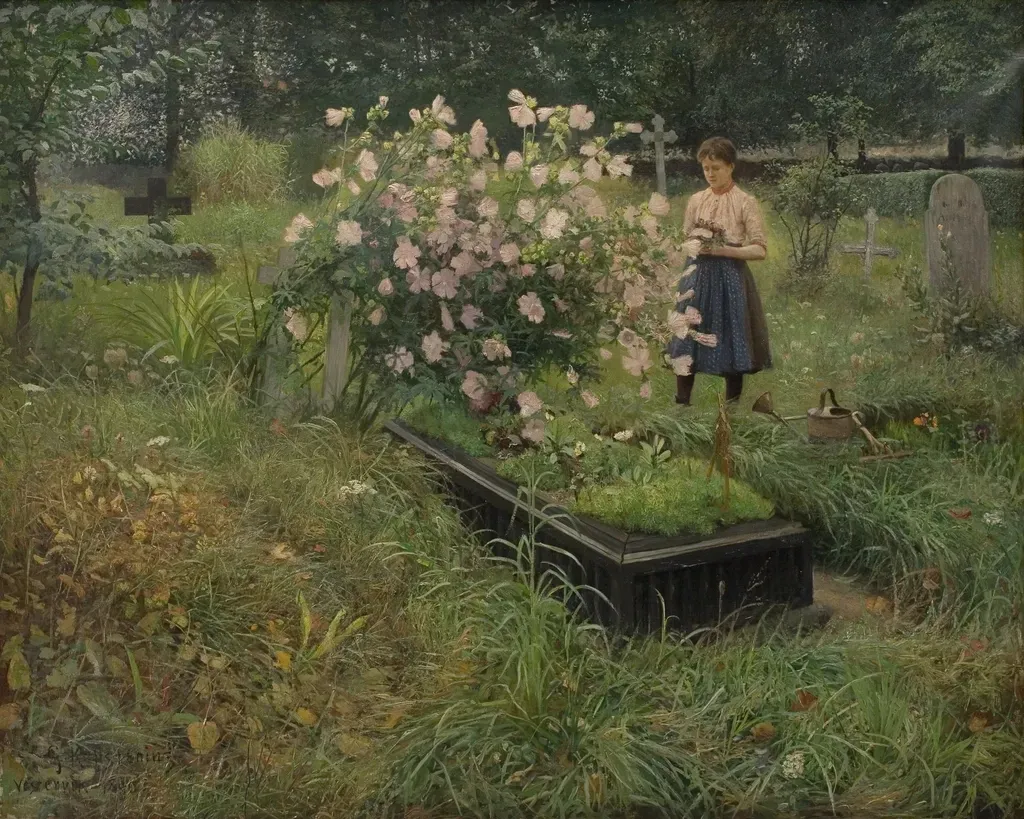
Finally, one of the most poignant is not wild at all: it’s the descendants of plants someone chose on purpose. Perennials like daylilies, irises, hostas, peonies, or even rose bushes can outlast the people who planted them by generations. When maintenance declines, these ornamentals often spread beyond their original neat borders.
I have seen stone markers completely framed by runaway iris clumps, or roses weaving themselves between fences and stones, long after anyone alive remembers who bought them. Sometimes, bulbs planted in rings around a family plot pop up every spring, even when the stones themselves are leaning and lichen-covered. Those flowers become accidental markers of love that persisted longer than expected.
Of course, ornamentals can also cause damage. Persistent roots can shift stones, and dense foliage can trap moisture and shade surfaces, speeding up biological colonization. But unlike invasive vines or weed trees, these plants carry an emotional weight. They are living echoes of care, grief, and remembrance, still doing their thing in a world that mostly moved on.
- Perennials and shrubs often outlive active cemetery caretakers
- Spread beyond their original planted locations
- Symbolize enduring, if unintended, remembrance
Conclusion: When Memory and Nature Share the Same Stone
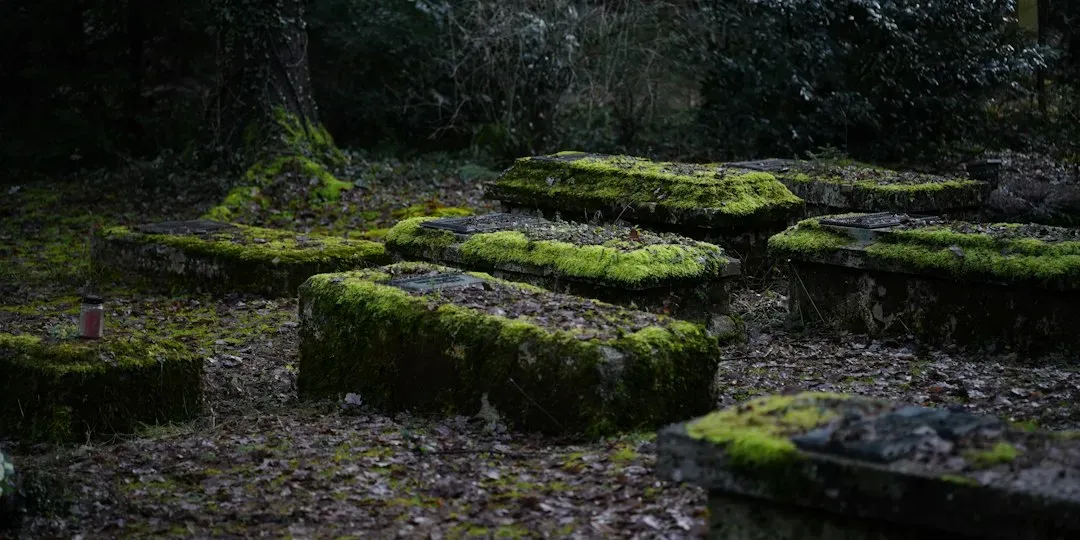
Old American gravestones were never meant to stay pristine forever. We carve names into marble and granite as if they will stand against time unchanged, but nature has other plans. Lichens, mosses, algae, vines, trees, and invisible microbes all see a gravestone not as a monument, but as usable real estate – a place to live, feed, and slowly transform.
There’s a tension here that I think we need to be honest about. Part of me wants every inscription to stay crisp and legible so that nobody is forgotten. Another part of me finds it deeply moving when a stone is half-claimed by moss and ivy, like the earth gently pulling one of its own back into the landscape. Pretending that cemeteries should look like sterile marble showrooms feels, frankly, a bit unrealistic and even cold.
Maybe the real respect lies in balance: caring enough to keep stones from collapsing or vanishing under aggressive growth, while accepting that a patina of life is inevitable – and maybe even beautiful. Next time you wander through an old graveyard and see something growing on a headstone, it might be worth pausing before calling it “damage.” Is it only decay, or is it also a reminder that nothing, not even stone, stands outside the living world for long?
In the end, these 14 things growing on old gravestones are telling us a quiet truth: memory and nature do not live in separate realms; they share the same fragile surface. When you picture an old grave now, do you see an isolated stone, or a living, changing part of the landscape around it?