You might not think of Missouri when you imagine dinosaur territory. Most people picture the badlands of Montana or the deserts of Utah, right? The Midwest doesn’t exactly scream prehistoric giants. Yet beneath the hills and forests of southeastern Missouri lies one of the most remarkable dinosaur discoveries east of the Mississippi River.
Missouri’s dinosaur story is truly one of a kind. The Chronister site, a couple dozen acres of woodland located near Bollinger County in Missouri, is the only place fossils have been found in Missouri, making every bone unearthed here exceptionally rare. Think about that for a second. While western states are practically overflowing with fossils, Missouri has just one location. That’s either incredibly unlucky or incredibly fortunate, depending on how you look at it.
Parrosaurus missouriensis – The State Dinosaur
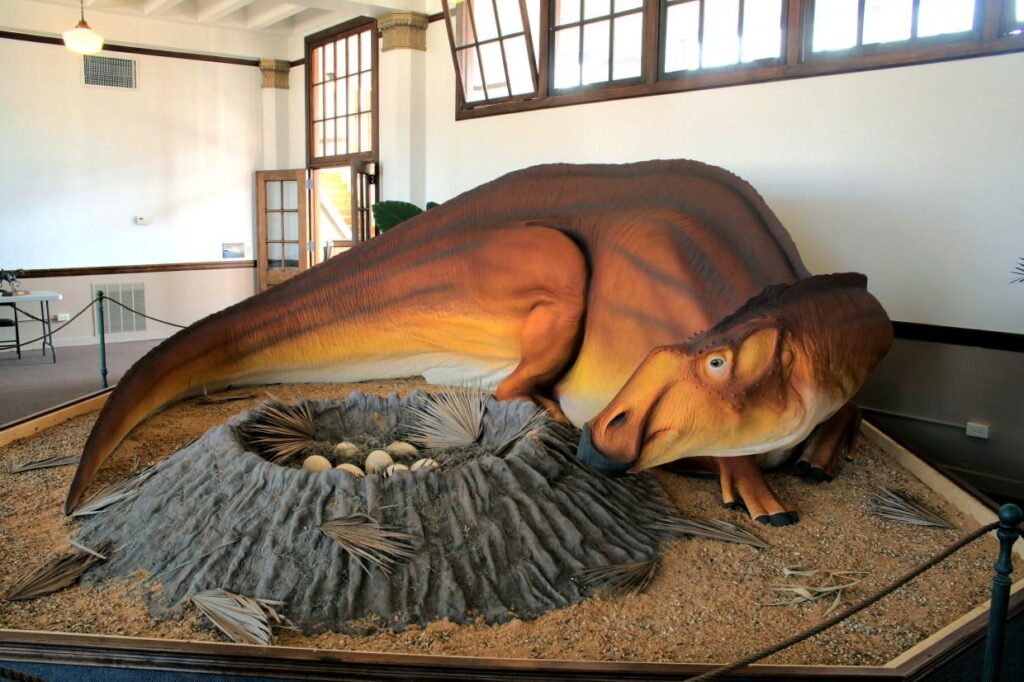
Hypsibema missouriensis (originally Neosaurus missouriensis, first renamed to Parrosaurus missouriensis) is a species of plant-eating dinosaur in the genus Hypsibema, and the state dinosaur of the U.S. state Missouri. Missouri became the sixth U.S. state to have designated an official state dinosaur, following Colorado, Maryland, New Jersey, Texas, and Wyoming, as well as the District of Columbia. This duck-billed creature has had more name changes than most celebrities, which tells you just how tricky dinosaur classification can be.
Parrosaurus missouriensis is a hadrosaur – a plant-eating duck-billed dinosaur having more than 1,000 teeth. The species is estimated to have had around 1,000 small teeth, weighed 3–4 short tons (or around as much as an elephant today), stood 10 feet tall at its back, and stretched about 30–35 feet from head to tail. Let’s be real, that’s massive. Picture something as heavy as an elephant but twice as long. The idea of these gentle giants munching vegetation in what’s now Missouri feels almost impossible.
Tyrannosauroidea – A Fearsome Relative
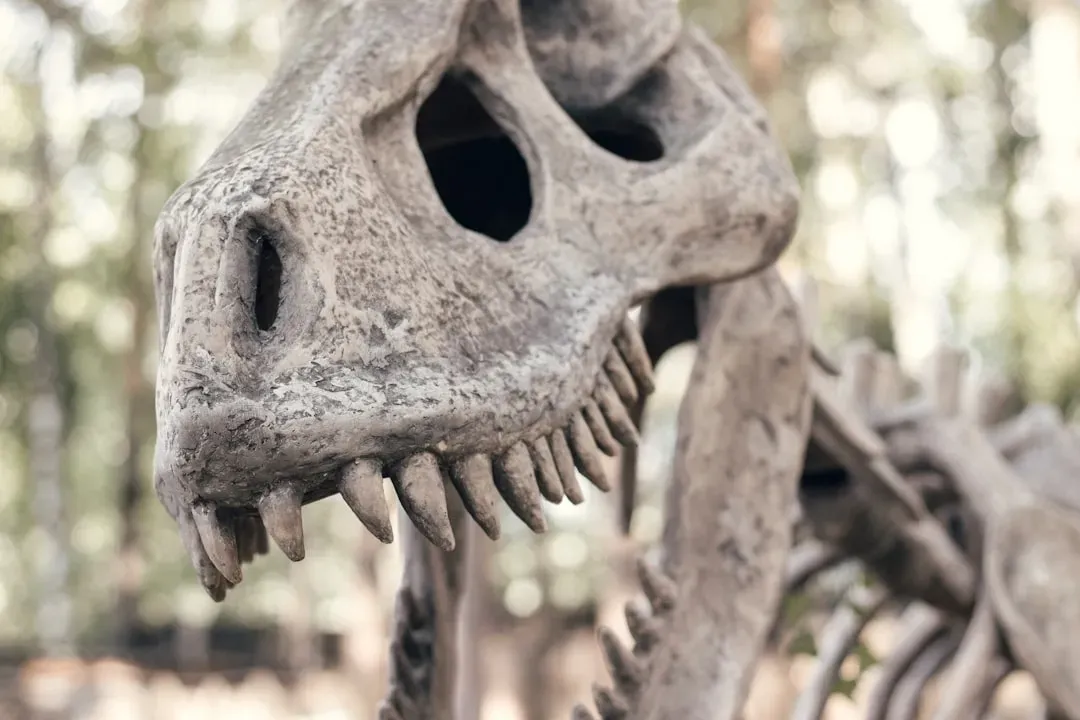
Remains of other dinosaurs, fish, turtles, and plants have also been found, including teeth belonging to a member of the Tyrannosauroidea. This finding is honestly thrilling. While not quite a full-blown T. rex, tyrannosauroids were still formidable predators that would make anyone think twice about a time-travel vacation to ancient Missouri.
From 1990 to 2009, they found about 170 fossils and dinosaur bone pieces, including a partial skeleton of an approximately 20-foot long juvenile Hypsibema missouriense; a tooth from a tyrannosaurid, a relative of the T. rex; and a tooth from a raptor. Finding a tyrannosaur tooth in Missouri suggests a complete food chain existed here. These weren’t just isolated creatures wandering through. There was a complex ecosystem with predators and prey coexisting along ancient shorelines.
Dromaeosauridae – The Raptor Connection
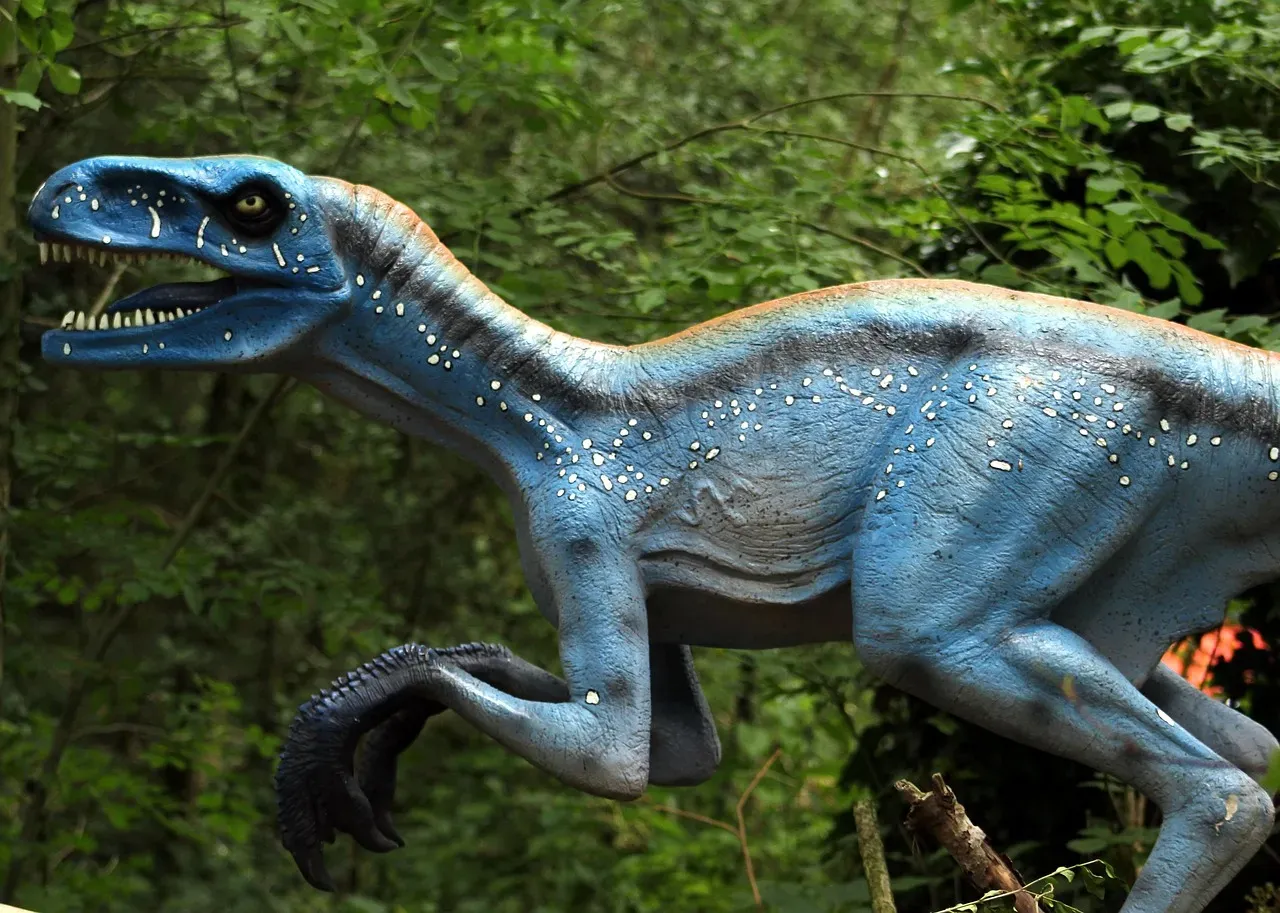
Bone fragments of a dromaeosaur have also been unearthed in this area. Dromaeosaurids, commonly called raptors, were the intelligent hunters that pop culture loves to dramatize. Generally, though, dromaeosaurids were small or medium feathery theropods. These dinosaurs were bipedal carnivores that probably chased down their prey.
It’s hard to say for sure, but the Chronister site raptor could have been turkey-sized or maybe large enough to look you straight in the eye. Some of them were the size of turkeys, like Velociraptor, while others were tall enough to look a human in the eye. The variety of sizes within this family makes identification challenging with limited fossil material.
Hadrosauridae – Unknown Duck-Bills
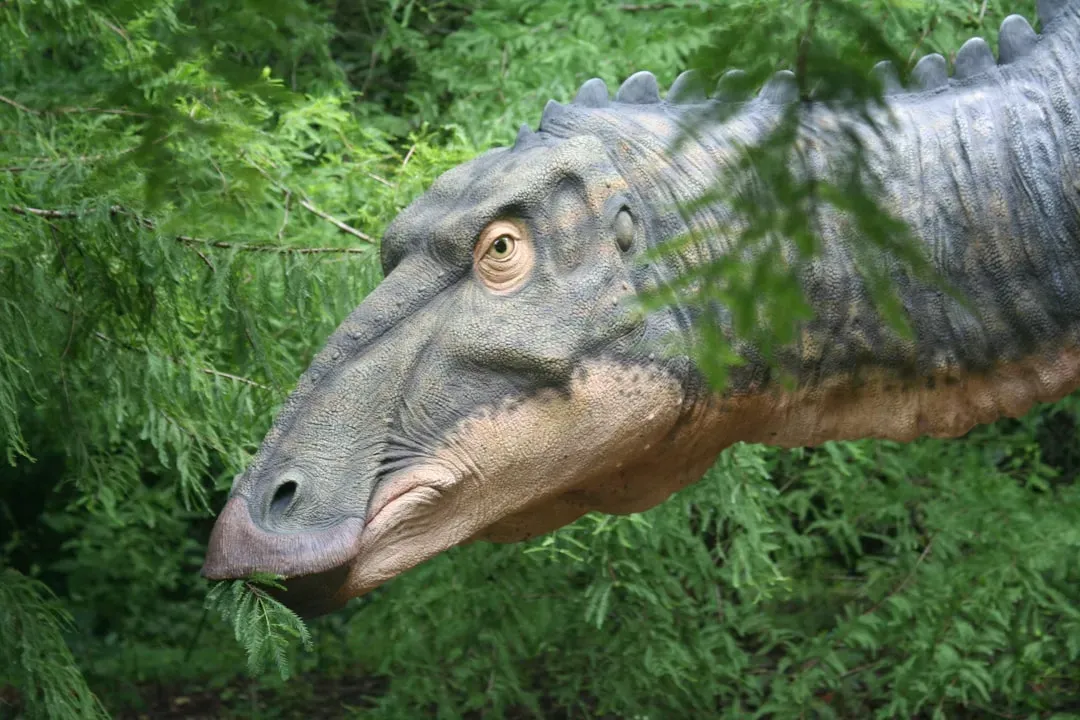
While the Parrosaurus missouriensis was clearly identified, remains of other unknown hadrosaurids were also found in Missouri. Given that the remains came from the same time as the Parrosaurus, the remains may have belonged to that species. This creates an interesting puzzle for paleontologists working the site.
Hadrosaurs, or duck-billed dinosaurs, were the most common large herbivores of the Late Cretaceous period across North America. They lived in herds, somewhat like modern-day bison, and likely migrated seasonally. The presence of multiple hadrosaurids at one location suggests Missouri was prime real estate for these plant-eaters roughly seventy million years ago.
The Miraculous Discovery at Glen Allen
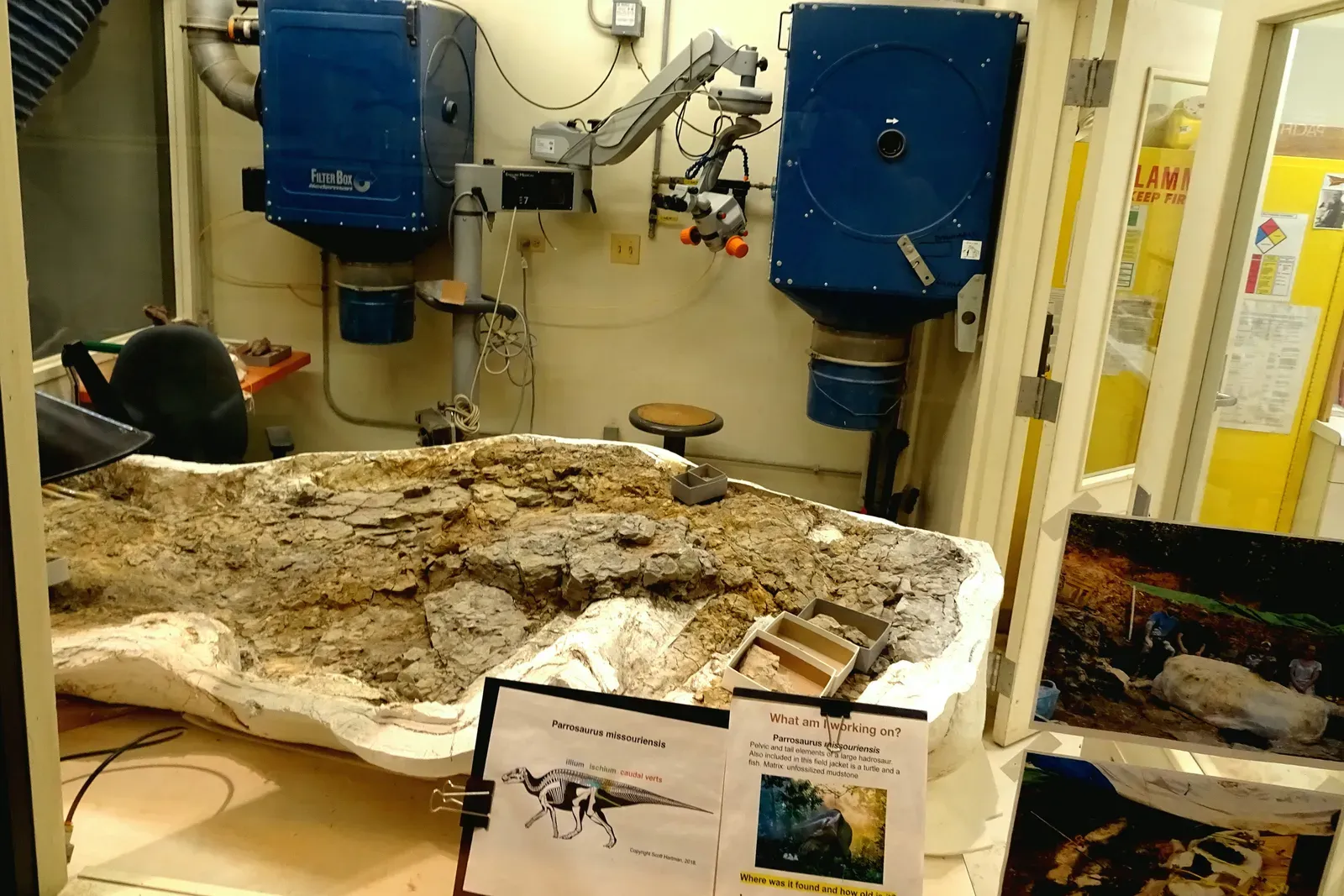
Remains of Hypsibema missouriensis were first discovered in Bollinger County, Missouri by members of the Chronister family while they were digging a cistern, and were subsequently collected by Stewart. In 1942, Stewart, of the Missouri Geological Survey, had been examining clay near Glen Allen when he came upon a boy who led him to the family at work digging. According to Stewart, property owner Lulu Chronister had found several “unusual” bones while digging and had saved them.
Stewart reported his discovery to the Smithsonian Institution, which bought the remains – thirteen vertebrae of a dinosaur’s tail – from Chronister for US$50, which was later used to purchase a cow. Imagine finding the first dinosaur bones ever discovered in your state and getting paid just enough for a cow. That’s quite the bargain from a modern perspective. One paleontologist from St. Louis currently working at the dig site said it was “pretty much a miracle” that dinosaur bones were found in Missouri, because the state’s soft soil has resulted in the deterioration of most prehistoric remains.
Where to See Missouri Dinosaur Fossils Today

Visit the Learning Center where you can see a large model of the dinosaur and others, and visit their lab where you can view scientific studies being conducted on dinosaur bones and real fossils. The Sainte Genevieve Museum Learning Center in Ste. Genevieve offers visitors a rare opportunity to watch paleontologists actively work on specimens. Genevieve Museum Learning Center also has a “Hall of Giants” area that has eight life-size floor-to-ceiling Lost World Studio models of other dinosaurs, such as the T-rex.
However, one can still see the bones and models on display at the Bollinger County Library, also in Marble Hill, and a few others a bit further at the Discovery Playhouse in Cape Girardeau and the Ste. Genevieve Museum Learning Center. Additionally, one of the town’s favorite life-size dinosaur models, named Elvis, is on permanent display along Highway 34 near the entrance to Marble Hill. The Missouri Institute of Natural Science in Springfield also features dinosaur exhibits and fossil dig opportunities. Meet a T-Rex, experience an earthquake, or dig for dinosaur bones at the Dana Brown Fossil Prep Lab and Dig Site at the Saint Louis Science Center for another interactive experience.
Missouri’s dinosaur legacy proves you don’t need vast desert landscapes to uncover prehistoric wonders. Sometimes the most extraordinary discoveries happen in the most unexpected places. What do you think it was like when those duck-billed giants roamed the wetlands that would one day become the Show-Me State?