Every time you think dinosaurs cannot possibly get any weirder, a new fossil crawls out of the rocks and proves you wrong. Over just the last decade or so, paleontologists have uncovered species that look less like the lumbering reptiles we grew up with and more like creatures that escaped from a fantasy role‑playing game or a sci‑fi concept artist’s sketchbook. We are talking bat‑winged “dragons,” diving raptors that behaved like ducks, and flamboyant show‑offs that would make a peacock look underdressed.
What makes these discoveries so gripping is that they are not movie monsters or game bosses, but real animals that walked, swam, or glided across our planet millions of years before humans existed. And unlike fiction, nature has to obey physics and biology, which somehow makes these forms even more mind‑bending. Let’s dive into five of the strangest dinosaur species described in roughly the last decade that push the boundaries of what we imagine a dinosaur can be.
1. Yi qi: The “Bat‑Winged” Dinosaur Dragon
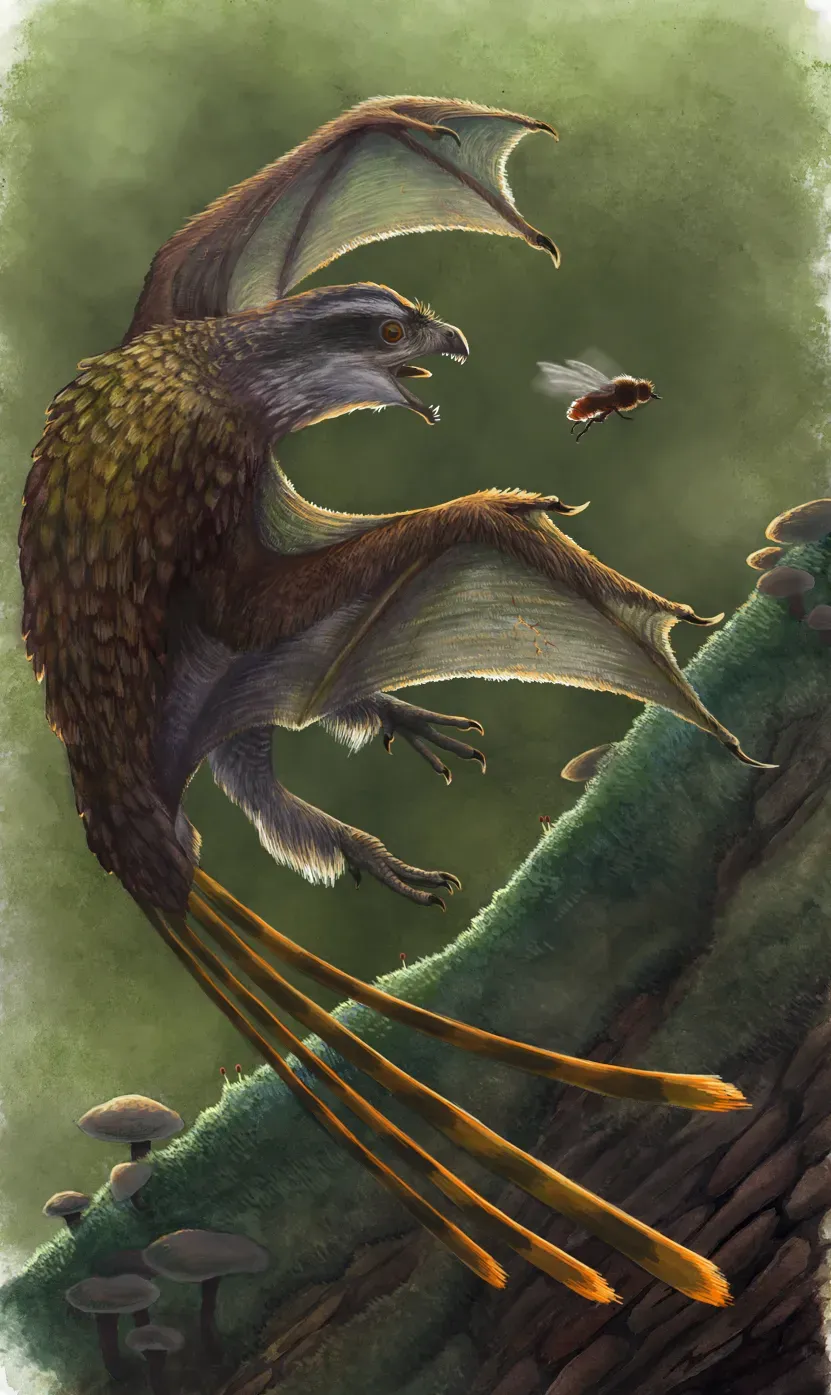
Imagine a crow‑sized dinosaur perched in a Jurassic forest, not with broad feathered wings like a typical bird, but with membranous sails stretched between its fingers like a bat or a fantasy dragon. That is Yi qi, a tiny theropod from China whose fossil was described in 2015 and immediately set paleontology social media on fire. Its name roughly means “strange wing,” and it lived about 159 million years ago, long before T. rex was even a bad idea. What made Yi qi so shocking was the discovery of an extra long rod‑like bone extending from its wrist, supporting a skin membrane that formed a wing unlike anything seen in other dinosaurs.
To make things even stranger, Yi qi also had feathers, but they were simple, paintbrush‑like filaments rather than the complex flight feathers we associate with modern birds. So you end up with this hybrid creature: part fuzz‑covered theropod, part bat, almost like evolution tried an experimental glider design and then never used that blueprint again. Scientists are still debating exactly how it moved through the air – was it a powered flier, a clumsy glider, or something in between? Whatever the final answer, Yi qi is one of those fossils that forces artists to redraw dinosaur posters and reminds us that evolution is much more creative, and much less conservative, than our childhood textbooks suggested.
2. Natovenator polydontus: The Diving “Duck‑Raptor”
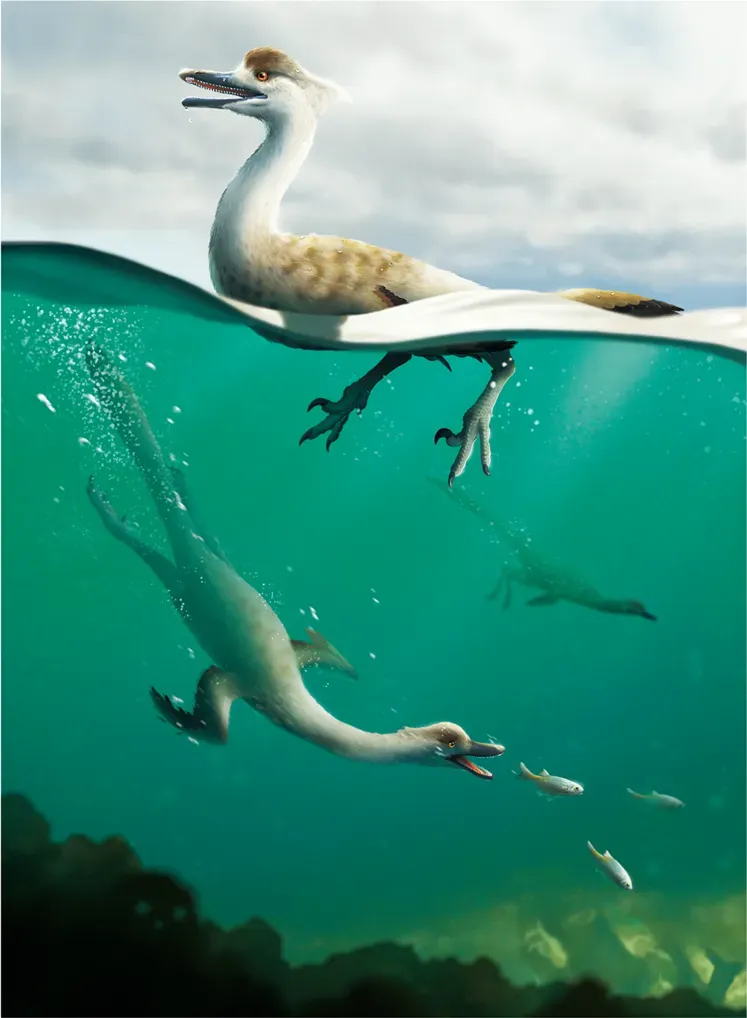
If Yi qi looks like it escaped from a dragon sketchbook, Natovenator polydontus feels like someone mashed up a Velociraptor with a diving bird. Described in 2022 from Late Cretaceous rocks in Mongolia, Natovenator belongs to the dromaeosaur family – the same broad group as Velociraptor – but its body screams “aquatic experiment.” It had a long, goose‑like neck, a narrow, streamlined torso, and a snout packed with numerous small teeth, more like a fish‑snapping bird than a land‑stalking predator. Its ribs sweep back in a way that suggests a hydrodynamic, torpedo‑shaped body built to slip through water efficiently.
Natovenator also sits in the same quirky branch of the dinosaur family tree as Halszkaraptor, another odd raptor originally interpreted as semi‑aquatic. Together, they hint at an entire lineage of small theropods that may have hunted like modern mergansers or cormorants, diving after fish and aquatic prey. For decades, people argued about whether non‑avian dinosaurs could really be strong swimmers, and Natovenator shoves that door wide open. It is one of those discoveries that makes you rethink the classic mental image of raptors as purely desert or forest sprinters; some of them, it seems, may have been paddling and diving like angry, toothy ducks.
3. Ubirajara jubatus: The Spear‑Shouldered Show‑Off
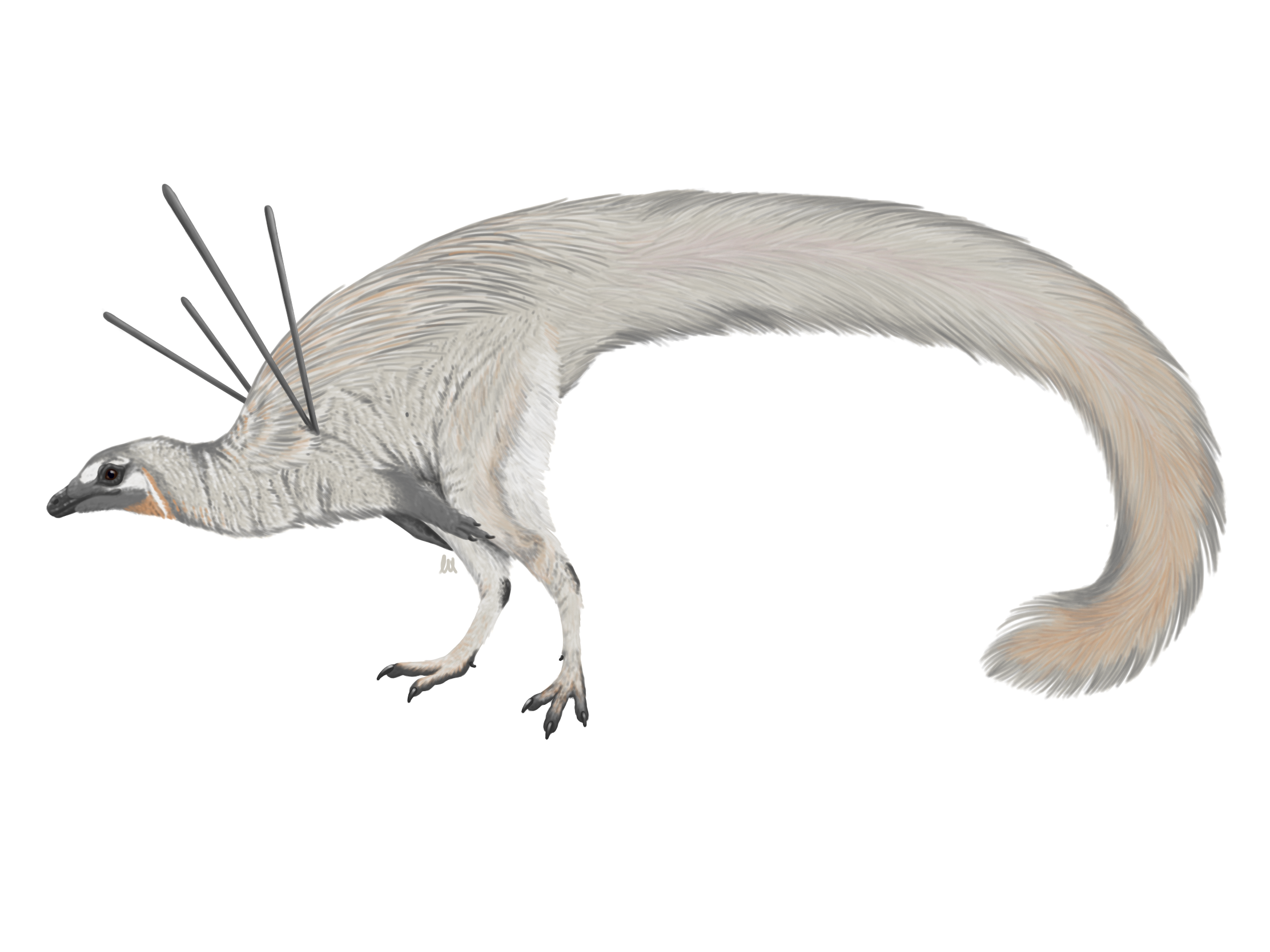
When the description of Ubirajara jubatus hit the scientific world in 2020, it read like someone had tried to design the most over‑the‑top cosplay dinosaur possible. This small theropod from the Early Cretaceous of Brazil was roughly the size of a chicken, but what it lacked in bulk it made up for in outrageous fashion. Its body carried a mane of hair‑like filaments down the back, and most famously, it had a pair of long, flattened, ribbon‑like structures projecting from each shoulder, stiff “spears” that pointed out and back from its body. Nothing else like this has ever been found in the dinosaur fossil record.
Those shoulder “spears” were almost certainly not weapons; they were display tools, the prehistoric equivalent of a light‑up festival outfit or an enormous feathered headdress. Many researchers interpret Ubirajara as a dramatic example of sexual selection in action, where looking impressive to potential mates mattered as much as escaping predators. There is also a very human side to this fossil: it sparked heated debate about colonialism in science, fossil export laws, and the ethics of collections held far from where they were found. So Ubirajara is not just visually wild; it also forced the field to confront how we handle the fossils of such extraordinary creatures in the modern world.
4. Fujianvenator prodigiosus: The “Weird” Near‑Bird That Bends the Rules
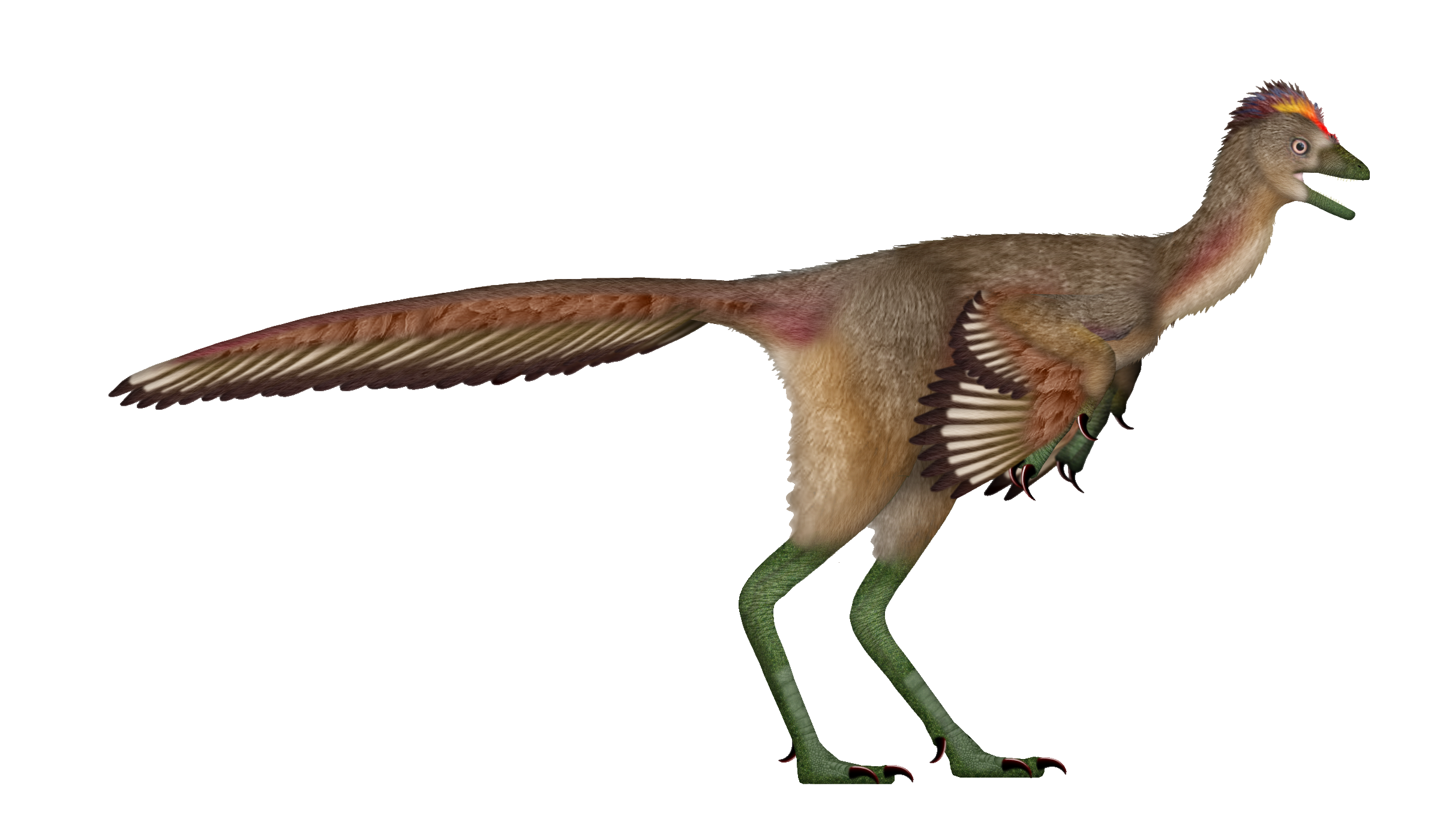
Fujianvenator prodigiosus, described in 2023 from southeastern China, is the kind of fossil that quietly wrecks neat evolutionary diagrams. It sits near the base of the bird lineage, in a group of small feathered theropods closely related to the first true birds. But instead of fitting smoothly into a tidy progression from ground‑runner to flier, Fujianvenator throws odd proportions and unexpected features into the mix. Its legs are unusually long and shaped in a way that has led some researchers to suggest it might have been adapted to life around wetlands, perhaps wading through shallow water or moving in a way quite different from other early bird‑like dinosaurs.
What makes Fujianvenator feel stranger than fiction is not just its bones, but what those bones imply about early bird evolution. Textbooks often present bird origins as a straight, upward climb from primitive dinosaur to modern sparrow, but fossils like this show it was more like a tangled bush of experiments. In that bush, Fujianvenator looks like one of the weirder offshoots – a creature that may have mixed birdlike traits with a lifestyle closer to a heron or rail. To me, it underlines a simple, unsettling idea: if you went back to the Jurassic and watched these creatures in real life, most of them would not fit comfortably into any of the labels we use today. They would just be…their own thing.
5. Halszkaraptor escuilliei: The Franken‑Mix of Raptor, Swan, and Penguin
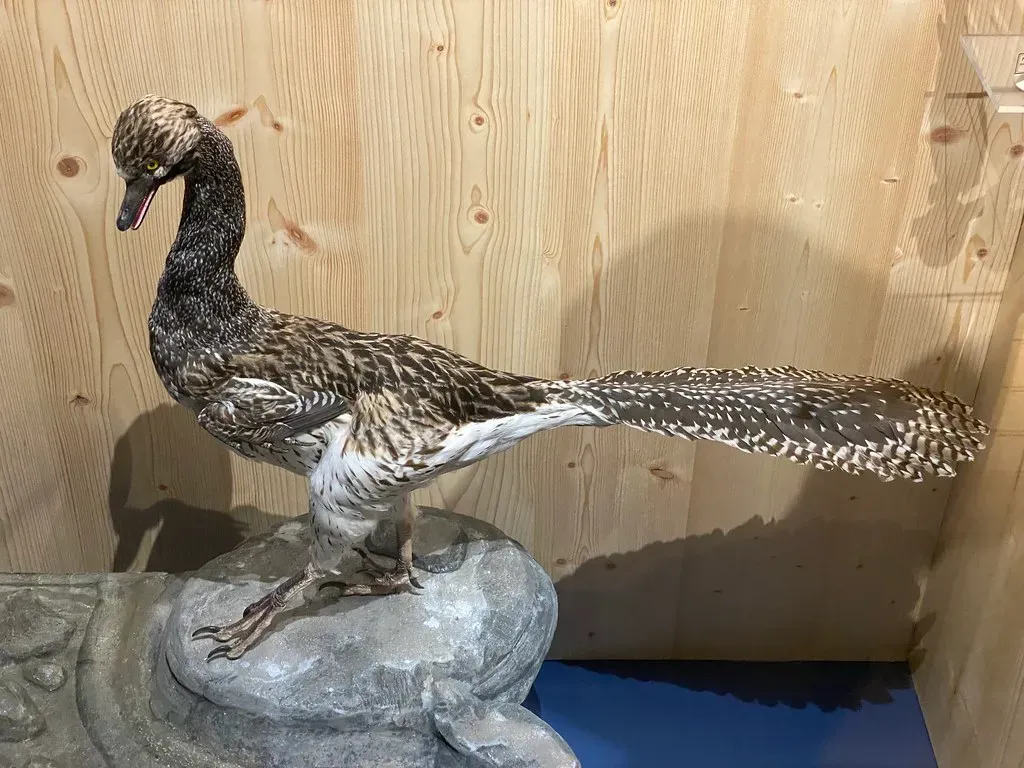
Halszkaraptor escuilliei was formally described in 2017, and even though that is now pushing slightly beyond a strict ten‑year window, it continues to shape how we think about “weird” dinosaurs and ties directly into discoveries like Natovenator. This small theropod from Mongolia looks at first glance like a Velociraptor that spent too much time watching water birds. It had a slender, swan‑like neck, a long snout with numerous teeth, and limb proportions that suggest it might have paddled with its forelimbs, a bit like a penguin or modern diving bird. When scans confirmed that the fossil was not a composite fake, paleontologists were left with a very real animal that seemed to fuse traits from raptors, ducks, and aquatic reptiles.
Halszkaraptor’s lifestyle is still debated, but there is growing support for the idea that it was at least partly adapted to life in and around water, perhaps hunting fish or small aquatic prey. That alone is wild: the same broader group that gave us sickle‑clawed land predators appears to have produced a semi‑aquatic cousin experimenting with a different ecological niche. When you place Halszkaraptor alongside Natovenator, you start to see a picture of an entire little radiation of “water raptors” that would have looked totally ridiculous – and totally believable – on the shores of Late Cretaceous lakes and rivers. Honestly, if a video game designer handed in concept art of this animal ten years ago, a lot of us would have told them to tone it down.
Conclusion: Real Dinosaurs Still Outweird Our Imaginations
Looking at Yi qi, Natovenator, Ubirajara, Fujianvenator, and Halszkaraptor side by side, it is hard not to feel that fiction has been playing it safe. Dragons in fantasy novels rarely bother with half‑feathers, experimental membranes, or spear‑like shoulder ribbons, yet the fossil record happily serves all of that and more. As someone who grew up on the classic “big scaly lizard” image of dinosaurs, I still get a small shock every time a new paper drops and reveals yet another animal that seems designed by a committee of overcaffeinated artists. The more we dig, the more the Mesozoic world looks like a mash‑up of a bird sanctuary, a reptile house, and a costume parade.
In my view, we are nowhere near the ceiling of dinosaur weirdness; if anything, these last‑decade discoveries are a teaser trailer. There are countless rocks we have not cracked open yet, and somewhere inside them might be a glider that makes Yi qi look plain, or a water‑adapted predator that makes Natovenator seem conservative. That is the thrill of following paleontology in 2026: every new fossil has the potential to rewrite the mental movie you play when you hear the word “dinosaur.” So the real question is not whether nature can top our fiction – it clearly can – but which long‑buried creature will be the next to prove it. Which one of these would you have sworn was too strange to be real?