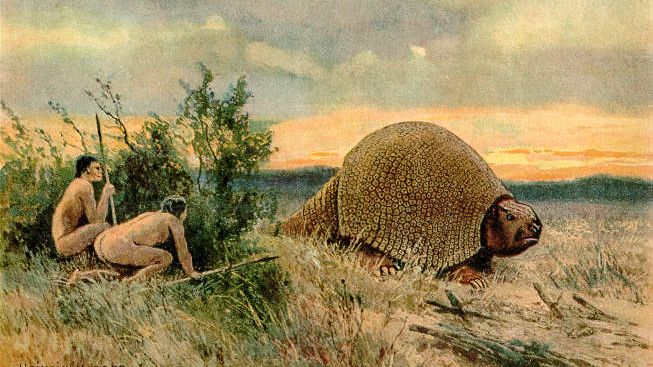
Picture the landscape of North America roughly 15,000 years ago. No cities, no highways, no fences. Just sprawling grasslands, ancient forests, and a cast of creatures so jaw-dropping wild that they make today’s wildlife look almost tame by comparison. You might think of Africa when you imagine lions, camels, and giant predatory cats, but the truth is, North America once had all of that, and then some.
When the glaciers receded in the late Pleistocene, North America was home to dozens of thriving species of extra-large mammals known as megafauna. Most of them vanished without a trace in geological terms, gone nearly overnight. What remains are fossils, a few frozen mummies, and a haunting sense that we barely knew what we had. So buckle up, because the continent beneath your feet has one of the most spectacular and underappreciated prehistoric histories on Earth. Let’s dive in.
The Woolly Mammoth: A Giant That Outlived Your Assumptions
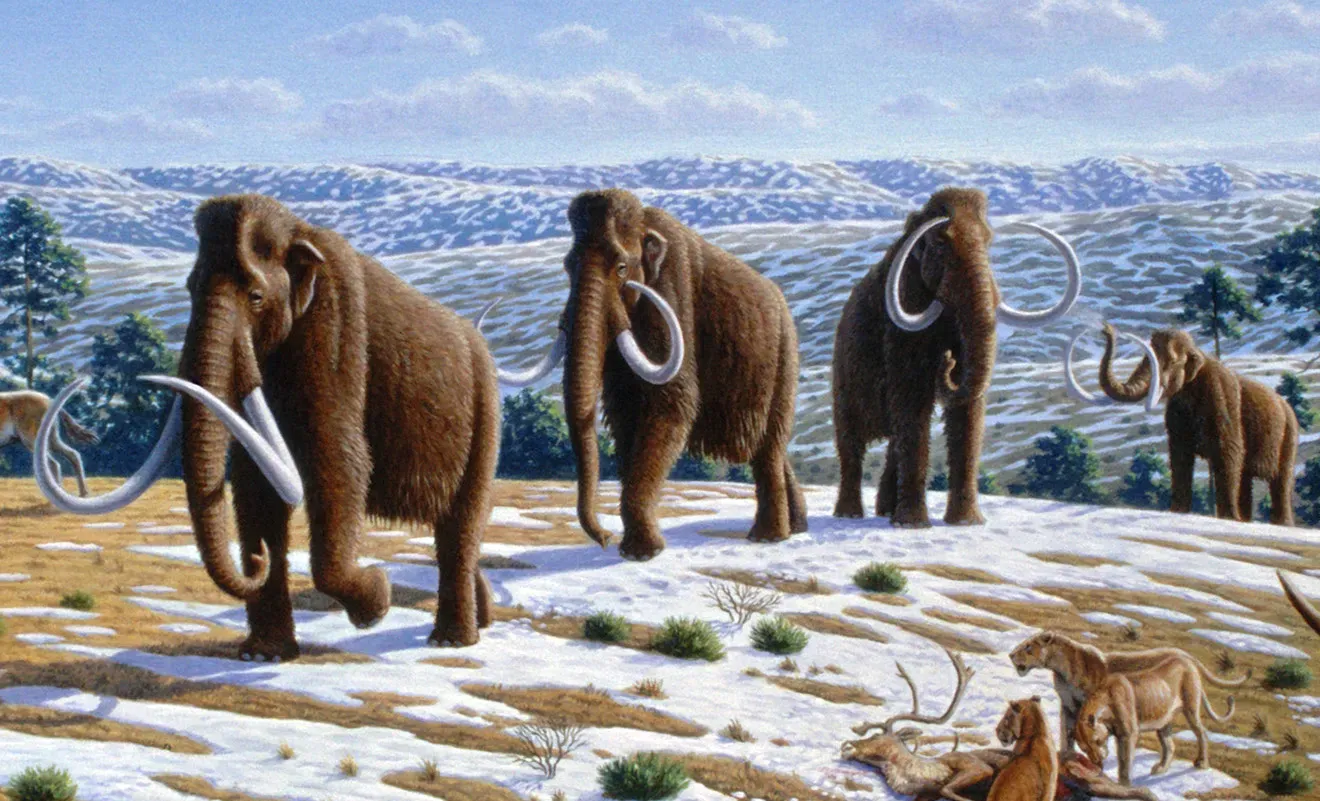
Here’s the thing about woolly mammoths that almost nobody talks about: they weren’t as ancient as most people think. The woolly mammoth stood 12 feet tall at the shoulders and weighed six to eight tons, grazing the northern steppes of Ice Age North America using its colossal, 15-foot curved tusks to dig under the snow for food and defend itself against predators. That already paints a picture of something formidable, something that would have made the ground tremble with every step.
Nearly all mammoths and mastodons were wiped out in the great megafauna extinction 10,000 years ago, but archeologists have dug up remains showing that lone bands of mammoths still roamed arctic islands as recently as 4,500 years ago. Think about that for a moment. Woolly mammoths were still alive while ancient Egyptians were constructing the great pyramids. That timeline is honestly mind-bending, and I think it deserves far more attention than it gets.
The American Mastodon: Not Just a “Smaller Mammoth”
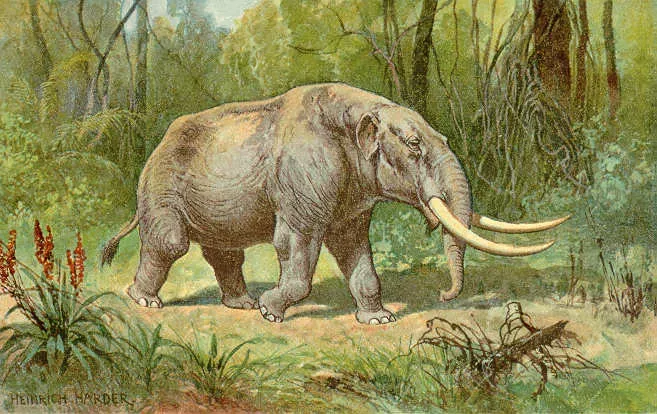
People often lump mastodons and mammoths together, which is a bit like confusing a grizzly bear with a polar bear. They’re related, sure, but very different animals. The American mastodon is the most ancient of the North American “elephants.” Its ancestors crossed the Bering Strait from Asia roughly 15 million years ago and evolved into the American mastodon 3.5 million years ago. That is an almost incomprehensible span of time on this continent alone.
The mastodon was shorter and stockier than the later mammoths, and the shape of its teeth indicate that mastodons didn’t graze on grass like mammoths, but ripped off leaves and entire tree branches for food. Picture it like a prehistoric lumber machine pushing through dense Ice Age forests. What makes this even more striking is that the bones of at least 140 mastodons and 18 mammoths have been found in New York state alone, suggesting these animals were everywhere across the continent, not just in the frozen north.
Smilodon: The Saber-Toothed Cat That Was Never a Tiger
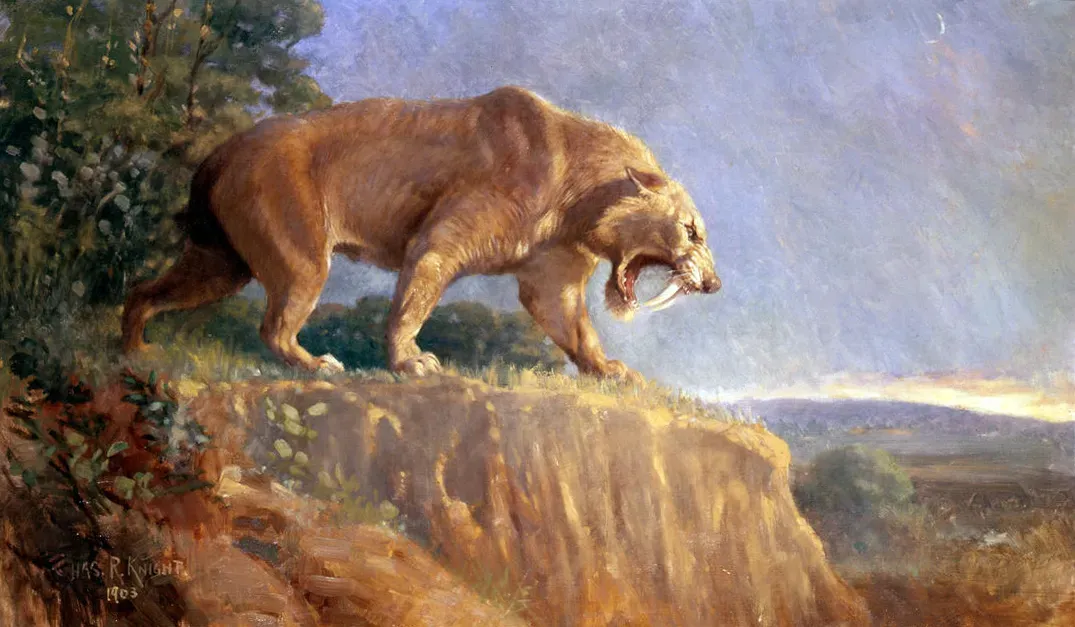
You’ve seen it on museum posters and in Hollywood films, but almost everything you think you know about the saber-toothed “tiger” is wrong. Although commonly known as the saber-toothed tiger, Smilodon was not closely related to the tiger or other modern cats, belonging to the extinct subfamily Machairodontinae, with an estimated date of divergence from the ancestor of living cats around 20 million years ago. Calling it a tiger is a bit like calling a bat a bird. The resemblance is superficial at best.
Its immense upper canine teeth, up to 20 cm long, were probably used for stabbing and slashing attacks, possibly on large herbivores such as the mastodon. Several physical adaptations suggest such a hunting technique: its skull was modified to accommodate the attachment of strong neck muscles for bringing the head down; the lower canines were reduced; and the molars formed shearing blades with no trace of grinding surfaces. Honestly, the more you learn about Smilodon, the more terrifying it becomes. Isotopes preserved in the bones of S. fatalis in the La Brea Tar Pits reveal that ruminants like bison and camels were most commonly taken by the cats there.
The Giant Short-Faced Bear: Fastest, Biggest, Deadliest
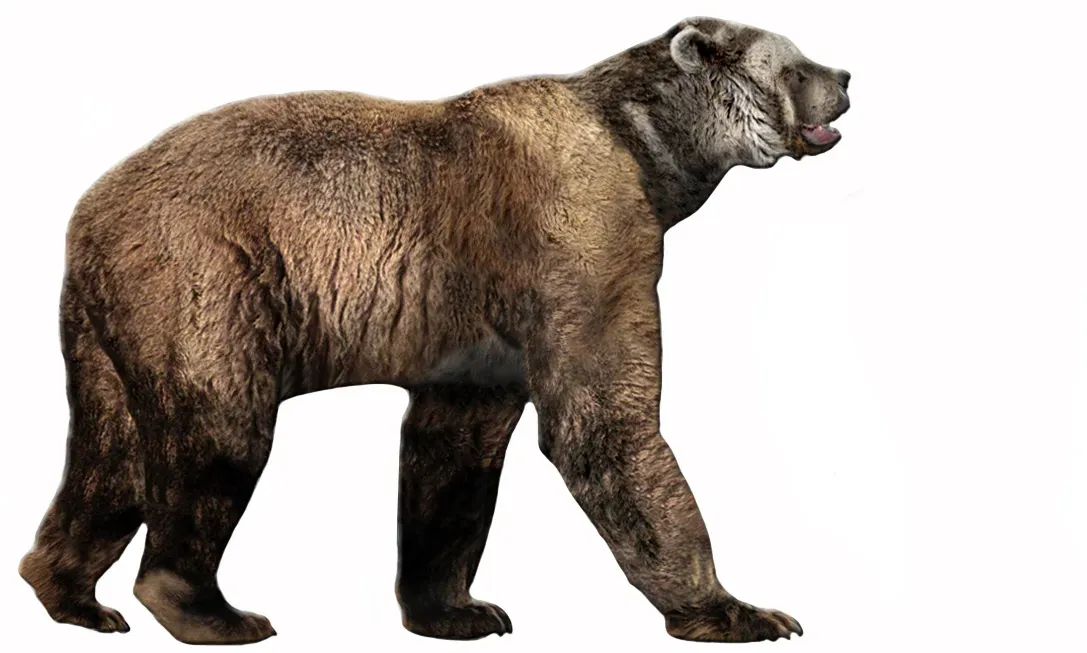
The illustration was originally uploaded by Dantheman9758 at http://dantheman9758.deviantart.com/art/Arctodus-simus-53736084, and later added to Wikimedia Commons by user: Ark., CC BY-SA 3.0)
Forget everything you know about bears. The giant short-faced bear, Arctodus simus, operated on a completely different scale. Also called the bulldog bear, the giant short-faced bear was undoubtedly the fastest running bear that ever lived. Rangier and longer legged than any bear today, it was about five feet at the shoulders when walking and stood as tall as 12 feet on its hind legs. Unlike pigeon-toed modern bears, its toes pointed straight forward, enabling it to walk with a fast, purposeful gait. It probably could run over 40 miles per hour despite weighing over 1,500 pounds. That combination of speed and size is almost unreal.
The giant short-faced bear was the largest carnivorous mammal to ever roam North America. Standing on its hind legs, an adult giant short-faced bear boasted a vertical reach of more than 14 feet. To put that in perspective, imagine a grizzly bear that could outrun a horse. Today considered to be an enormous omnivore, Arctodus simus is believed to be one of the largest known terrestrial carnivorans that has ever existed. Yet somehow, most people have never even heard its name.
The Dire Wolf: Real, Terrifying, and Nothing Like the TV Show
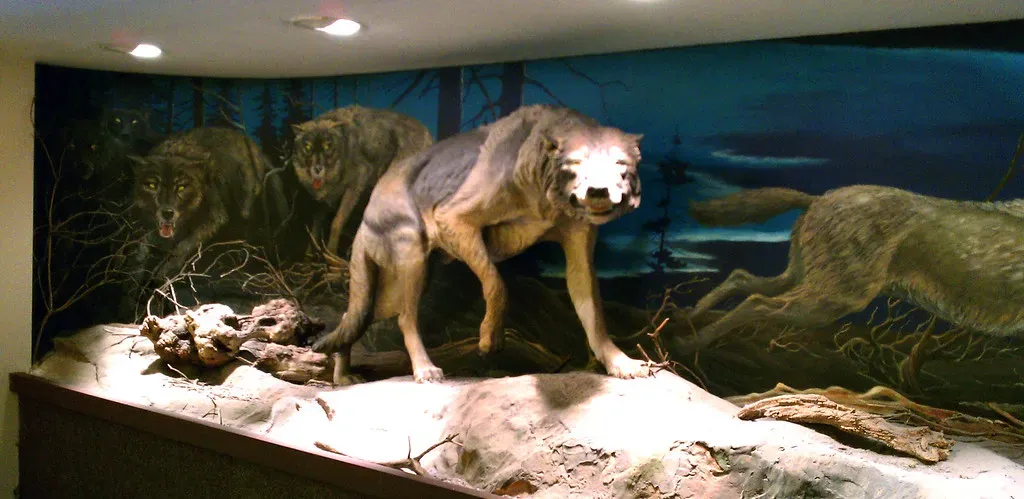
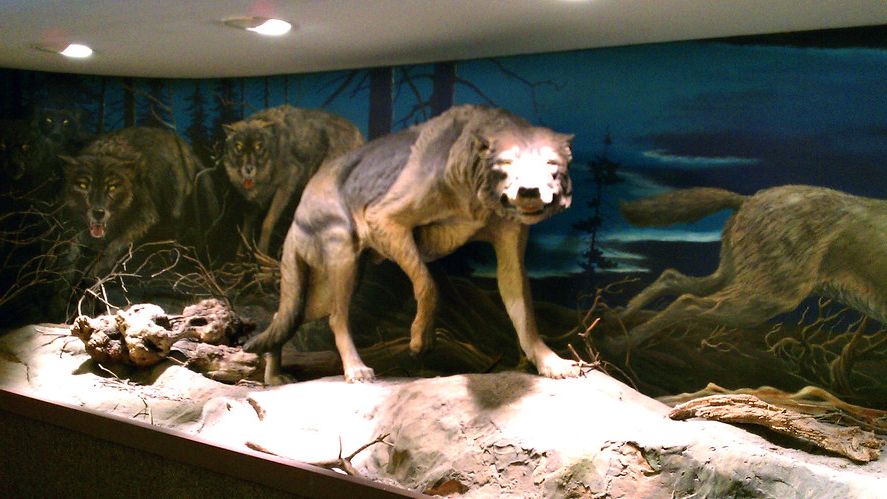
Long before any fantasy television show made dire wolves famous, these predators were very much a real and dominant force across ancient North America. Dire wolves are the largest of the Genus Canis group, which includes wolves, coyotes, jackals, and domestic dogs. That’s right, the largest canid that ever walked the earth wasn’t some fictional beast. It was right here, in what would one day become the United States.
Here’s a surprising twist though. Although often depicted as huge wolves in popular culture, the dire wolf was actually smaller than some living northern timber wolves, reaching five feet long and weighing around 110 pounds. Making up for their relatively small size, they had massive teeth and hunted in large packs. The dire wolves spread across North and Central America, coexisting with the smaller grey wolves, and were predominant hunters in California; remains of thousands have been recovered at the La Brea Tar Pits. Thousands of specimens, all trapped in sticky tar while chasing easy prey. It’s a sobering and strangely poetic end.
The Giant Ground Sloth: A Prehistoric Beast Thomas Jefferson Once Mistook for a Giant Cat
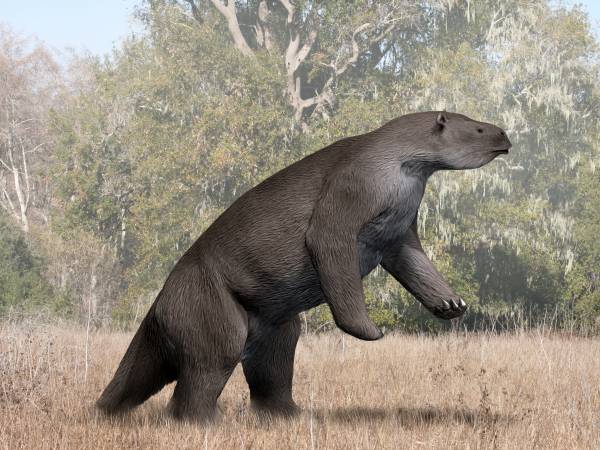
Today’s sloths hang upside down in tropical trees and move at roughly the speed of a sleepy toddler. Their ancient relatives were in a completely different league. In Ice Age North America, sloths were an entirely different beast. The giant ground sloths of the late Pleistocene were bear-sized herbivores that stood 12 feet on their hind legs and weighed up to 3,000 pounds. That’s not a slow, gentle tree-hugger. That’s a creature that could look you in the eye from the second floor of a building.
The story gets even stranger when you add a Founding Father to the mix. One giant sloth species, the Jefferson ground sloth, was named for Thomas Jefferson, who initially believed that sloth fossils were a type of colossal cat. Jefferson was wrong, but it’s easy to see how the fossils would have inspired wild guesses. The giant ground sloth evolved in South America around 35 million years ago and is estimated to have migrated into North America around 8 million years ago, making it one of the longest-running megafauna stories on the continent.
The Ancient North American Camel: Born Right Here, Not in the Sahara
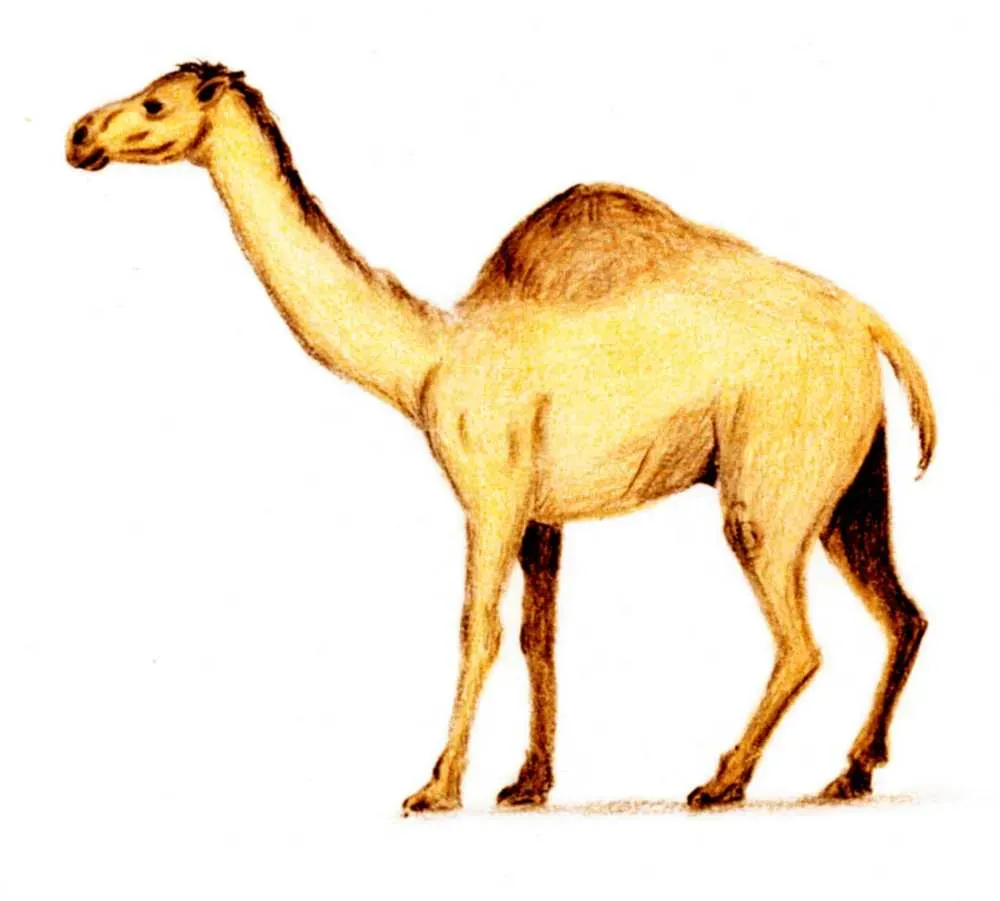
If someone told you camels are native to North America, you’d probably laugh. Most people associate camels with deserts in Africa and Asia, which makes this next fact genuinely shocking. The very first camels on the planet evolved in North America around 44 million years ago. North America didn’t import camels. It invented them. Every camel that has ever plodded across the Sahara or the Gobi Desert is ultimately descended from an animal that first appeared on this continent.
Those ancient camels migrated westward over the Bering land bridge around 7 million years ago, later becoming the one-humped dromedary and two-humped Bactrian camels of North Africa and Asia. Meanwhile, horses went extinct in North America alongside other megafauna at the end of the Pleistocene, some 10,000 years ago, only to be reintroduced by the Spanish conquest. It’s hard to say for sure which discovery is more surprising: that camels started here, or that horses had to come back. Either way, the ancient landscape of North America was far more exotic than most people ever imagine.
Conclusion: The Lost World Beneath Our Feet
![Conclusion: The Lost World Beneath Our Feet (Current version from the following site without attribution:[1] Previous version from NPS Foundation Document (archive), page 19 (no name is credited in the "Photo and Art Credits", page 42)original version stitched together from images credited to "NPS Photo" on NPS Paleontology page (archive) and NPS Fossilized Footprints page (archive), Public domain)](https://nvmwebsites-budwg5g9avh3epea.z03.azurefd.net/dinoworld/c57b29a82ed33b590420bf00b0f0b6db.webp)
North America’s prehistoric past is not some distant, irrelevant story. It is the story of this land. Around 70 percent of North America’s large animals have gone extinct, and with them went an entire ecological world that we are only now beginning to fully understand through fossil evidence and new science. From thundering mammoths to bear-sized sloths, from charging saber-toothed cats to fleet-footed giant bears, this continent was once as wildly alive as anywhere on Earth.
These megafauna thrived in the geological period called the Pleistocene epoch, which spans 1.8 million to 12,000 years ago. That is an extraordinary run. What ended it remains one of science’s most compelling debates, a combination of climate change, human arrival, and ecological collapse all weaving together in ways researchers are still untangling today. What’s undeniable is that the land you’re standing on was once shared with some of the most spectacular creatures to ever walk the planet. Doesn’t that make you look at an empty field a little differently? What do you think would surprise most people about prehistoric North America? Share your thoughts in the comments below.