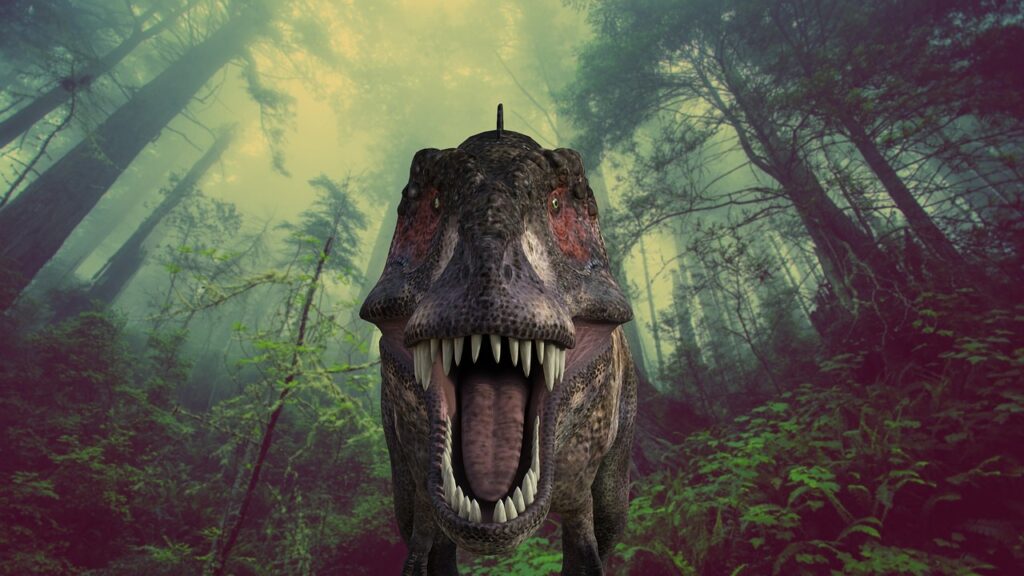
Most people, when they think of prehistoric predators, jump straight to T. rex or Velociraptor. Fair enough. Those creatures are legitimately terrifying. But here’s the thing – the dinosaurs were late to the party. Long before a single Tyrannosaurus set foot on this earth, there were killers stalking the oceans, skies, and ancient land masses that were just as devastating, and honestly, in some cases far stranger.
These were the original rulers. Creatures shaped by hundreds of millions of years of brutal evolutionary pressure. Some looked alien. Some looked like nothing alive today. All of them were utterly dominant in their time. Buckle up, because what you’re about to discover is going to surprise you. Let’s dive in.
1. Anomalocaris – The World’s First Super Predator
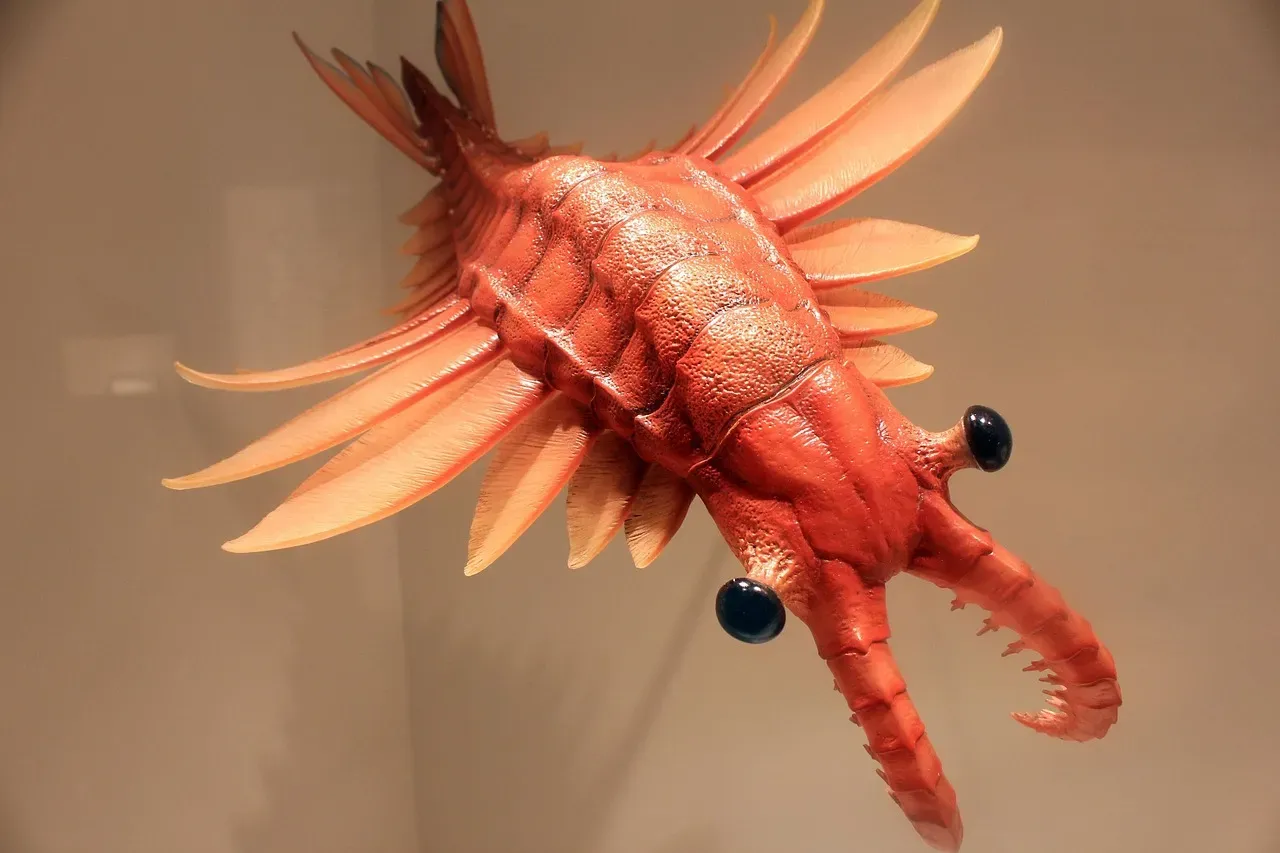
Here’s a fact that genuinely blows my mind every time I think about it: before killer whales and polar bears, before sharks and tyrannosaurs, the world’s top predator was probably a bizarre animal called Anomalocaris, living in the Cambrian period over half a billion years ago, when life was confined to the seas and animals took on bizarre shapes that haven’t been seen since. You can imagine it like the great white shark of its era, except it looked like nothing evolution had ever tried before or since. This bizarre-looking animal, whose name means ‘unusual shrimp,’ is widely regarded as the world’s first apex predator, measuring up to a metre in length from its grasping frontal appendages to the tips of its tail fans.
What made Anomalocaris so formidable wasn’t just size. Stalked, compound eyes with thousands of lenses gave it extremely sharp vision, its presumed undulating swimming motion made it a fast swimmer, and once it caught up to prey, it could grab using front limbs equipped with sharp spikes on each segment. There’s ongoing scientific debate about exactly what it ate, but it’s now believed Anomalocaris was a hunter that relied on speed, agility, and superior sight rather than strength. Most fascinatingly, as the first top apex predator, Anomalocaris may have been responsible for an early evolutionary arms race, forcing other animals to develop hard shells for protection. One predator. Entire evolutionary consequences.
2. Dunkleosteus – The Armored Nightmare of the Devonian Seas
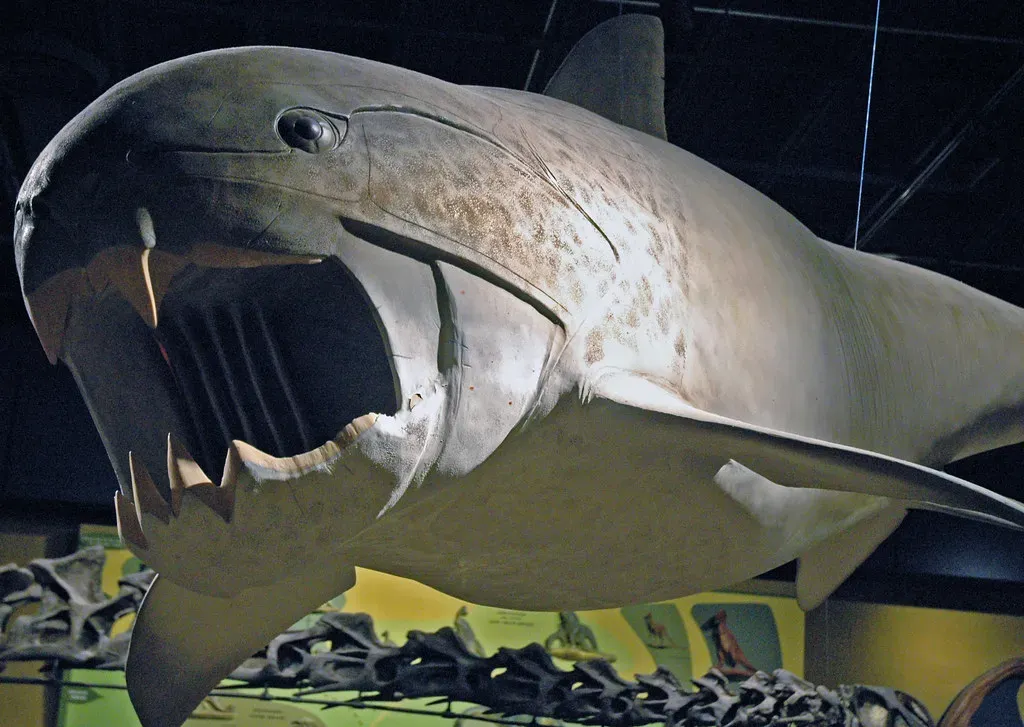
Dunkleosteus is an extinct genus of giant armored predatory fishes, known as placoderms, that lived in the Late Devonian roughly 382 to 358 million years ago, and is best known for its massive bony jaw plates forming a powerful biting apparatus and for being among the top marine predators of its time. Honestly, describing Dunkleosteus feels almost unfair to modern fish. This creature had no real teeth. Instead, like all placoderms, Dunkleosteus was toothless, but its armored jaw plates formed massive self-sharpening blades. Every time it opened and closed its mouth, the plates ground against each other and stayed razor sharp.
Despite lacking traditional teeth, its mouth could open in twenty milliseconds, creating a strong vacuum force that swept prey between its jaws, which featured two razor sharp slabs engineered by evolution to slice through bone, snapping shut with enormous bite force. Think of it like a biological bear trap that also reloaded itself automatically. The species Dunkleosteus terrelli was Earth’s first vertebrate “superpredator” and lived during the Age of Fishes, the Devonian Period, when North America was near the latitude of what is now Rio de Janeiro. Its reign came to an end when a series of mass extinction events at the end of the Devonian Period wiped out most of the animals existing at the time, including Dunkleosteus and other placoderms.
3. Dimetrodon – The Sail-Backed Hunter That Predates Dinosaurs by Tens of Millions of Years
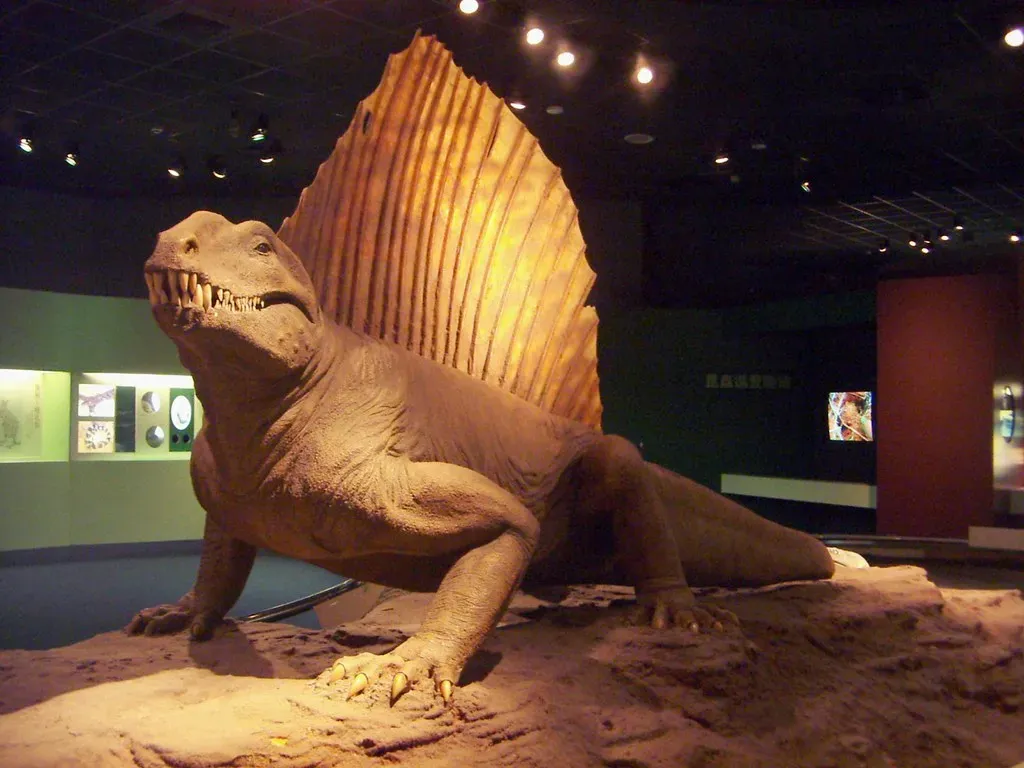
Ask most people to identify Dimetrodon from a picture and they’ll call it a dinosaur. You’d be forgiven. It looks the part – dramatic fin on the back, reptile-like body, fearsome teeth. Although Dimetrodon has been made popularly familiar as a dinosaur, often as the first creature described in children’s books about dinosaurs, it is not a member of the dinosaur family at all. Dimetrodon actually lived in the Early Permian period and so predates the dinosaurs by tens of millions of years. In fact, the Dimetrodon were more closely related to mammals than to dinosaurs, birds, and surviving reptiles. Wrap your head around that one.
Dimetrodon was the largest predator of its time, preying on giant amphibians nearly 300 million years ago during the Early Permian period. Its teeth were a key evolutionary innovation: Dimetrodon is one of the first terrestrial vertebrates to develop multiple types of teeth, including tightly compressed, recurved teeth with sharp cutting edges, known as ziphodont teeth, with scientists speculating this development was a result of a new, refined feeding style in which flesh is sheared from the bones by pulling instead of direct bone-crushing force. As for that iconic sail on its back, the sail, which was dense with blood vessels, was probably used to regulate body temperature, with the surface area allowing it to warm up or cool off more efficiently, giving the animal more time to hunt prey, and the sail may also have been used in mating rituals and to warn off other predators.
4. Inostrancevia – The First Saber-Toothed Terror on Land
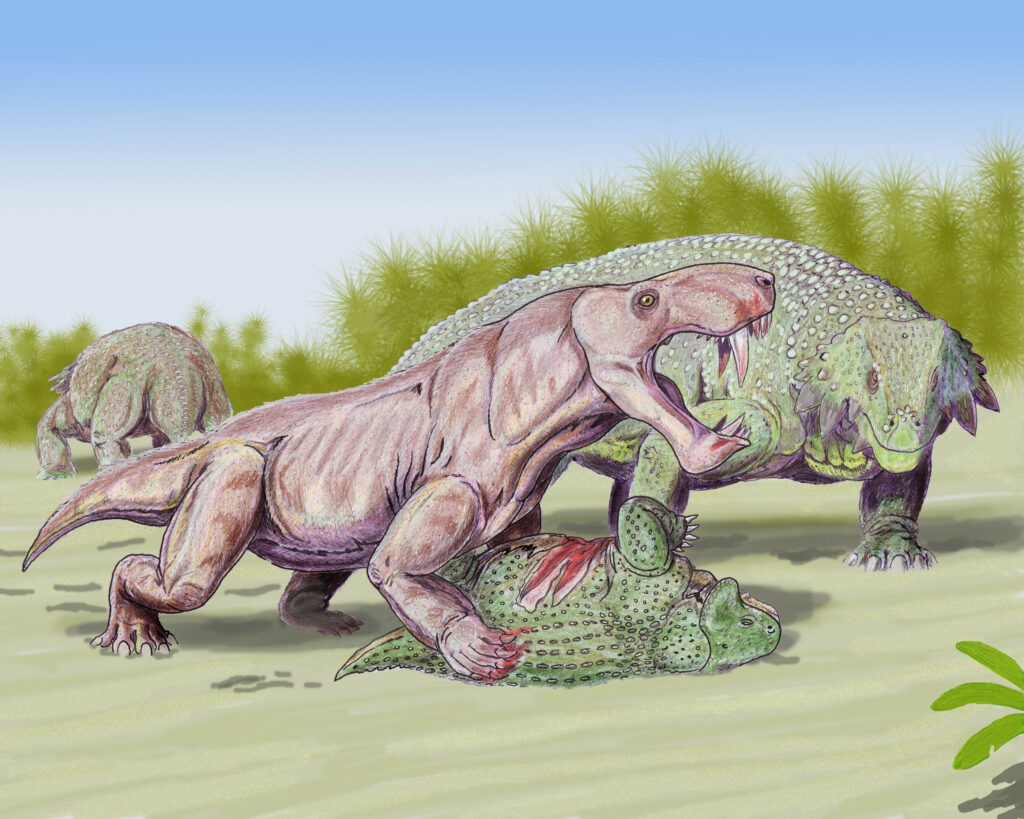
When you picture a saber-toothed predator, you probably think of the famous Smilodon of the Ice Age. But here’s the surprising truth: gorgonopsians were the first group of predatory animals to develop saber teeth, long before true mammals and dinosaurs evolved. And Inostrancevia was the crown jewel of this group. Inostrancevia was a tiger-sized, saber-toothed gorgonopsian that lived on the supercontinent Pangea during the Permian period, approximately 252 million years ago. The largest gorgonopsians attained massive, bear-like sizes, with Inostrancevia reaching up to 3.5 metres in length and 300 kilograms in body mass.
Its hunting strategy was something that would look oddly familiar today. For hunting large prey, gorgonopsians possibly used a bite-and-retreat tactic, ambushing and taking a debilitating bite out of the target and following it at a safe distance before its injuries exhausted it, and they would have had an exorbitant gape, possibly in excess of 90 degrees, without having to unhinge the jaw. Inostrancevia had very advanced dentition, possessing large canines, the longest of which could reach 15 centimetres, which may have been used to shear the skin of prey. What truly shocked paleontologists recently was the discovery that Inostrancevia migrated 11,300 kilometres across Pangea, filling a gap in a faraway ecosystem that had lost its top predators, before going extinct itself. Even at the edge of extinction, this creature was still finding new hunting grounds.
5. Meganeura – The Sky’s First Apex Predator
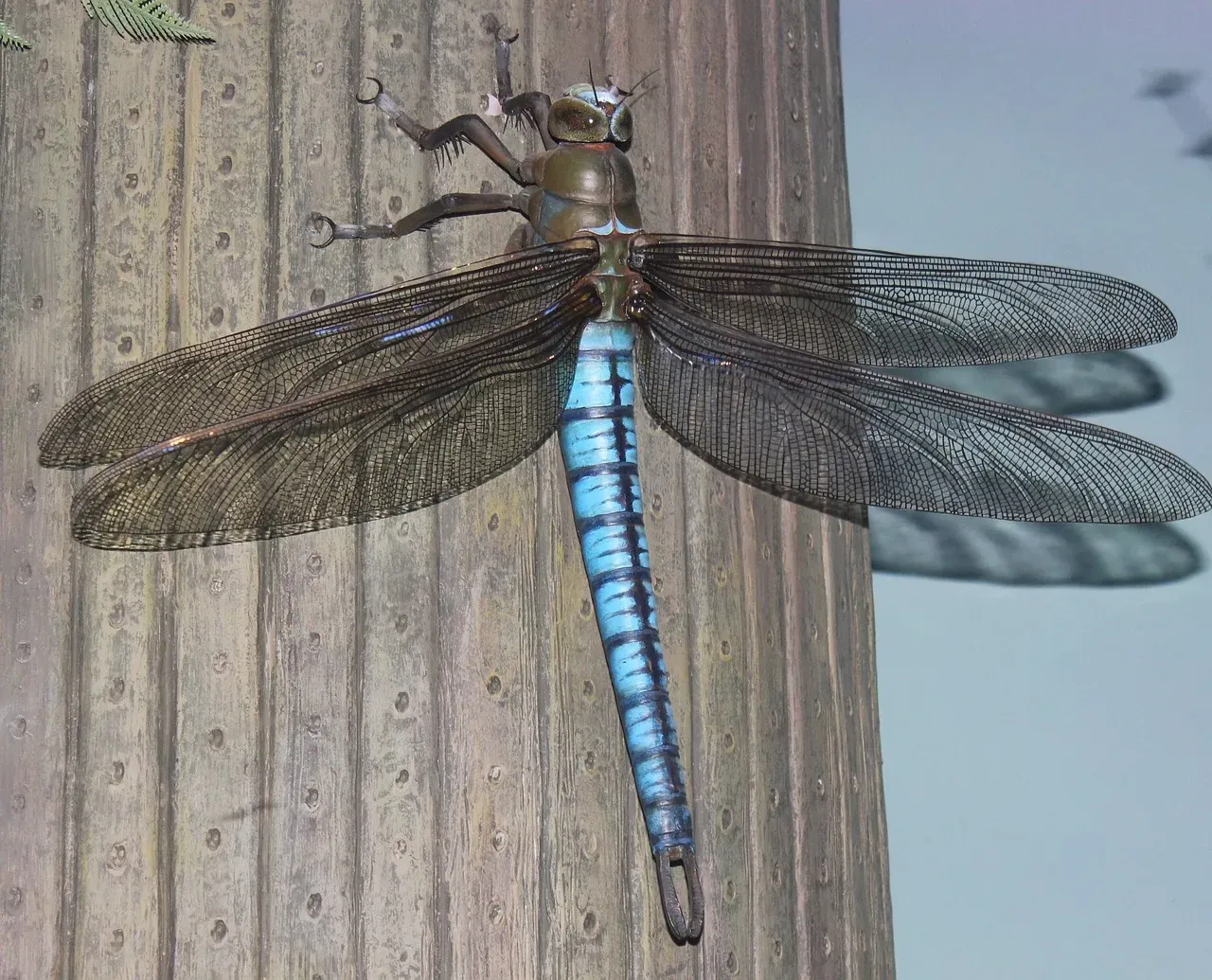
Not every great predator stalked the ground or ocean. During the Carboniferous period, the sky belonged to a creature that defies modern imagination. Meganeura was a gigantic dragonfly-like insect boasting a wingspan of up to two feet, making it one of the largest known flying insects of the Carboniferous period, thriving in the warm, swampy environments abundant during this era approximately 300 million years ago. Fossils of Meganeura were first discovered in coal-bearing rocks in France in 1880, and these specimens were exceptionally preserved, displaying detailed networks of wing veins, which inspired the name Meganeura, or ‘large-nerve’.
Meganeura’s size was not an accident. Its large size is attributed to the higher oxygen levels present in the atmosphere at the time. Think of it like this – Carboniferous Earth was basically a giant gym for insects, with the air itself acting as a performance enhancer. Like many of today’s dragonfly species, Meganeura lived in open habitats close to ponds and slow-moving streams, and it was likely the apex predator in these clearings, using the spines on its legs as a ‘flying trap’ to ensnare prey ranging from other flying insects to amphibians and even lizard-like vertebrates. Meganeura is thought to have benefitted from a lack of competition from vertebrates and heightened levels of oxygen during the Carboniferous. With no birds, bats, or other large flying animals to challenge it, the sky was all its own.
6. Eryops – The Terrifying Amphibian That Walked on Land and Water
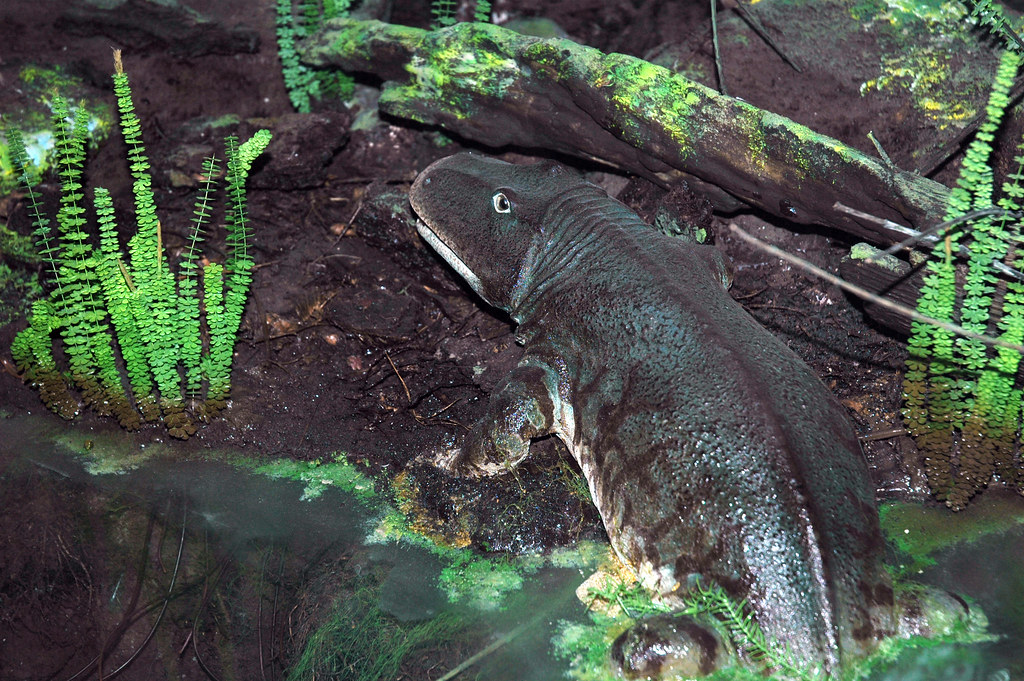
You might think of amphibians as small, harmless creatures. Frogs. Salamanders. Things that hide under rocks. Eryops would like a word. Eryops was a large amphibian that thrived in the swamps and waterways of the Carboniferous and early Permian periods, growing up to two metres in length, with a robust body and strong limbs well-suited for both aquatic and terrestrial environments, and thick skin that helped prevent dehydration, allowing it to spend extended periods out of water. In terms of scale for its time, Eryops was essentially what crocodiles are today – something every smaller creature should be deeply afraid of.
Eryops was a carnivore, feeding on fish and smaller tetrapods using its wide mouth and sharp teeth. What made Eryops particularly significant wasn’t just its predatory power, but its position as a bridge animal – a creature occupying the blurry evolutionary line between fully aquatic life and committed land-dwelling. Eryops was among the large predators that Dimetrodon competed with, as it could reach sizes comparable to Dimetrodon itself. Two heavyweight predators, sharing the same swampy floodplains, almost certainly crossing paths regularly. I think that’s the kind of world that makes you realize just how rough prehistoric life really was. The Permian was not a place you’d want to wander through unarmed.
7. Eurypterid (Sea Scorpions) – The Ancient Ocean’s Stealthiest Killers
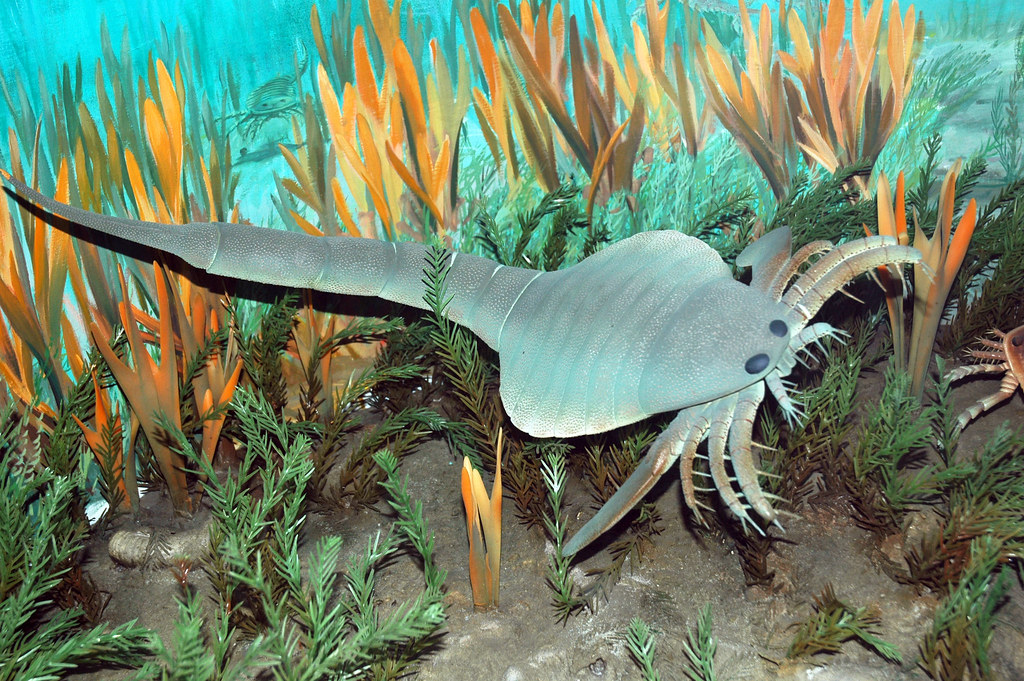
If you’re afraid of scorpions, do yourself a favor and don’t look up their Paleozoic ancestors too closely before bed. Eurypterids, commonly called sea scorpions, were among the most formidable aquatic predators of the Silurian and Devonian periods, hundreds of millions of years before the first dinosaur. Placoderms eventually outcompeted the previously dominant marine arthropods such as eurypterids, which had themselves produced some of the first and most infamous vertebrate apex predators of their era. Some species of eurypterids grew to extraordinary lengths, with the largest genera estimated at well over two metres long, making them the largest arthropods to have ever existed.
These creatures were built for ambush. Flattened bodies, powerful claws, and paddle-like limbs made them surprisingly fast through water. Smaller prey simply had no defense against a predator this well-armored and this agile. It’s hard to say for sure exactly how they hunted every kind of prey, but the fossil evidence clearly positions the larger eurypterids at the very top of their ecosystems. Their eventual decline came partly as a result of competition from the rising placoderms, including Dunkleosteus itself, showing that even at the top of a food chain, an apex predator’s dominance is never truly permanent. That’s a sobering thought for any creature, prehistoric or otherwise.
8. Tiktaalik – The Transitional Hunter That Changed Everything
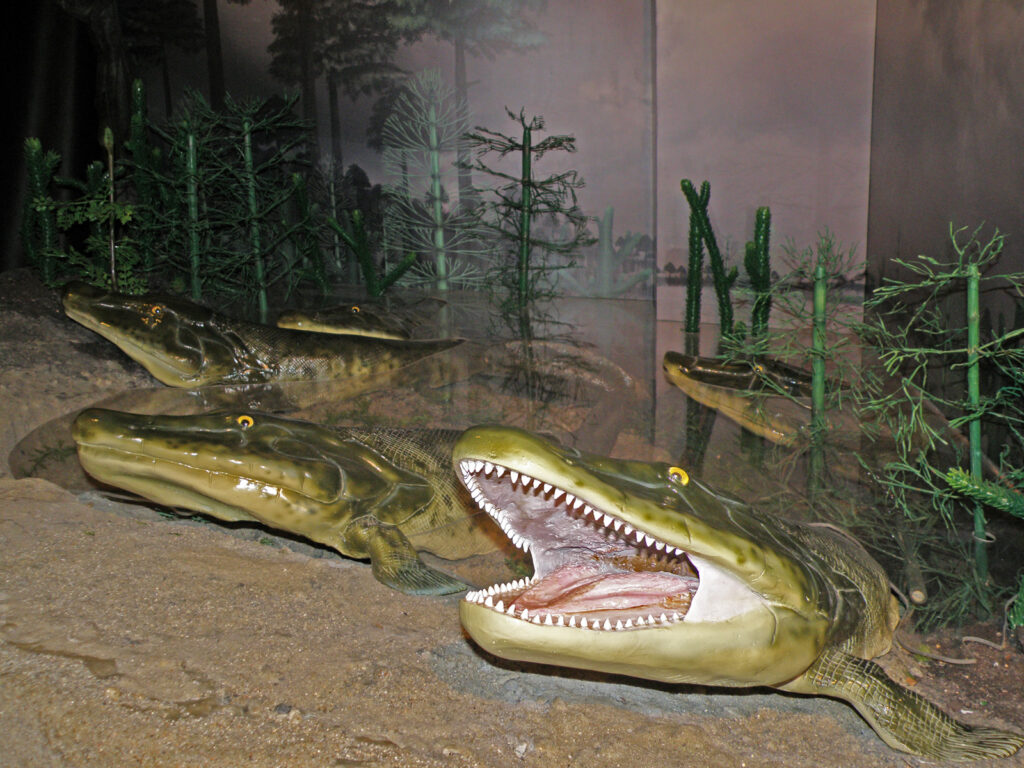
Tiktaalik occupies a truly unique position in the history of life on Earth. It is not famous merely for being a predator. It is famous for being the predator that helped life crawl out of the water. From fossils found in Arctic Canada, it’s estimated that Tiktaalik grew to lengths of 3 metres, and this huge size, combined with large jaws full of needle-like teeth, a mobile neck, and eyes on the top of its head, suggests it was a predator specially adapted for hunting fish in the shallows, with some thinking it may have even preyed on other, smaller ‘fishapods’ living on the margins between land and water. It was, in its own way, a top predator of its habitat – shallow water zones where few others could compete.
What makes Tiktaalik genuinely mind-bending is what it represents evolutionarily. Fish aren’t typically known for their ability to walk on land, but Tiktaalik wasn’t your typical fish. It was, by definition, a fish, but sporting primitive air-breathing lungs as well as gills and four fleshy appendages that resembled limbs, it was well on its way to becoming a fully fledged, terrestrial tetrapod. In short, you’re looking at a creature that used to hunt at the water’s edge about 375 million years ago and whose descendants eventually became every land-dwelling vertebrate alive today – including you. Unlike most other fish, Tiktaalik had robust fins that could support its weight outside of the water, attached to highly mobile joints, and it’s this combination that allowed Tiktaalik and others of its kin to experiment with a life on land. Without this hunter, there may have been no land vertebrates at all.
Conclusion: The Throne Was Never Empty
What strikes me most about these eight creatures is the sheer continuity of predation across deep time. From the shallow Cambrian seas ruled by Anomalocaris to the Permian killing grounds patrolled by Inostrancevia, Earth has never once been without something that sits at the very top of the food chain. The throne of apex predator has always been occupied. The occupants just kept changing.
Every one of these animals dominated its world completely, and every single one of them eventually disappeared or gave way to something new. That’s not a story of failure – that’s a story of relentless evolutionary momentum. The dinosaurs didn’t inherit an empty planet. They inherited a world that had already been shaped and reshaped by hundreds of millions of years of extraordinary predators.
Next time someone tells you the dinosaurs were the greatest predators in Earth’s history, you’ll know better. The greatest story of predation on this planet started long before T. rex ever took its first step. Which of these ancient hunters surprised you the most?