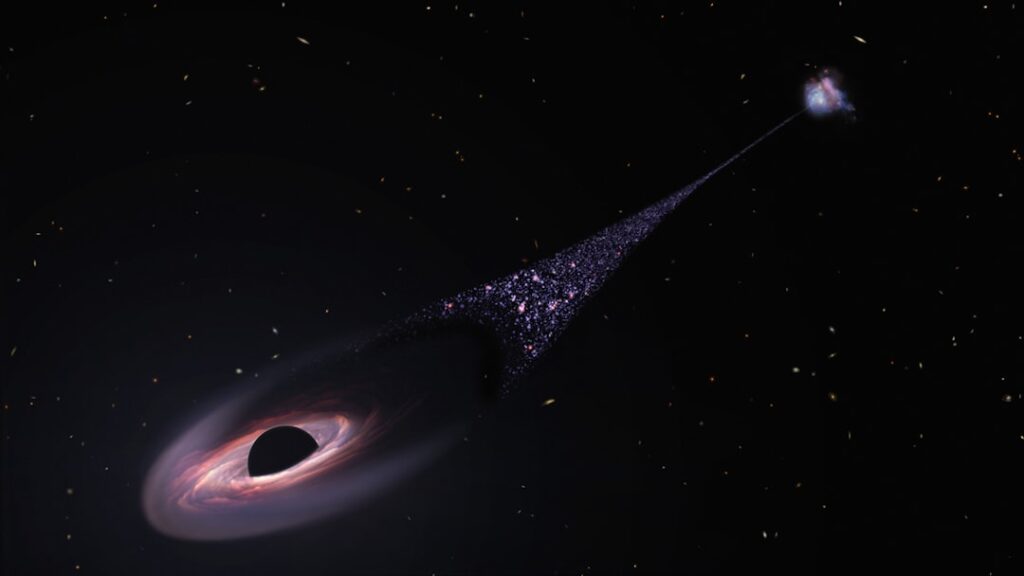

The Surprising Shift in Quasar Emissions (Image Credits: Unsplash)
Astronomers have uncovered evidence that the intricate balance of light emissions from quasars, powered by supermassive black holes, has shifted dramatically across cosmic history.
The Surprising Shift in Quasar Emissions
Recent observations from international teams have revealed a profound change in how quasars emit ultraviolet and X-ray light. For nearly 50 years, scientists assumed this relationship remained constant, serving as a cornerstone for understanding black hole environments. However, data from distant quasars show that in the early universe, X-ray emissions were notably weaker relative to ultraviolet light compared to what we observe today.
This discovery emerged from analyzing spectra of hundreds of quasars at various distances, corresponding to different epochs in the universe’s 13.8-billion-year lifespan. The shift indicates that the physical conditions around supermassive black holes have not stayed static. Instead, they appear to have evolved, possibly due to changes in the density or temperature of surrounding gas and plasma.
Unpacking the Role of Supermassive Black Holes
Quasars represent the most luminous phase of galaxies, where supermassive black holes at their cores devour vast amounts of matter. As gas spirals inward, it forms a hot accretion disk that generates intense ultraviolet radiation through friction and heating. A corona of superheated electrons above this disk then scatters the ultraviolet photons, boosting them into high-energy X-rays.
The traditional model held that this process operated uniformly across time, allowing astronomers to use the light ratio as a reliable diagnostic tool. Yet, the new findings suggest variations in the corona’s properties or the accretion flow itself. In the universe’s youth, when black holes grew rapidly, these structures might have been more compact or less efficient at producing X-rays.
Implications for Cosmic Evolution
This evolving relationship carries significant weight for models of galaxy formation and black hole growth. If the environments around black holes change over time, it could explain why early quasars powered some of the universe’s most rapid expansions. Astronomers now question whether feedback mechanisms, where black hole activity influences star formation, operated differently in the past.
Moreover, the discovery prompts a reevaluation of observational techniques. Tools like the James Webb Space Telescope and upcoming X-ray observatories may provide clearer views of these ancient phenomena. The shift also ties into broader questions about the universe’s expansion and the role of dark energy.
Key Observations Driving the Debate
To illustrate the findings, researchers compiled data from quasars spanning billions of light-years. The analysis highlighted consistent patterns: closer, more recent quasars exhibit a tighter ultraviolet-to-X-ray link, while distant ones show a looser correlation.
- Early universe quasars (over 10 billion years ago) displayed up to 20% less X-ray output relative to ultraviolet compared to modern counterparts.
- The change correlates with the peak era of black hole accretion, around 2-3 billion years after the Big Bang.
- Spectral studies confirmed no instrumental biases, ruling out observational errors.
- Simulations suggest denser interstellar gas in the young universe influenced the corona’s behavior.
- Future surveys aim to map this evolution across thousands more quasars.
Key Takeaways
- The ultraviolet-X-ray relationship in quasars has weakened over cosmic time, pointing to dynamic black hole surroundings.
- This challenges a 50-year-old assumption and refines our understanding of supermassive black hole growth.
- New data could reshape models of galaxy evolution and the universe’s early history.
As astronomers delve deeper into these revelations, the cosmos reveals itself as far more fluid than previously imagined. The evolving nature of black hole structures not only rewrites textbook theories but also invites us to ponder the universe’s ongoing transformations. What aspects of cosmic history might this uncover next? Share your thoughts in the comments below.