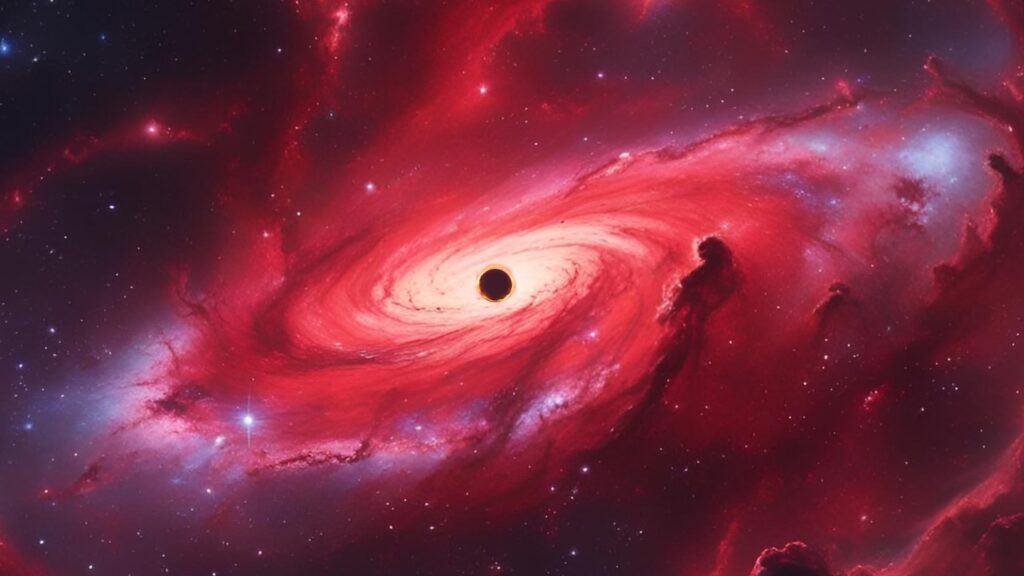
Astronomers peering into the universe’s infancy through the James Webb Space Telescope have identified compact, crimson-hued objects that challenge long-held views on black hole origins.
Unveiling the Cosmic Enigma

Unveiling the Cosmic Enigma (Image Credits: Cdn.mos.cms.futurecdn.net)
Since their discovery in late 2022, these “Little Red Dots” (LRDs) have puzzled scientists with their unexpected appearance just hundreds of millions of years after the Big Bang. Observations revealed thousands of these faint, point-like sources at redshifts around z=5 to 10, corresponding to when the universe was less than a billion years old.
Compact sizes, roughly 100 parsecs across, combined with stellar masses between 10^9 and 10^11 solar masses, suggested densities rivaling or exceeding those in globular clusters. Such extreme conditions prompted researchers to question whether stars alone could account for their glow.
A Pathway Through Stellar Chaos
Recent studies proposed that LRDs serve as nurseries where stellar dynamics forge massive black hole seeds. In these ultra-dense environments, dynamical friction rapidly segregated heavy stars toward the centers within less than 0.1 million years. Runaway collisions then built very massive stars (VMS) weighing 9,000 to 50,000 solar masses in under a million years, according to Fokker-Planck models, analytical calculations, and N-body simulations.
Once fuel depleted, these VMS contracted over about 8,000 years via Kelvin-Helmholtz cooling before collapsing under general relativity into intermediate-mass black holes around 10,000 solar masses. This mechanism outperformed traditional direct-collapse models in seed production rates. Dense leftover stellar cores in LRDs could also fuel frequent tidal disruption events, offering detectable signatures.
Direct-Collapse Alternatives Gain Traction
Other research positioned LRDs as immediate aftermaths of direct-collapse black holes (DCBHs), formed when pristine gas clouds collapsed without fragmenting into stars. These nurseries featured dust-free, compact hydrogen envelopes around newborn DCBHs accreting near or beyond Eddington limits. Such setups explained weak X-ray and hot dust emissions observed in LRDs.
PopIII stars ignited later, contributing to spectral energy distributions distinguishable via JWST’s NIRCam filters.
- Effective radii: ~100 pc
- Stellar masses: 10^9 – 10^11 M⊙
- Central densities: 10^4 – 10^5 M⊙ pc⁻³ (up to 10^9)
- Redshift range: z ~ 5-10
- Spectral features: V-shaped continua, broad lines
Observational Clues and Open Questions
JWST data from surveys like JADES and CEERS compiled large LRD samples, revealing flat short-wavelength emission and steep long-wavelength rises. Dust-reddened starlight mixed with obscured active galactic nuclei emissions fit many spectra. Yet debates persisted: Were LRDs pure stellar systems, accreting black holes, or hybrids?
Absence of strong X-rays hinted at dense gas shrouds cloaking growing black holes. Future deep JWST observations aimed to resolve these degeneracies, probing ultraviolet filtering into red visible light.
Key Takeaways:
- LRDs challenge early galaxy and black hole formation timelines.
- Stellar collisions or direct gas collapse offer viable seed mechanisms.
- Dense cores promise ongoing tidal disruptions for study.
These discoveries reshaped narratives of cosmic dawn, suggesting black holes bulked up swiftly to anchor early galaxies. As JWST delves deeper, clearer pictures of LRDs may illuminate black hole seeding across the universe. What secrets will these red specks yield next? Share your thoughts in the comments.