
Have you ever stared at a canyon wall and tried to imagine the millions of years that carved those layers? Your brain probably struggled with that concept, right? It’s not your fault. There’s something fascinating happening inside your skull when you try to grasp spans of time that stretch beyond your lifetime, your grandchildren’s lifetimes, or even beyond the entire existence of human civilization. When geologists casually talk about events that happened 500 million years ago, they’re asking your mind to do something it wasn’t designed to do.
Your brain evolved to handle time intervals from moments to days, seasons, years, and maybe a human lifetime. Thinking about billions of years? That’s an entirely different challenge. Let’s explore how your mind grapples with this cosmic puzzle and why geologic time feels so impossibly distant.
Why Your Brain Wasn’t Built for Deep Time
When your mind evolved, it only needed to process small numbers, like counting fingers on a hand, and we still base our counting systems on that foundation. Think about it. Your ancestors needed to track seasons for planting, remember where food was stored for winter, or anticipate when predators might return. Nobody needed to contemplate millions of years of continental drift to survive another day.
Geology deals with vastness of time that exists far outside your direct experience. When you attempt to comprehend 4.6 billion years, you’re essentially asking your brain to perform mental gymnastics it never trained for. Even when you’re told that 4.6 billion years contains 10 digits, you still cannot truly comprehend anything that large, particularly that amount of time. Honestly, even professional geoscientists admit this struggle.
The Cognitive Shortcuts Your Mind Takes

Here’s where it gets interesting. Research shows that children cluster geologic events into just two categories: extremely ancient and less ancient. Your brain wants to simplify the incomprehensible. Instead of accurately processing the timeline, you create mental bins labeled “really old” and “not quite as old.”
Many geoscientists find it easier to think about ages like millions of years relative to Earth’s total age rather than as absolute numbers. This reveals something crucial about how you process these immense timescales. You need reference points, anchors, something concrete to hold onto when the numbers become meaningless noise.
Your everyday time perception relies on specific brain regions. Time perception involves a distributed system including your prefrontal cortex, cerebellum, and basal ganglia, with the suprachiasmatic nucleus handling your daily circadian rhythm. Yet none of these systems evolved to handle geologic scales.
The Problem With Analogies and Mental Models

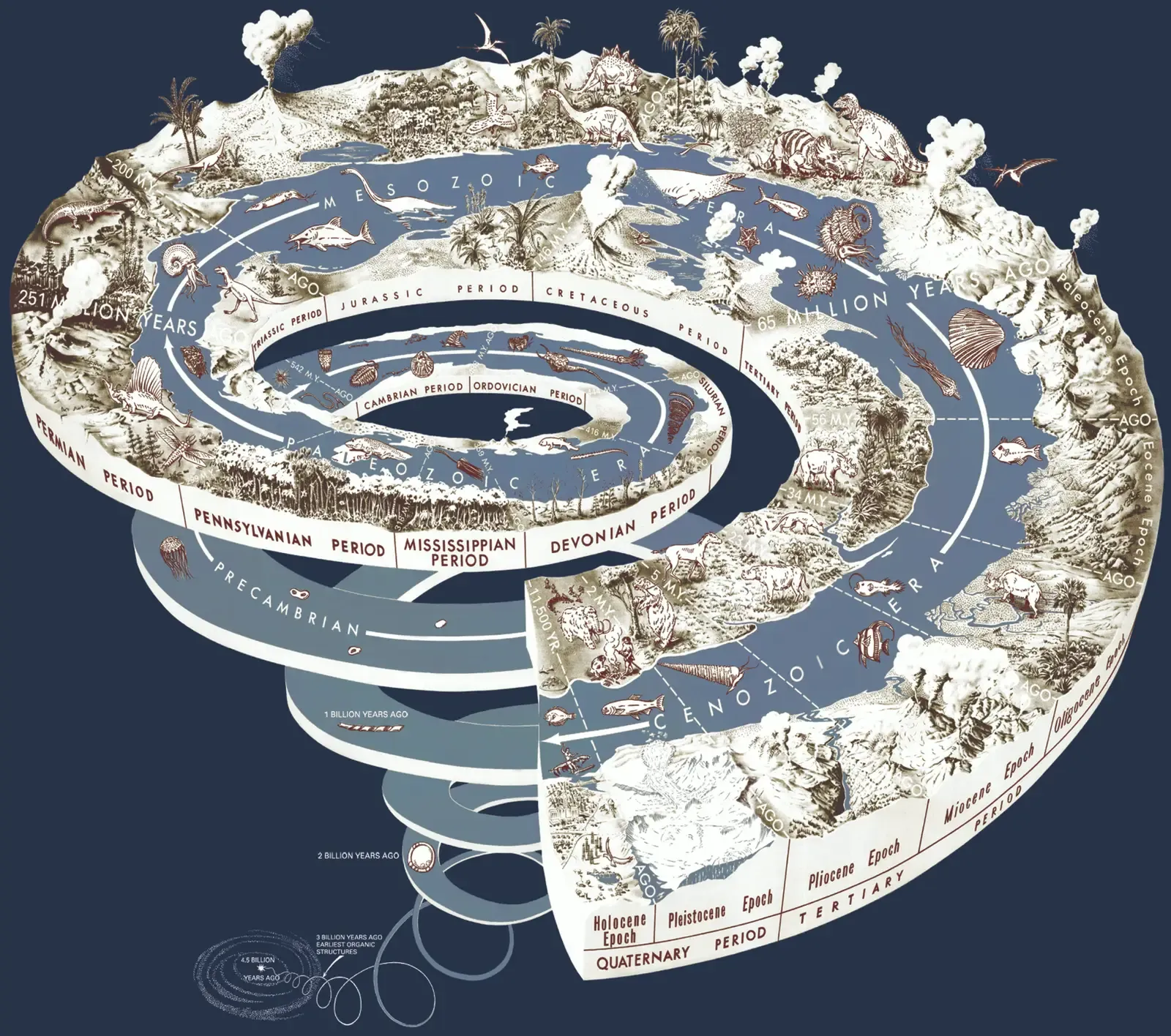
Scientists have tried countless ways to help you visualize deep time. Imagine a football field representing all of Earth’s history, with early humans appearing in just the last one eighth of an inch, and all of civilization represented by the width of two human hairs. Sounds helpful, right? The problem is your brain still struggles to translate these comparisons into genuine comprehension.
When deep time gets compressed into a 12 hour clock span, life emerges around 2 o’clock but humans don’t appear until just one second before noon. These analogies work mathematically, but do they truly help you feel the weight of those billions of years? I think they give us intellectual understanding without the emotional grasp.
For most people, grasping geological time remains impossible because of its massive scale. Your brain wants patterns, rhythms, and familiar references. Geologic time offers none of these comforts.
How Memory and Experience Shape Your Time Perception
Your perception of time isn’t just about counting seconds. The perception of time represents the sum of stimuli associated with your cognitive processes and environmental changes. When you remember last week, you’re not accessing an internal clock. You’re reconstructing events, emotions, and sensory details.
Memory traces that persist over time allow you to judge the age of memories from their strength, though the inference model suggests you determine when events occurred based on their relationships to other known events. This works beautifully for your personal history. It fails spectacularly for geologic time because you have zero direct experiences to anchor those vast ages.
Activity in your parietal cortex correlates with how accurately you perceive time duration, while time cells in your hippocampus relate more to long range perception like long term memory. Still, “long range” for your hippocampus means hours or days, not epochs spanning millions of years.
The Distortion Effect of Unfamiliar Timescales
Let’s be real. When you try to estimate geologic timescales, your guesses go wildly wrong. Students examining Martian crater erosion suggested weathering might have occurred over just 10 to 100 years, or maybe a few thousand years, when Mars geologists actually estimate hundreds of thousands or millions of years for these processes. This massive underestimation reveals how your Earth based intuitions sabotage your understanding.
The history of our planet includes timescales and events far beyond human experience, requiring you to imagine a planet without humans, animals, plants, or life of any kind. Your imagination resists. You keep inserting familiar references because your cognitive architecture demands it.
If you don’t grasp the immenseness of geological time, distortions get introduced into your view of earth history and processes. You might think mountains form quickly during dramatic earthquakes, missing the reality that imperceptibly slow processes create monumental changes over vast spans.
Learning to Think in Geological Rhythms
You can easily grasp nine days, which is how long a water drop stays in Earth’s atmosphere, but spans of hundreds of years approach the limits of your comprehension. The carbon dioxide molecule you exhale today? It might linger in the atmosphere for centuries, affecting climates your great great great grandchildren will experience.
Some thinkers argue that grasping geological time simply requires practice, like learning to use maps or microscopes, suggesting deep time requires training your imagination. Perhaps you can develop what researchers call “timefulness,” a poly temporal worldview that acknowledges overlapping rates of change in Earth’s systems, some fast and some slow.
As humanity has become a geophysical force in the Anthropocene, changes are beginning to show on the huge scales of geological deep time, with some calculations suggesting anthropogenic climate change has already delayed the next ice age by at least 100,000 years. Your emissions from the last 150 years, just five generations, are causing effects lasting 3,333 generations.
Building Your Deep Time Intuition
So what can you actually do to improve how your brain processes geologic time? One strategy involves decoupling geological time between the macroscale of deep time and the microscale of relative time represented by strata. You can learn to think about sequences and relationships between events without fixating on the crushing weight of those billion year numbers.
Museums now encourage visitors to think beyond human lifespans and understand the long arc of planetary transformation, with media outlets describing how contemplating deep time can foster patience, humility, and long term thinking. These aren’t just nice qualities. They’re cognitive tools that help you contextualize your place in Earth’s story.
The concept of deep time influences how you think about the planet and yourself, allowing you to envision how constant, slow processes like tectonic plate movement can produce the tallest mountains from the sea floor over 70 million years. Your brain needs practice seeing time as geologists do, recognizing that landscapes appearing static to your lifetime experience are actually dynamic, just changing at rates too slow for you to witness directly.
Conclusion

Your brain’s struggle with geologic time isn’t a failing. It’s simply operating outside its evolutionary design specifications. Understanding the brevity of human existence relative to Earth’s history requires what some call an innovation in your sense of reality. You’re not just learning facts about dates and epochs. You’re fundamentally reshaping how your consciousness relates to temporal scales.
The next time you hold a rock or stand before an ancient cliff face, remember that your initial intuition about its age is probably wildly inaccurate. Your brain will want to compress those timescales into something manageable, something human sized. Resisting that urge, training yourself to sit with the uncomfortable vastness of deep time, might be one of the most profound cognitive shifts you can make. What does it feel like to truly know that the ground beneath your feet has witnessed eons you can barely name, let alone imagine? That’s the question your brain keeps trying to answer.