
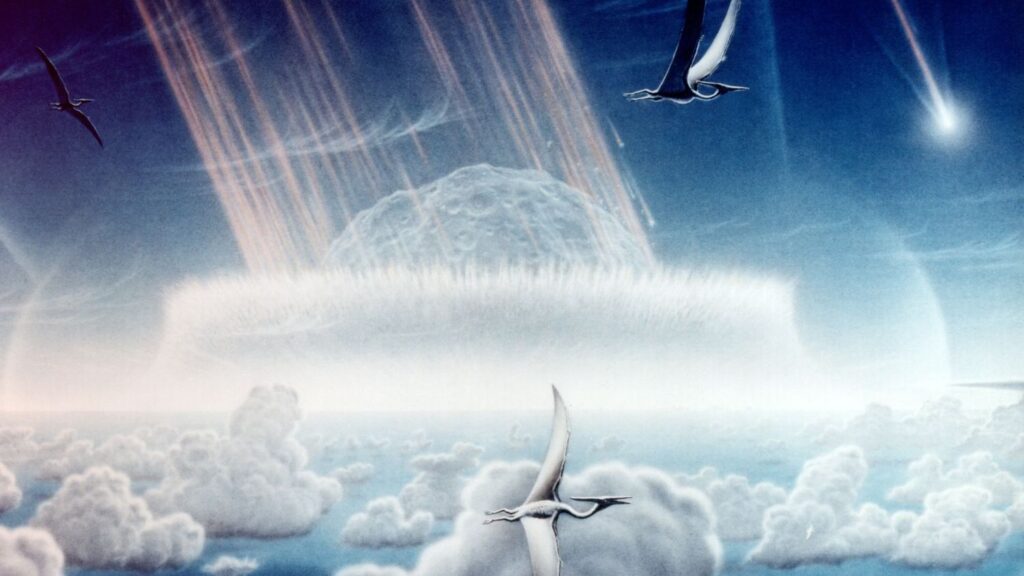
Sixty-six million years ago, the Earth was thriving. Colossal dinosaurs ruled vast forests, inland seas teemed with ancient marine life, and a world of extraordinary biodiversity hummed along as it had for over 160 million years. Then, in a single catastrophic moment, everything changed.
What followed that moment was not just a mass die-off. It was arguably the most dramatic reset of life on Earth that has ever been recorded in stone, bone, and mineral. Scientists are still untangling just how it all unfolded, and with every new drilling expedition, fossil site, and chemical analysis, the picture becomes more vivid, more terrifying, and frankly more astonishing than we ever imagined. So buckle up, because this story has everything.
The Rock That Changed Everything: What Slammed Into Earth
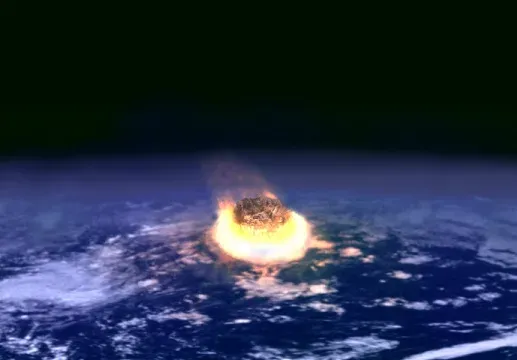
Transferred from en.wikipedia to Commons by Vojtech.dostal., Public domain)
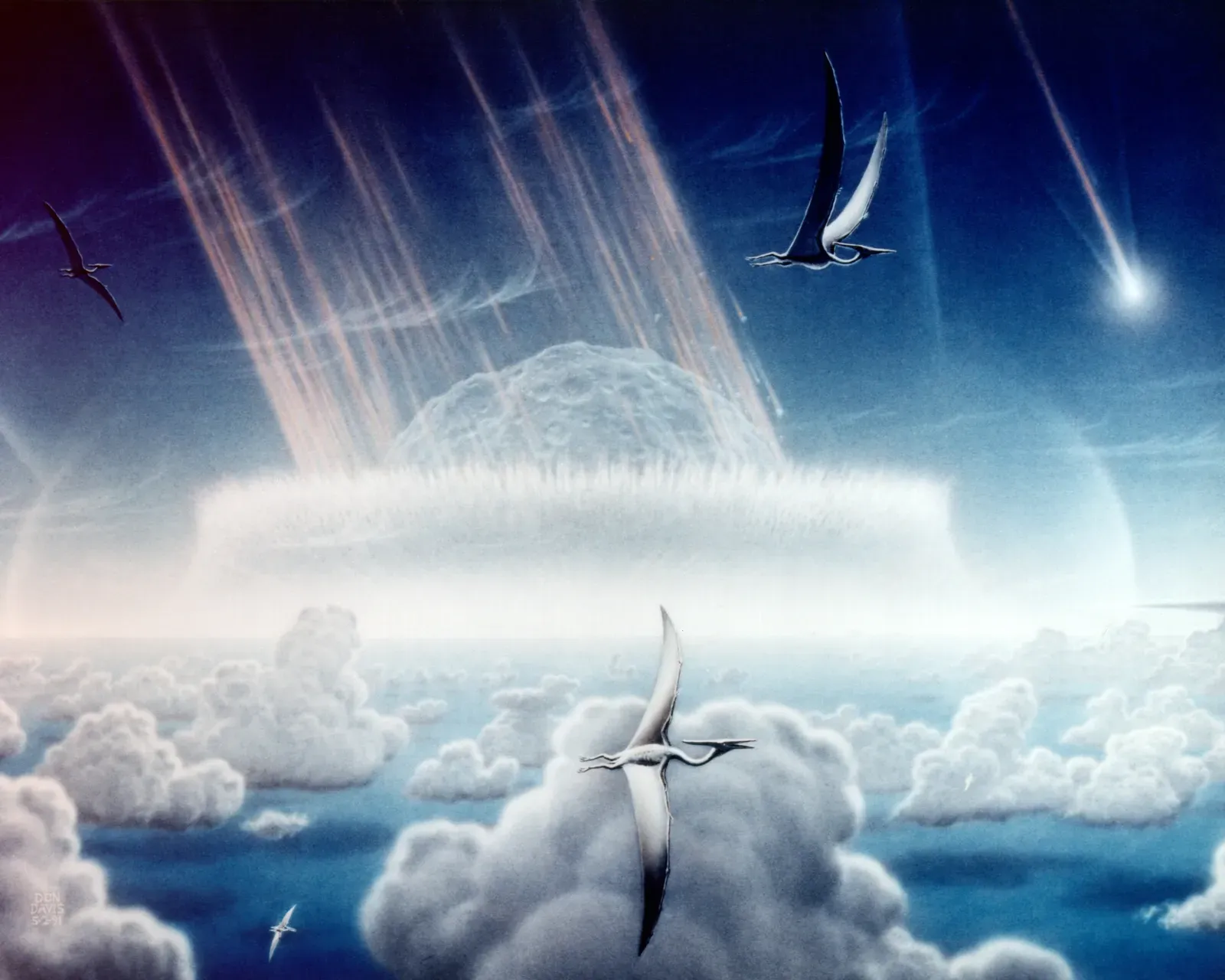
Let’s start with the obvious question: what exactly hit us? Approximately 66 million years ago, the Chicxulub asteroid, estimated to be between 10 and 15 kilometers in diameter, struck the Yucatán Peninsula in what is now Mexico, creating a roughly 200-kilometer-wide impact crater. To put that in perspective, imagine an object roughly the width of a major city slamming into our planet at incomprehensible speed.
The rock, roughly the size of Mount Everest, hurtled toward Earth traveling about 15.5 miles per second. That is so fast it is genuinely hard to wrap your head around it. For context, a bullet from a rifle travels at around 0.5 miles per second. This thing was moving thirty times faster.
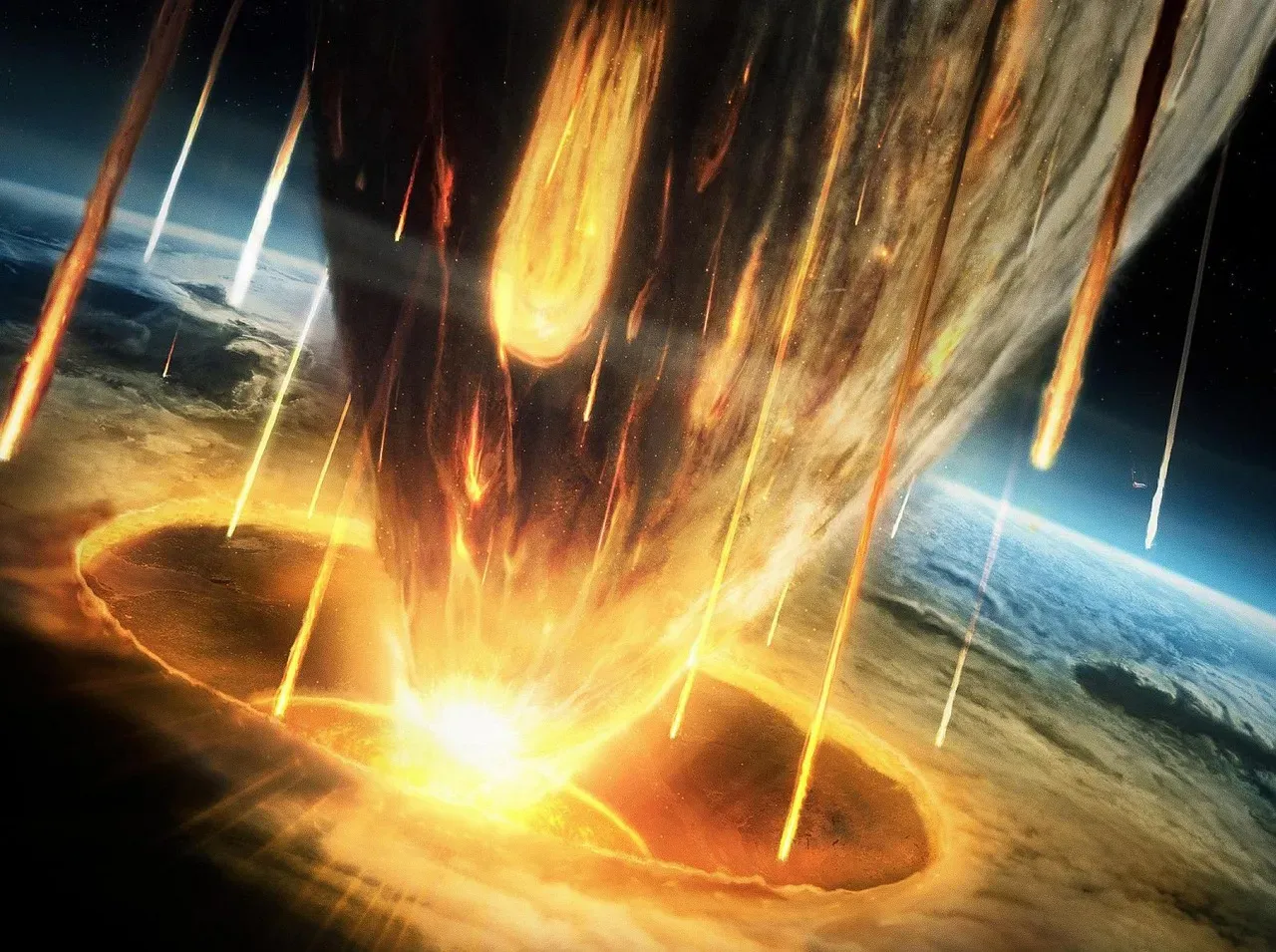
The impact generated immense energy, equivalent to about 100 million megatons of dynamite, leading to catastrophic consequences including massive tsunamis, firestorms, and drastic climate changes. The scale of destruction was total, immediate, and relentless. No corner of the Earth would be left untouched by what came next.
A Fingerprint in Stone: The Chemical Identity of the Killer
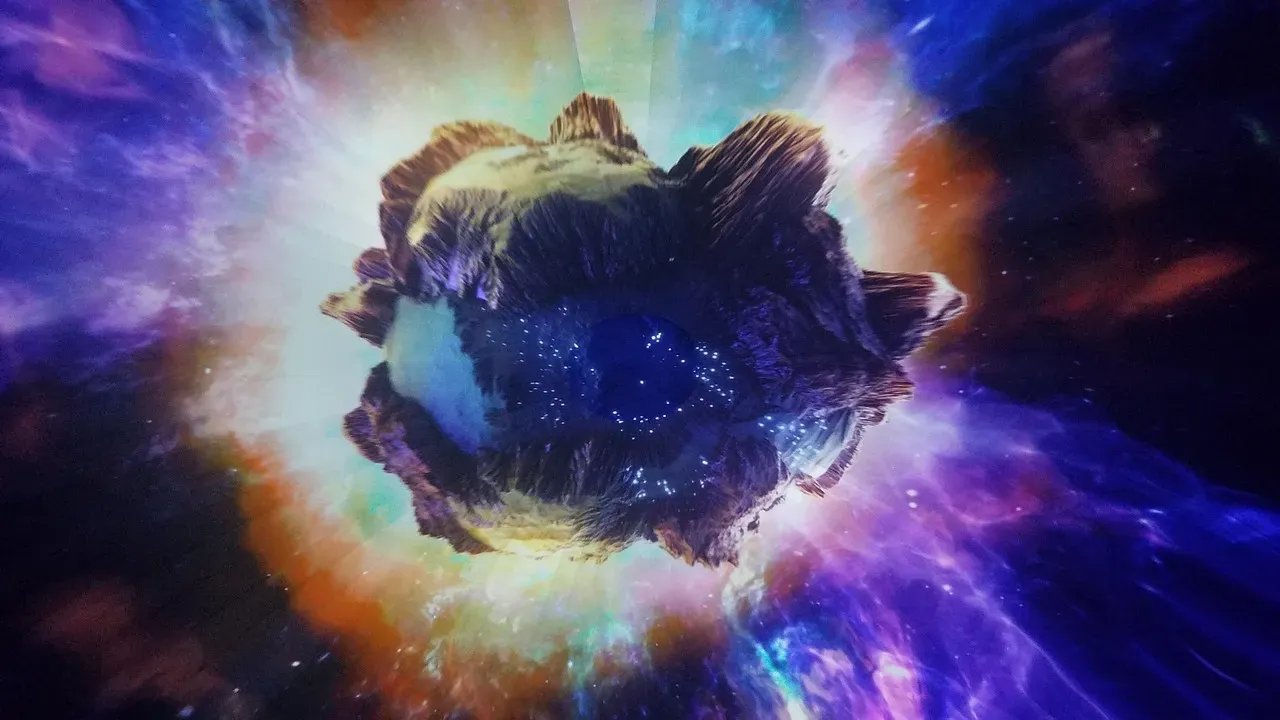
For decades, scientists knew an asteroid had struck, but pinning down exactly what kind of space rock it was took a surprisingly long time. A study found the chemical identity of the asteroid that collided with what is now the Yucatán Peninsula in Chicxulub, Mexico, 66 million years ago, triggering events that led to the demise of most dinosaurs. That research, published in 2024, used a brilliant approach to crack the case.
Ruthenium isotopes confirmed the Chicxulub impactor was a carbonaceous-type asteroid. Carbonaceous chondrites often contain water, clay, and carbon-bearing compounds and make up the majority of rocks in space, but only about 5% of the meteorites that fall to Earth belong to this category. Honestly, it is a strange twist that the most common type of rock in space is one of the rarest to actually reach Earth’s surface.
Data shows that within the last 500 million years, almost exclusively fragments of S-type asteroids have hit the Earth, which originate from the inner solar system, in contrast to the Chicxulub impactor. In other words, you were not just dealing with any asteroid. This was a rare visitor from the outer reaches of our solar system, arriving at precisely the wrong moment.
Ground Zero: The Chicxulub Crater and What It Tells You
In the geologic record, the K-Pg event is marked by a thin layer of sediment called the K-Pg boundary, which can be found throughout the world in marine and terrestrial rocks. That single thin layer is like a bookmark in Earth’s history, separating two completely different worlds. On one side: dinosaurs, pterosaurs, ammonites. On the other: silence, then mammals.
The boundary clay shows unusually high levels of the metal iridium, which is more common in asteroids than in the Earth’s crust. This iridium signature was the first real clue that pointed scientists toward an extraterrestrial cause. In 1980, a team of researchers including Nobel Prize-winning physicist Luis Alvarez, his son geologist Walter Alvarez, and chemists Frank Asaro and Helen Michel discovered that sedimentary layers found all over the world at the Cretaceous-Paleogene boundary contain a concentration of iridium many times greater than normal.
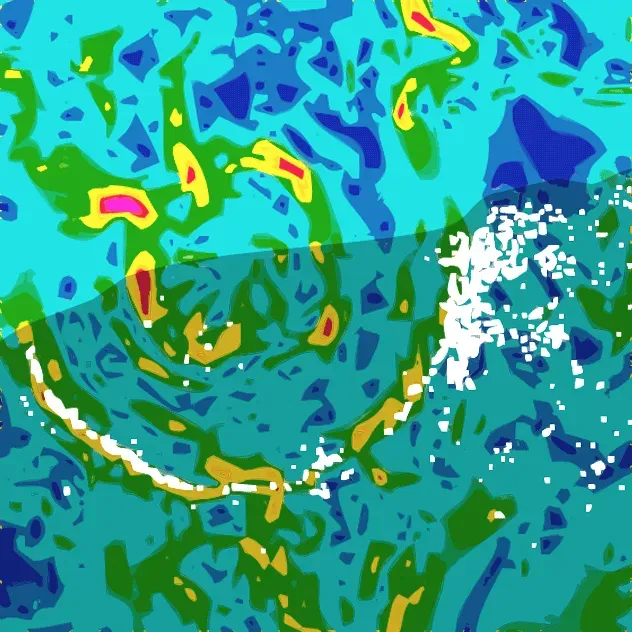
In 2016, scientists co-led a scientific drilling expedition to the impact site at Chicxulub, recovering 829 meters of core samples retrieved by an international team of researchers. Those cores have been yielding extraordinary discoveries ever since, reshaping everything we thought we knew about the impact and its aftermath.
The Tanis Site: A Snapshot of the Worst Day in Prehistoric History
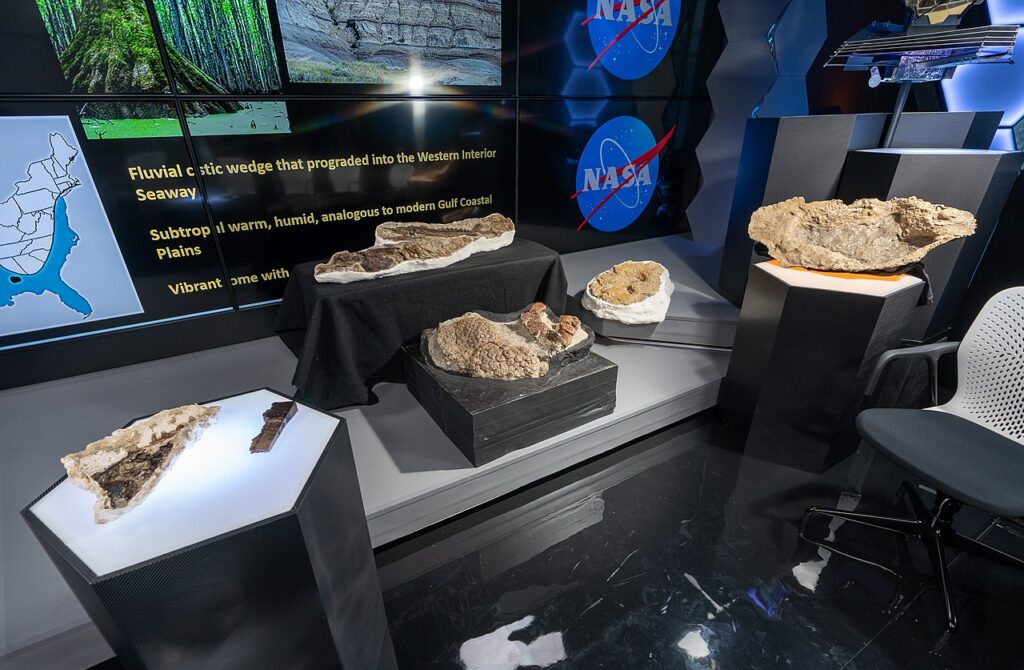
Here is where things get genuinely spine-tingling. A site in North Dakota called Tanis may hold sediments laid down within minutes to hours of the asteroid impact that set off this mass extinction 66 million years ago. Think about that. A place where you can literally see, in fossilized form, the chaos that unfolded in real time on that catastrophic day.
Mere minutes after a miles-wide asteroid slammed into Earth 66 million years ago, a hailstorm of tiny glass beads rained down on a flooding estuary in what is now North Dakota. As seismic waves from the impact thrashed the water, plants and animals were jumbled up and buried in the shifting sediments, which preserved the aftermath for millennia. The preservation is so extraordinary it almost defies belief.
Among the remarkable finds at the site are large primitive feathers believed to come from large dinosaurs, a turtle killed by impalement on a tree branch, broken remains from almost all known Hell Creek dinosaur groups, fossils of hatchlings and intact eggs with embryo fossils, and even a partial mummified Thescelosaurus with its skin still intact, unearthed in 2022. To me, this is the most emotionally striking thing in this entire story. Skin. Still intact. From a dinosaur that witnessed the end of its world.
The Impact Winter: When the Lights Went Out for Years

The main culprit driving the mass extinction is most likely the impact winter, which was caused by the massive release of dust, soot, and sulfur into the atmosphere, leading to extreme cold, darkness, and a collapse in global photosynthesis, with lasting effects on ecosystems for years to decades after impact. Think of it like pulling the plug on the Sun. Slowly. For years.
A model showed soot particles were so good at absorbing sunlight that photosynthesis levels dropped to below one percent of normal for well over a year. When you remove photosynthesis from the equation, you remove the base of every food chain on Earth. The darkness would have been devastating to photosynthesizers and could explain the mass extinction through a collapse of the food web. All life on Earth depends on photosynthesizers like plants and algae that harvest energy from sunlight.
In terms of rapid cooling, soot was the worst culprit, dropping temperatures over land by nearly 30 degrees Celsius and over the oceans by 13 degrees in just three years. Because the particles lingered in the atmosphere, temperatures in some areas did not return to their pre-impact levels for more than a decade. A decade of unrelenting cold and darkness. No wonder so few large species survived.
Rethinking the Kill Mechanism: New Clues on Sulfur and Dust
For a long time, sulfur was considered the main villain in the story of the impact winter. New research is now challenging that idea in fascinating ways. New evidence indicates that the sulfur released by the Chicxulub asteroid impact was significantly less than previously estimated. Empirical analysis of sulfur concentrations and isotopic compositions from impact rocks suggests about 67 billion tons of sulfur were released, five times less than earlier models suggested.
This suggests a milder impact winter than previously believed, leading to a less severe temperature decline and faster climate recovery, which could have contributed to the survival of at least a quarter of species on Earth following the event. So in a horrible kind of way, it could have been even worse. A recent study by the Royal Observatory of Belgium and VUB suggests a massive plume of micrometer-sized fine dust may have played a crucial role in creating a two-year-long dark period, blocking photosynthesis and further compounding the environmental impacts.
Dust from pulverized rock, amounting to around 2,000 gigatons, was propelled into Earth’s atmosphere, overshadowing the sun and severely disrupting plant photosynthesis. Advanced modeling techniques demonstrated that this atmospheric dust persisted for up to 15 years, triggering a global nuclear winter that ultimately caused the dinosaur extinction. It is hard to say for sure which was the primary killer, but the evidence increasingly points to dust as a key, underestimated player.
Who Survived and Why: The Unexpected Winners of the Apocalypse
The event caused the extinction of all non-avian dinosaurs and most other tetrapods weighing more than 25 kilograms, with the exception of some ectothermic species such as sea turtles and crocodilians. Why did crocodiles make it when a Tyrannosaurus rex didn’t? It is one of the great survival puzzles of paleontology, and the answer comes down to lifestyle and metabolism more than size or strength.
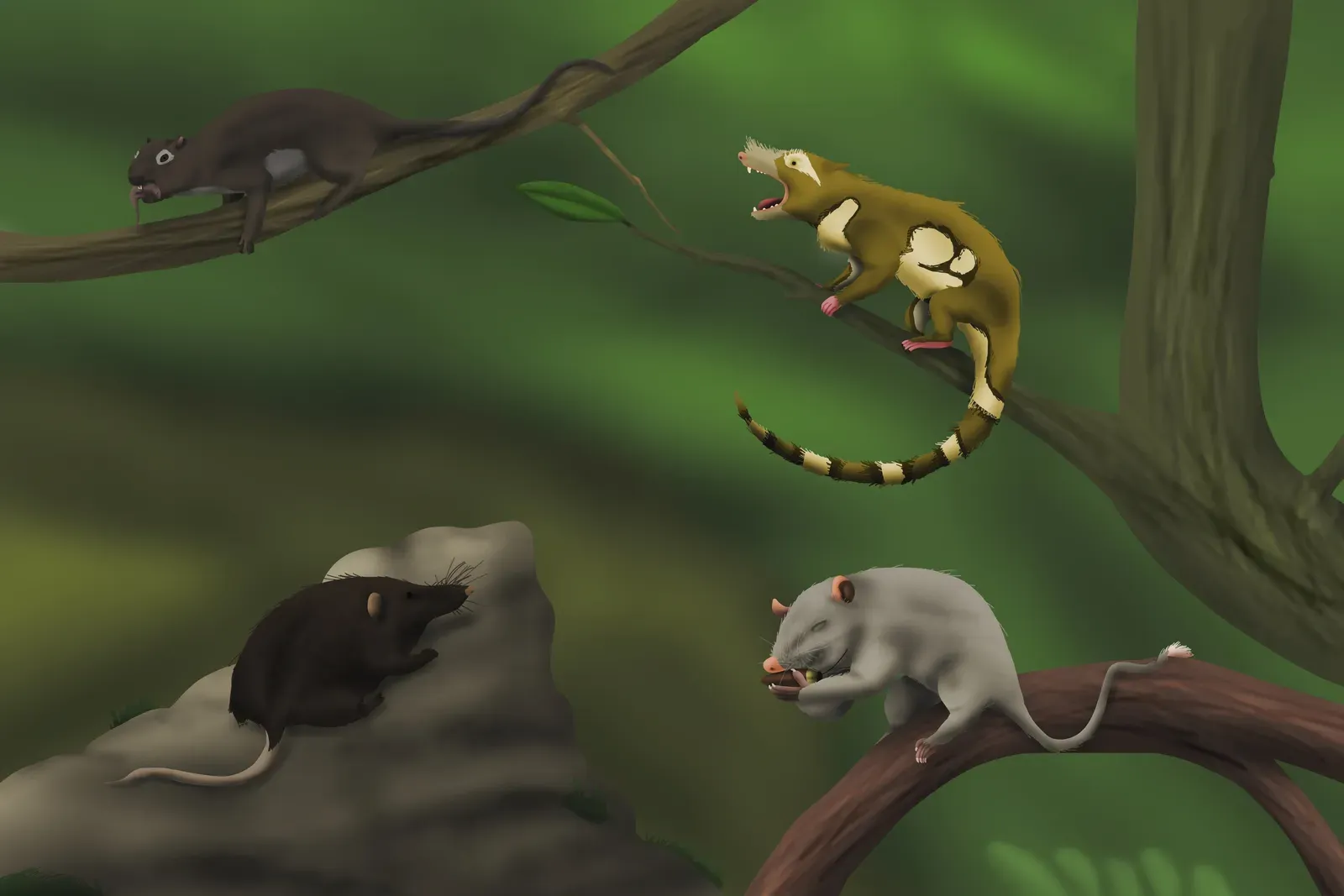
A study suggests that ground-dwelling and semi-arboreal mammals were better able to survive the cataclysm than tree-dwelling mammals, due to the global devastation of forests that followed the Chicxulub asteroid impact. Basically, if you lived underground, could eat almost anything, and stayed small, your odds went up dramatically. Mammalian species at the K-Pg boundary were generally small, comparable in size to rats, and this small size would have helped them find shelter in protected environments.
Dinosaurs promoted open habitats in the Late Cretaceous, and their extinction could have led to a radical reorganization of the landscape and ecosystem structure at the beginning of the Paleogene, according to sedimentology, biostratigraphy, and geochemistry data from western North America. In other words, dinosaurs themselves were shaping the very landscape that collapsed without them. Their absence sent ripple effects through the entire planet’s ecology, eventually giving rise to the forests, flowers, and mammals that define the world you live in today.
Conclusion
The story of the dinosaur extinction is not just a prehistoric curiosity. It is arguably the most consequential single event in the history of complex life on Earth, and its details keep getting richer with every new discovery. You now know the rock came from the outer solar system. You know a site in North Dakota froze the horror of that day in time. You know the darkness, the soot, and the cold were the true executioners. You know who survived, and roughly why.
What is perhaps most humbling is this: every mammal alive today, including you, is a descendant of the small, scared creatures that somehow clawed through those years of darkness. The cataclysm that ended the dinosaurs is, in the most literal sense, the reason you exist. It raises a question worth sitting with for a moment: if that asteroid had arrived just a few minutes earlier or later, or missed us entirely, would there be anyone around to study it at all?