Western Australia’s Kimberley region – once a brackish shoreline teeming with life – holds clues to one of Earth’s most dramatic comebacks. Researchers recently reexamined long-lost fossils from this remote area, uncovering evidence of diverse marine predators that emerged mere moments after the end-Permian mass extinction. These 250-million-year-old remains highlight how ancient oceans repopulated with surprising speed.
Skulls Lost for Decades Yield Surprising Secrets
Skulls Lost for Decades Yield Surprising Secrets (Image Credits: Reddit)
Field expeditions in the 1960s unearthed three skull fragments from the Blina Shale on Noonkanbah station, about 250 kilometers inland from Broome. Paleontologists John Cosgriff and Richard Garbutt described them in 1972 as a new temnospondyl species, Erythrobatrachus noonkanbahensis. The originals soon vanished after distribution to museums in Australia and the United States, leaving only a plaster cast at the Western Australian Museum.
A dedicated search recovered one fragment from a Berkeley collection, enabling modern scrutiny with high-resolution imaging. This reanalysis, published in the Journal of Vertebrate Paleontology, transformed initial assumptions. What seemed like one creature now pointed to a thriving community of Early Triassic hunters.
Two Distinct Predators Emerge from the Fragments
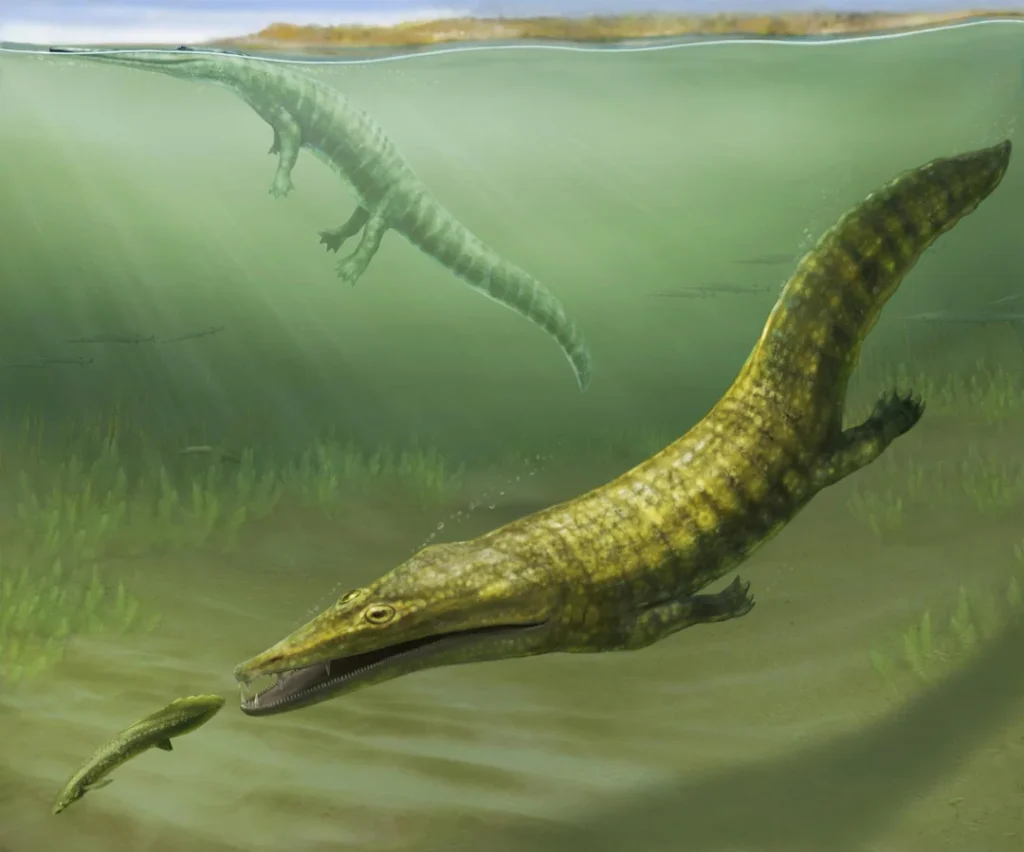
The broader, robust skull belonged to Erythrobatrachus noonkanbahensis, a top predator suited for ambushing larger prey like fish and smaller animals. Its 40-centimeter-long head suggested a powerful bite in shallow bays. In contrast, the other fragment matched Aphaneramma, with a slender, elongated snout ideal for snatching swift, small fish.
These crocodile-salamander hybrids, relatives of today’s frogs and salamanders, grew up to two meters long. Their coexistence in the same mudflat habitat showcased early niche partitioning – different hunting styles reduced competition. Temnospondyls like these dominated vertebrate life for over 210 million years, outlasting multiple crises.
- Broad skull of Erythrobatrachus: Built for crushing larger prey.
- Thin snout of Aphaneramma: Optimized for agile fish pursuits.
- Marine tolerance: Thrived in salty brackish waters, unlike modern amphibians.
- Body length: Up to six feet, ruling coastal ecosystems.
- Era-spanning lineage: From Carboniferous to Cretaceous.
Rebound from the Great Dying
The end-Permian extinction, around 252 million years ago, eradicated over 90 percent of marine species through volcanic upheaval and ocean anoxia. Early Triassic seas remained chaotic, with hot temperatures and chemical instability. Yet trematosaurids like these appeared in coastal deposits less than one million years later, claiming apex roles.
This Australian evidence fills a Southern Hemisphere gap in the recovery story. Previously sparse records from the region now confirm structured predator guilds formed swiftly. Lachlan Hart, lead researcher from UNSW Sydney, noted, “Our research adds an exclamation point to just how adaptable temnospondyls were. They had an amazing ability to utilise a plethora of ecological niches to survive, even in the face of extreme global change – proving they were definitely one of evolution’s success stories.”
Globe-Trotting Invaders of Ancient Oceans
Aphaneramma fossils match those from Svalbard, Pakistan, Madagascar, and Russia’s Far East – all from comparable Early Triassic layers. This pattern suggests these amphibians migrated along supercontinent coastlines, dispersing worldwide in the Mesozoic’s dawn. Erythrobatrachus appears unique to Australia, but the duo underscores a cosmopolitan radiation.
Such mobility defied post-extinction hurdles, as these vertebrates tolerated high salinity and fluctuating conditions. Their success reshaped recovering food webs, paving the way for dinosaur-era seas. Modern parallels remain elusive, given amphibians’ freshwater limits today.
| Species | Skull Feature | Prey Type | Known Locations |
|---|---|---|---|
| Erythrobatrachus noonkanbahensis | Broad, robust | Large fish, animals | Australia |
| Aphaneramma | Long, thin | Small, fast fish | Australia, Svalbard, Pakistan, Madagascar, Russia |
Key Takeaways
- Two species coexisted, partitioning niches just after mass extinction.
- Global spread within one million years signals rapid ecosystem structuring.
- Temnospondyls’ adaptability ensured 210-million-year dominance.
These Kimberley fossils rewrite the timeline of marine revival, proving life seized opportunities amid devastation. They remind us of nature’s resilience in chaos. What do you think about these ancient survivors? Tell us in the comments.