During the Mesozoic era, when towering dinosaurs ruled the land, a group of early mammals carved out their own niches as cunning predators and versatile survivors. Eutriconodonts, named for their distinctive three-cusped teeth, persisted for over 100 million years across multiple continents. These creatures ranged from tiny insect-hunters to badger-sized carnivores capable of tackling young dinosaurs, showcasing remarkable adaptability in a world not their own.
Triconodont Teeth Defined a Predator Lineage
Triconodont Teeth Defined a Predator Lineage (Image Credits: Reddit)
Researchers first recognized eutriconodonts through their unique dental structure, where molars featured three main cusps aligned in a straight row. This arrangement enabled efficient shearing of flesh, setting them apart from contemporaries. Unlike the grinding teeth of later herbivores, these mammals specialized in carnivory, with sharp canines and premolars suited for grasping prey.
Early finds consisted mainly of isolated teeth and jaw fragments, but complete skulls later revealed more about their predatory prowess. Gobiconodontids, for instance, even replaced worn molars with complex successors, a rare trait among early mammals. Such adaptations allowed them to thrive from the Early Jurassic around 184 million years ago until the Late Cretaceous.
Diversity in Size and Habitats Shaped Their Success
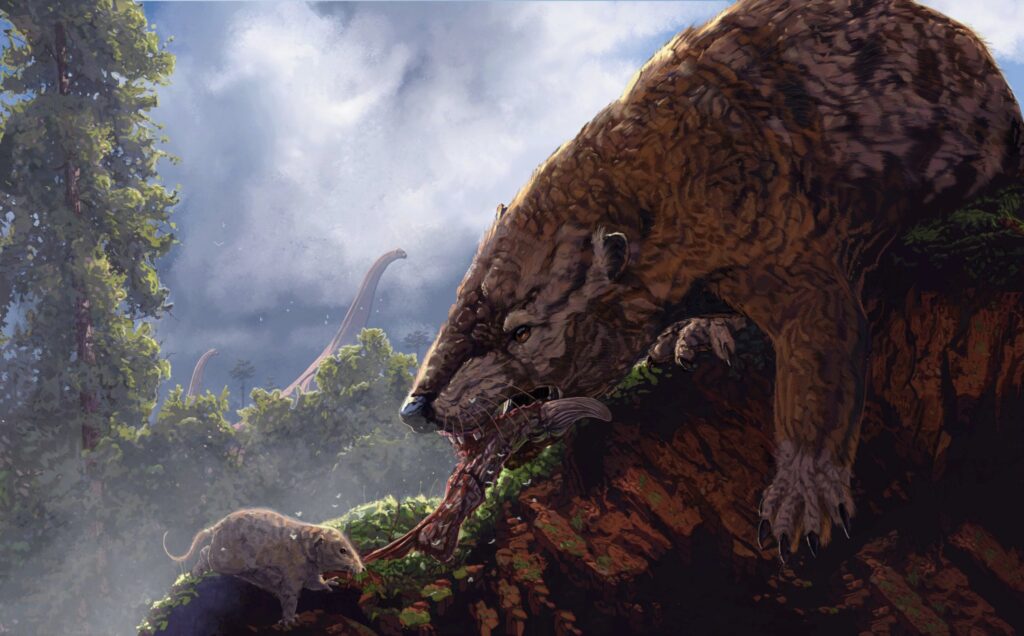
From shrew-sized insectivores weighing as little as two grams to robust forms reaching 12 to 14 kilograms, eutriconodonts occupied varied ecological roles. Repenomamus stood out as a bulky semi-fossorial carnivore, with evidence from fossils showing dinosaur bones in its stomach. This badger-like mammal preyed on juvenile dinosaurs, challenging the notion of mammals as mere scurriers in the underbrush.
Geographically widespread, their fossils appeared in Asia, Europe, North and South America, Africa, and even India. Gondwanan records, like the recent Maastrichtian find of Indotriconodon in India, extended their timeline to the end of the Cretaceous. Habitats spanned forests, riversides, and open terrains, with some taxa venturing into specialized niches.
Adaptations That Pushed Evolutionary Boundaries
Eutriconodonts displayed an array of locomotor styles rarely matched by other Mesozoic mammals. Gliding species like Volaticotherium possessed patagia – skin membranes – for aerial travel, while Liaoconodon featured a barrel-shaped body and paddle-like limbs suggestive of aquatic pursuits. Spinolestes impressed scientists with preserved fur, skin scutes, and even signs of a fungal infection, confirming mammalian traits like external ears.
- Terrestrial carnivores: Yanoconodon, with versatile limbs for multiple gaits.
- Arboreal insectivores: Jeholodens, suited for tree-dwelling.
- Fossorial diggers: Repenomamus, burrowing for ambush hunts.
- Aquatic piscivores: Possible in Ichthyoconodon and Liaoconodon.
- Gliders: Volaticotherium and Argentoconodon, converging on modern flying squirrels.
These innovations highlighted their evolutionary flexibility, peaking in diversity during the Early Cretaceous before a mid-Cretaceous decline.
Unraveling Their Place in Mammal Evolution
Phylogenetic studies placed eutriconodonts within Theriimorpha, potentially as crown mammals closer to placentals and marsupials than monotremes. However, debates persisted, with some analyses suggesting paraphyly or stem-group status due to long-branch issues in trees. Shared features like epipubic bones and tarsal spurs linked them to other early therians.
Exceptional fossils provided crucial postcranial data. The Spanish Spinolestes specimen from 125 million years ago preserved soft tissues, while Yanoconodon’s skeleton informed limb mechanics. Recent work on tooth eruption and jaw mechanics in Triconodon added layers to understanding their feeding.
| Family | Notable Genera | Key Traits |
|---|---|---|
| Gobiconodontidae | Repenomamus, Gobiconodon | Bone-crushing jaws, large size |
| Triconodontidae | Triconodon | Cat-sized carnivores |
| Volaticotherini | Volaticotherium | Gliding membranes |
Recent Discoveries Reignite Interest
A 2024 description of Indotriconodon marked the first eutriconodont from India’s Late Cretaceous, underscoring Gondwanan persistence until the K-Pg extinction. High-precision body mass estimates for small Mesozoic mammals further refined size reconstructions. Fossils capturing predation scenes, like Repenomamus with Psittacosaurus remains, vividly illustrated their bold ecology.
These findings, alongside phylogenetic reevaluations, painted eutriconodonts as far more than transitional forms. They embodied Mesozoic mammal radiation, filling predatory gaps dinosaurs overlooked.
Key Takeaways
- Eutriconodonts spanned 130 million years, outlasting many dinosaur groups.
- Diverse diets and locomotion set them apart in a dinosaur-dominated world.
- Ongoing debates refine their spot in mammal family tree.
Eutriconodonts remind us that mammal history began with tenacious survivors, not post-extinction booms. Their story challenges simplistic views of the Mesozoic, revealing a richer tapestry of life. What surprises you most about these ancient hunters? Share in the comments.