Alabama – A fossil from the Mooreville Chalk formations revealed a startling snapshot of prehistoric violence between two top marine predators. Researchers found a massive broken tooth embedded in the neck vertebra of a four-meter-long Polycotylus plesiosaur, marking the first direct evidence of such an attack. The injury showed no signs of healing, indicating it occurred at or near the animal’s death around 80 million years ago during the Late Cretaceous period.
A Surprising Find Emerges from Museum Storage
A Surprising Find Emerges from Museum Storage (Image Credits: Flickr)
Professor Christopher Brochu of the University of Iowa spotted the anomaly while examining specimens at Chicago’s Field Museum of Natural History. The fossil, cataloged as FMNH PR 187 and collected in 1949 from Greene County, had sat in a drawer for decades. What caught his eye was a damaged protrusion in one of the plesiosaur’s mid-cervical vertebrae, hinting at a violent past event.
Initial inspection revealed a crushed tooth fragment, broken at both base and tip from the force of the bite combined with fossilization processes. Brochu enlisted a team led by paleontologist Stephanie Drumheller from the University of Tennessee, Knoxville. Their investigation transformed a overlooked bone into proof of a rare predator-on-predator confrontation in the Western Interior Seaway.
Profile of the Victim: Subadult Polycotylus
The Polycotylus latipinnis specimen represented a subadult, estimated at four meters in length based on a humerus measuring 48.3 centimeters. This polycotylid plesiosaur featured an elongate neck that aided in hunting but exposed vital structures like the trachea, esophagus, carotid sheath, and major blood vessels. Such vulnerabilities made a throat strike particularly devastating.
Preservation of the nearly complete skeleton suggested the animal sank quickly into oxygen-poor bottom waters after the attack. Microbial decay and bioerosion marred the bones, but the core structure remained intact, limiting scavenger access. This rapid descent preserved the embedded tooth, linking victim and attacker across millions of years.
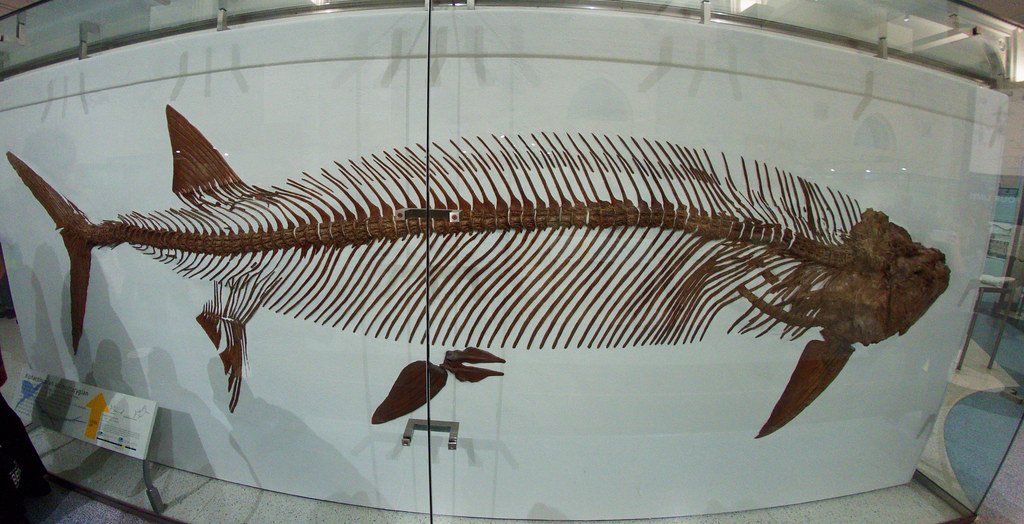
The Culprit Revealed: Enormous Xiphactinus
CT scans exposed the tooth’s full form: a 44.3-millimeter-long, conical structure with a 11.28-millimeter maximum diameter, slight curvature, smooth enamel, and a large central pulp cavity. These traits ruled out local sharks or marine reptiles and matched the mandibular fangs of Xiphactinus audax, an ichthyodectid fish that grew over six meters long.
Xiphactinus dominated Cretaceous seas, known from fossils with swallowed prey like the smaller fish Gillicus still inside their stomachs. The fish typically engulfed meals whole, making a targeted neck bite unusual and pointing toward agonistic behavior, such as territorial defense, rather than straightforward predation.
Advanced Imaging Cracks the Case
University of Tennessee undergraduates Miles Mayhall and Emma Stalker processed dual CT scans from the University of Chicago’s Paleo CT lab. Using software like Dragonfly and Blender, they digitally segmented the tooth and created precise 3D models, including a physical print for verification. This non-destructive approach allowed detailed study without further damaging the fragile fossil.
The models confirmed the tooth penetrated midline through the vertebra, exiting on the right side. No surrounding bone reaction indicated perimortem implantation. Findings appeared in the Journal of Vertebrate Paleontology, solidifying Xiphactinus as the source.
| Feature | Polycotylus latipinnis | Xiphactinus audax |
|---|---|---|
| Length | ~4 meters (subadult) | Up to 6+ meters |
| Neck | Elongate, vulnerable | N/A |
| Dentition | Smaller teeth | Conical fangs, large gape |
| Feeding Style | Hunter of smaller prey | Whole-prey swallower |
Reshaping Views of Ancient Marine Food Webs
The Mooreville Chalk yields abundant bite traces from sharks, fish, and reptiles, alongside gut contents and washed-in dinosaur bones. This discovery joins evidence of a chaotic ecosystem where apex hunters competed fiercely, blurring traditional food chain roles.
“We sometimes get these fixed ideas in our heads about who the top predator in any given environment is,” Drumheller noted. “This fossil is a good reminder that nature is rarely that cut and dry.” Co-author F. Robin O’Keefe added, “Plesiosaurs are famous for their long necks, but those necks come at a price.”
- Direct tooth implantation provides unambiguous predator identification.
- No healing signals a fatal or near-fatal wound.
- Quick sinking preserved the evidence intact.
- Highlights neck vulnerability in plesiosaurs.
- Suggests agonistic encounters among giants.
- Expands known interactions in dynamic seaways.
Key Takeaways
- Rare embedded tooth proves Xiphactinus attacked Polycotylus.
- CT and 3D modeling enabled precise analysis.
- Mooreville Chalk depicts violent, competitive marine life.
This Alabama fossil underscores the unpredictable brutality of Cretaceous oceans, where even elite predators faced mortal threats from unlikely rivals. It prompts reevaluation of ancient trophic structures and invites further hunts for similar traces. What other hidden stories lurk in museum collections? Share your thoughts in the comments.