Barro Colorado Island, Panama – Researchers exploring the island’s lush rainforest encountered a striking anomaly one night in March 2025: an adult female katydid glowing hot pink under a station light. This rare form of Arota festae, a leaf-mimicking species typically pale green, prompted scientists to document its unexpected transformation. Their observations revealed a potential adaptive strategy finely tuned to the rainforest’s dynamic foliage.
A Neon Glow in the Night
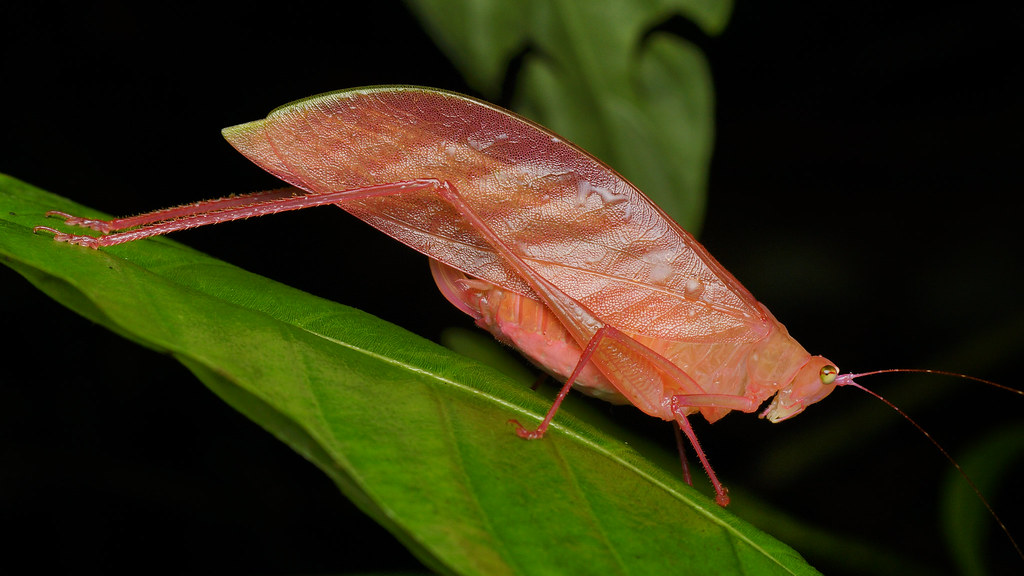
A Neon Glow in the Night (Image Credits: Flickr)
At precisely 11:12 p.m. on March 27, 2025, a team led by biologist J. Benito Wainwright spotted the vivid pink insect just meters from primary tropical forest on Barro Colorado Island. The katydid, measuring about 27 millimeters long and weighing around 1 gram, stood out dramatically against its usual green counterparts. During a four-month field season, the researchers recorded 21 green A. festae individuals in the area, underscoring the pink morph’s rarity.
Lead researcher Wainwright, from the University of St Andrews, described the encounter as a genuine surprise. “Finding this individual was a genuine surprise. Because it was so rare, we kept it in natural conditions and found it changing color from hot pink to green,” he stated. Previously, pink katydids observed since 1878 had been dismissed as genetic mutants suffering from erythrism, a condition causing excess red pigment that rendered them conspicuous to predators. This discovery challenged that view, suggesting a functional role instead.
Tracking the Slow Shift
The team captured the female and placed her in a spacious mesh cage alongside green conspecifics, maintaining ambient rainforest conditions. They provided unlimited access to fresh green vegetation, apple slices, and water, replacing foliage every two days. Daily photographs with a smartphone captured the progression.
Over 14 days, the insect’s hue evolved predictably. Here’s the timeline:
- Day 0 (March 27): Intense hot pink, photographed in focus-stacked detail.
- Day 4 (March 31): Faded to pastel pink.
- Day 5: Continued lightening.
- Day 14 (April 7): Fully green, indistinguishable from common morphs.
Evidence of a spermatophylax on day 10 confirmed she mated successfully with a green male. The katydid lived another 12 days before dying naturally on April 26.
Syncing with Leaf Life Cycles
Tropical rainforests feature “delayed greening,” where young leaves emerge white, red, or pink due to low chlorophyll levels, deterring herbivores. These mature to green over roughly two weeks. On Barro Colorado Island, 36% of plant species display this trait year-round, especially shade-tolerant trees.
The pink katydid’s transformation mirrored this process. Scientists compared it to local plants like Paullinia bracteosa, Coccoloba manzinellensis, Inga ruziana, and Andira inermis. Dietary studies confirm A. festae feeds on such species, positioning the pink phase as camouflage via background matching and masquerade.
| Day | Katydid Color | Comparable Plant Stage |
|---|---|---|
| 0-4 | Hot to pastel pink | Emergent pink/red leaves |
| 5-14 | Transition to green | Maturing foliage |
Co-author Dr. Matt Greenwell noted, “You would think that a bright pink insect in a mostly green forest would stand out to predators like a worker in a high-vis jacket.” Yet this synchrony likely disrupts predator recognition in the forest’s mosaic of leaf stages.
Challenging Decades of Assumptions
Historically, pink forms in katydids and related species were seen as evolutionary dead-ends. This marked the first documented full color shift within an adult katydid instar, without molting. The gradual pace points to hormonal pigment changes, possibly triggered by green diet or surroundings.
Experts praised the finding. Jeffrey Cole, a katydid evolution specialist, called the observation “remarkable” as the first such demonstration in the group. Wainwright emphasized its abnormality: collaborators with over two years on the island had never seen one, despite his own eight months in the tropics.
Researchers also noted a new leaf-necrosis patterned morph, expanding known variation in A. festae.
Key Takeaways
- Pink Arota festae likely evolved to mimic delayed-greening leaves, offering survival advantages in Panama’s rainforests.
- Color change occurred over 11-14 days in one adult, the first such record for katydids.
- 36% of Barro Colorado plants show pink juvenile leaves, aligning perfectly with the insect’s shift.
This revelation underscores the intricacies of rainforest adaptations, where even bold colors serve concealment. As tropical habitats face pressures, such discoveries highlight the need to protect these biodiversity hotspots. What do you think about this color-changing camouflage? Tell us in the comments.