Over 260 million years ago, carnivorous synapsids emerged as Earth’s first truly terrestrial apex predators amid the harsh ecological upheavals of the Permian period. These mammal ancestors dominated landscapes following the collapse of Carboniferous rainforests, filling top roles in newly forming food webs. A recent study reveals that their skull shapes primarily reflected adaptations to feeding strategies rather than inherited traits or body size effects.
Permian’s First Top Hunters Took Shape
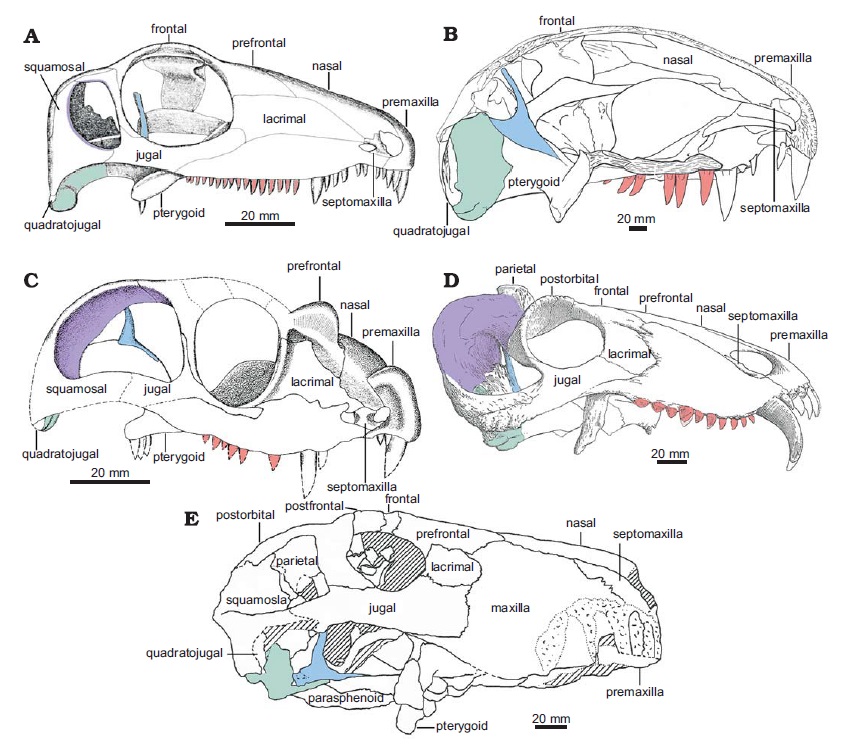
Permian’s First Top Hunters Took Shape (Image Credits: Upload.wikimedia.org)
The Permian epoch, spanning 299 to 252 million years ago, marked a pivotal shift in terrestrial life. Synapsids rose to prominence after global aridity devastated earlier ecosystems, paving the way for amniotes to thrive on land. Carnivorous forms led this radiation, evolving specialized skulls suited to predation in competitive environments.
Researchers examined 77 taxa from basal synapsids like sphenacodonts and later therapsids including gorgonopsians and therocephalians. These predators mirrored later mammalian carnivores in form and function, raising questions about whether similarities stemmed from natural selection or built-in evolutionary limits. The analysis pinpointed feeding ecology as the dominant force.
Dissecting Skulls with Modern Tools
A team led by Elías Adán Warshaw from University College London, alongside Suresh Anmol Singh of the Open University and Michael J. Benton of the University of Bristol, applied geometric morphometrics to lateral skull views. They placed 10 landmarks and 113 semilandmarks on specimens from museum collections, capturing shape variations through principal component analysis.
Anatomical network analysis further probed structural modularity, while phylogenetic comparative methods tested evolutionary models on time-calibrated trees. Functional traits, such as mechanical advantages of jaw levers and tooth heterodonty, helped cluster taxa into feeding guilds. This multifaceted approach separated ecological influences from phylogenetic history and allometry.
The study highlighted consistent anterior-posterior modularity in skulls, echoing developmental patterns in modern mammals, yet found no constraints on evolutionary direction or pace.
Three Distinct Feeding Strategies Emerged
Consensus clustering identified three functional feeding groups among the carnivores. Basal synapsids, such as Dimetrodon, clustered as “speed specialists” with gracile jaws optimized for rapid prey capture. Therapsids like gorgonopsians formed “power specialists,” featuring robust builds, hypertrophied canines, and strong bite mechanics.
Generalists spanned both groups, showing intermediate traits. Therapsids occupied a broader morphospace post-Olson’s Extinction around 270 million years ago, reflecting niche diversification. These patterns paralleled shifts in later mammalian predators, driven by intensifying competition.
- Speed specialists: Low jaw mechanical advantages, narrow temporal regions, long rostra (e.g., Sphenacodontia, Varanopidae).
- Power specialists: High temporal width, pronounced canines, shorter toothrows (e.g., Gorgonopsia, Therocephalia).
- Generalists: Balanced features, smaller sizes overall.
Feeding Ecology Trumped Heritage and Size
Shape variance dissected clearly: trophic function correlated strongly with skull form, explaining up to 85% in some therapsid subclades. Phylogenetic signal proved moderate overall but faded within groups like gorgonopsians, signaling convergence through selection rather than inheritance.
Allometry played a larger role in basal synapsids but diminished in therapsids. Evolutionary rates accelerated in middle Permian therapsids, supporting adaptive bursts amid ecosystem complexification. Distant relatives, such as certain gorgonopsians and therocephalians, converged on similar forms to partition niches and reduce competition.
| Factor | Influence on Skull Shape |
|---|---|
| Trophic Function | Primary driver (strong correlations) |
| Phylogeny | Low signal in subclades |
| Allometry | Secondary, higher in basals |
Lessons from Deep Time Predators
The research underscores competition and adaptation’s primacy in macroevolution, offering tools to detect these processes in fossils. Permian synapsids exemplified how ecological pressures molded forms, free from rigid constraints, much like modern ecosystems. Read the full study in Communications Biology.
Key Takeaways
- Carnivorous synapsid skulls adapted primarily to feeding roles, fostering convergence across lineages.
- Low phylogenetic signal highlights selection’s power over heritage.
- Ecosystem competition spurred diversification post-major extinctions.
These ancient predators remind us that survival hinges on fitting the ecological niche. What insights do Permian fossils offer for understanding modern biodiversity? Tell us in the comments.