Researchers recently explored the feeding mechanics of ceratosaurs, a group of theropod dinosaurs that ruled Southern Hemisphere ecosystems during the Mesozoic era. Through detailed finite element analysis on three-dimensional skull models, the team examined species from different body sizes and time periods. Their work highlights unexpected parallels with Northern Hemisphere tyrannosaurids, such as Tyrannosaurus rex, suggesting convergent evolution in apex predator adaptations.
Advanced Tools Unlock Ancient Bites
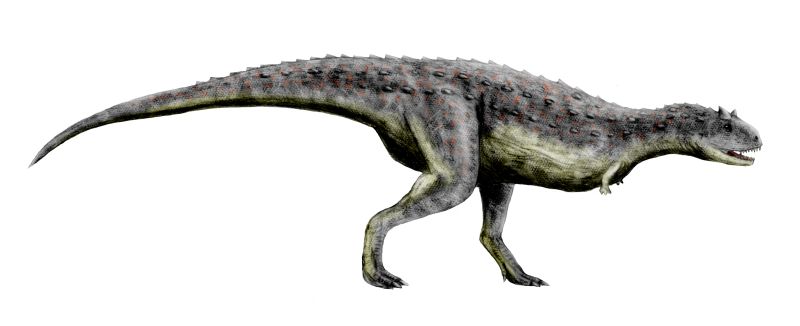
Advanced Tools Unlock Ancient Bites (Image Credits: Upload.wikimedia.org)
A team led by Andre J. Rowe from the University of Bristol created precise 3D models of four ceratosaur skulls using computed tomography scans and surface scanning techniques. They focused on Ceratosaurus from the Late Jurassic, the small noasaurid Masiakasaurus from the Cretaceous, and the large abelisaurs Carnotaurus and Majungasaurus, also Cretaceous forms. Finite element analysis simulated bite forces, with muscle magnitudes scaled from Tyrannosaurus using subtemporal fenestra measurements.
This approach allowed evaluation of von Mises stresses during feeding scenarios, revealing how each skull handled loads. The models incorporated crocodilian bone properties for realism. Such methods provided insights into mechanical performance without prior assumptions about low-stress designs in compact skulls.
Large Abelisaurs Faced High-Stress Feeding
Contrary to expectations, the robust skulls of Carnotaurus and Majungasaurus experienced the highest stresses under bite simulations. Majungasaurus showed peak cranial and mandibular stresses throughout its structure, while Carnotaurus displayed elevated levels at the quadrate and anterior dentary. These patterns increased with skull size, challenging ideas of inherent strength from their deep, short shapes.
Cranial ornamentation, including Carnotaurus’s prominent horns and Majungasaurus’s nasal struts, played no role in buttressing stresses. The features remained largely unaffected by loading, pointing toward functions like display or combat rather than feeding support. Ceratosaurus fell in the middle, with moderate stresses at the jugal.
| Dinosaur | Skull Length (cm) | Estimated Body Mass (kg) | Stress Pattern |
|---|---|---|---|
| Ceratosaurus | 55.8 | 418 | Moderate |
| Masiakasaurus | 27 | 33-47 | Lowest |
| Carnotaurus | 59.6 | 1,350 | High |
| Majungasaurus | 65 | 1,130 | Highest |
Masiakasaurus: Niche for Small Prey
The diminutive Masiakasaurus stood out with the lowest overall stresses, thanks to its procumbent anterior teeth. Simulations showed that biting with these forward-projecting teeth isolated loads, reducing mandibular bending. Midline or posterior bites, however, raised stresses significantly.
This configuration suited grasping and holding small, agile prey, avoiding competition with the larger sympatric Majungasaurus. The findings support niche partitioning among ceratosaurs, where smaller forms specialized while giants tackled bigger meals.
Echoes of Tyrannosaurids Across Oceans
The high stresses in large abelisaurs closely paralleled those in tyrannosaurids, despite independent evolutionary paths. Both groups developed short, deep skulls capable of withstanding intense feeding loads as body sizes grew. Researchers noted that abelisaurids like Carnotaurus likely generated bite forces around 7,000 Newtons, supporting a “bite-and-hold” strategy similar to northern giants.
“Large abelisaurids including Carnotaurus and Majungasaurus appear to have occupied a biomechanical and ecological space analogous to that of large tyrannosaurids,” the study stated. This convergence underscores shared challenges for gigantic apex predators, regardless of hemisphere.
- Ceratosaurs dominated Gondwanan ecosystems much like tyrannosaurids ruled Laurasian ones.
- Skull stresses rose predictably with size, defying geometric scaling expectations.
- Ornamentation served display, not structural roles.
- Masiakasaurus’s teeth enabled low-risk hunting of small vertebrates.
- Overall, ceratosaurs filled tyrannosaur-like niches through parallel adaptations.
- Abelisaur skulls handled high bite stresses akin to tyrannosaurids, enabling apex predation.
- Cranial horns and struts prioritized display over feeding mechanics.
- Small Masiakasaurus grasped prey efficiently, partitioning niches with giants.
These discoveries reshape views on ceratosaur biology, emphasizing functional parallels over superficial differences. The parallel evolution of large-bodied ceratosaurs in Gondwana and tyrannosaurids in Laurasia marks a striking case of convergence in non-avian dinosaurs. As paleontologists continue to probe ancient predators, such studies bridge hemispheres and eras. What do you think about these dino parallels? Tell us in the comments.