Mongolia’s Gobi Desert yielded a remarkable fossil that paleontologists recently named Shri rapax, a dromaeosaurid closely related to Velociraptor. This predator, preserved in the Djadokhta Formation from about 75 million years ago, surfaced through a shadowy path involving poaching and smuggling before returning to scientific study. Its exceptional anatomy reveals how ancient raptors diversified to exploit different hunting strategies in a harsh prehistoric landscape.
A Fossil’s Turbulent Path from Shadows to Science
Poachers extracted the Shri rapax specimen from the Gobi’s red sands sometime before 2010. They smuggled it out of Mongolia, where it entered private collections in Japan and England. A French fossil company, Eldonia, eventually acquired the nearly complete skeleton.
Negotiations among researchers, the company, and Mongolian officials led to its repatriation to the Institute of Paleontology and Geology at the Mongolian Academy of Sciences. In 2016, technicians CT-scanned the skull and first four neck vertebrae at a Belgian museum. Those parts vanished afterward, leaving only digital casts for analysis. The body, cataloged as MPC-D 102/117, now resides in Ulaanbaatar.
This episode underscored the damage of illegal trade. Paleontologists emphasized that such trafficking delays discoveries and erodes cultural heritage. Tsogtbaatar Chinzorig, a co-author on the describing paper, noted the importance of returning fossils to their origin for proper study.
Built for Grip: The Standout Anatomy of Shri Rapax
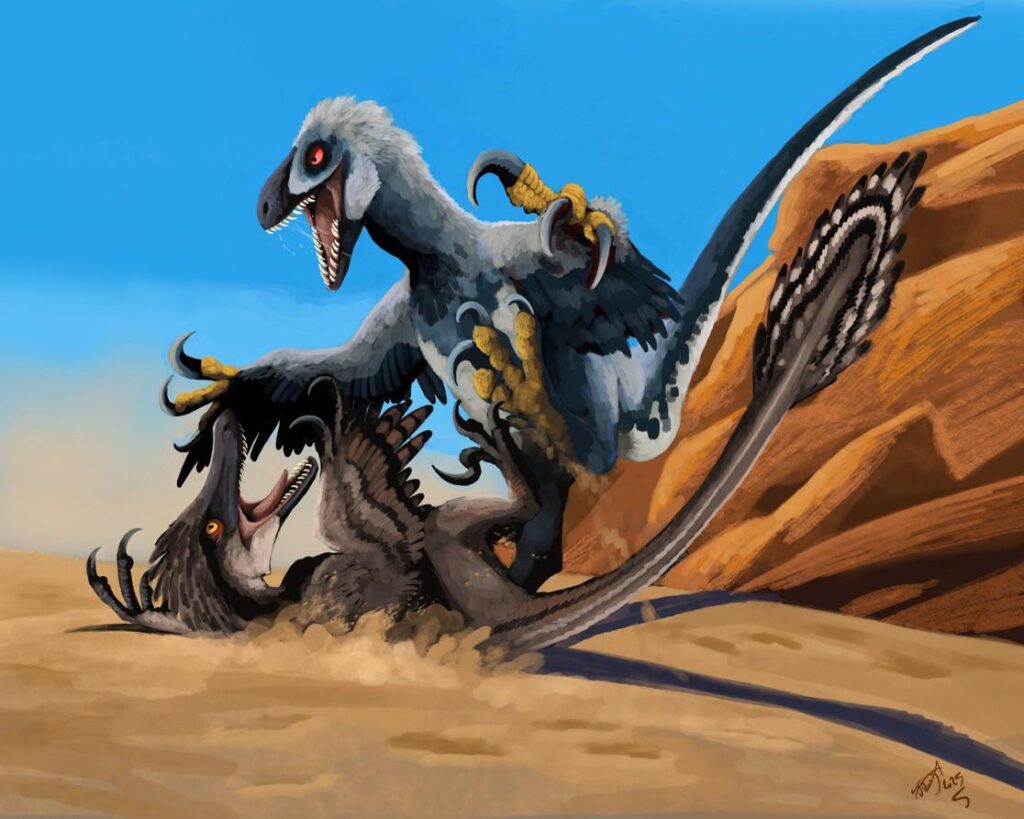
A Fossil’s Turbulent Path from Shadows to Science (Image Credits: Reddit)
Researchers described Shri rapax in July 2025 in the journal Historical Biology. The holotype preserved most of the vertebral column, ribs, sternal plates, gastralia, shoulder girdle elements, a complete right forelimb with manus, pelvis, and partial femora. Its hands stood out as exceptionally robust, with all pollex elements about 150 percent thicker than in comparable dromaeosaurids.
The thumb claw measured roughly eight centimeters, surpassing the foot sickle claw of similarly sized Velociraptor specimens. CT data revealed a shorter, deeper snout with an interdigitated jaw suture, adaptations for a stronger bite force. Proportional traits included a longer neck and shorter tail than typical velociraptorines. At around two meters long and turkey-sized, Shri rapax weighed perhaps 15 kilograms.
- Stout arm bones supporting powerful grappling.
- Enlarged, curved hand claws for restraining prey.
- Robust pelvic and vertebral features unique to the genus.
- Feathered body, as inferred for dromaeosaurids.
- Specialized second toe claw, like all raptors.
Rivals in the Desert: Diverging from Velociraptor
Shri rapax belonged to Velociraptorinae, emerging as the sister species to Shri devi, described in 2021 from nearby formations. Phylogenetic analyses placed both near Velociraptor mongoliensis, the iconic Gobi raptor. Yet Shri rapax diverged sharply in build.
Velociraptor featured slender arms and a longer snout suited to smaller, agile prey. Shri rapax, by contrast, emphasized hand power over foot slashes. Andrea Cau, lead author and independent paleontologist, described its hand as signaling “a predator that relied on pure grip strength rather than slashing kicks.”
| Feature | Shri rapax | Velociraptor mongoliensis |
|---|---|---|
| Hand Robustness | 150% thicker pollex | Slender |
| Thumb Claw | ~8 cm | Smaller (~6.5 cm foot claw) |
| Snout | Short, deep | Long, slender |
| Hunting Style | Grip-focused | Slash/kick |
These differences pointed to niche partitioning. Both species shared dunes and lakes in the Djadokhta environment, yet targeted distinct prey. Shri likely tackled bulkier herbivores like Protoceratops, gripping them firmly.
Revealing Diversity in a Lost World
The Djadokhta Formation preserved a dynamic ecosystem of sand dunes, intermittent lakes, and combative dinosaurs. Fossils like the “Fighting Dinosaurs” – a Velociraptor locked with Protoceratops – hinted at predator-prey battles. Shri rapax added complexity, suggesting multiple raptor strategies boosted survival.
Chinzorig highlighted ecological contrasts: a short snout, long neck, and short tail set Shri apart. Such partitioning explained coexistence among similar predators. The genus Shri, named for the Buddhist deity Palden Lhamo, now anchored two species illuminating velociraptorine evolution.
Key Takeaways
- Shri rapax’s massive hand claws enabled grappling larger prey, differing from Velociraptor’s agility.
- Poaching delayed study, but repatriation advanced knowledge of Gobi dinosaurs.
- Niche partitioning among raptors fostered biodiversity in Late Cretaceous Mongolia.
Shri rapax transformed a poached relic into a window on prehistoric innovation. Its story reminded scientists of the stakes in preserving fossils amid modern threats. What do you think about this raptor revelation? Tell us in the comments.