
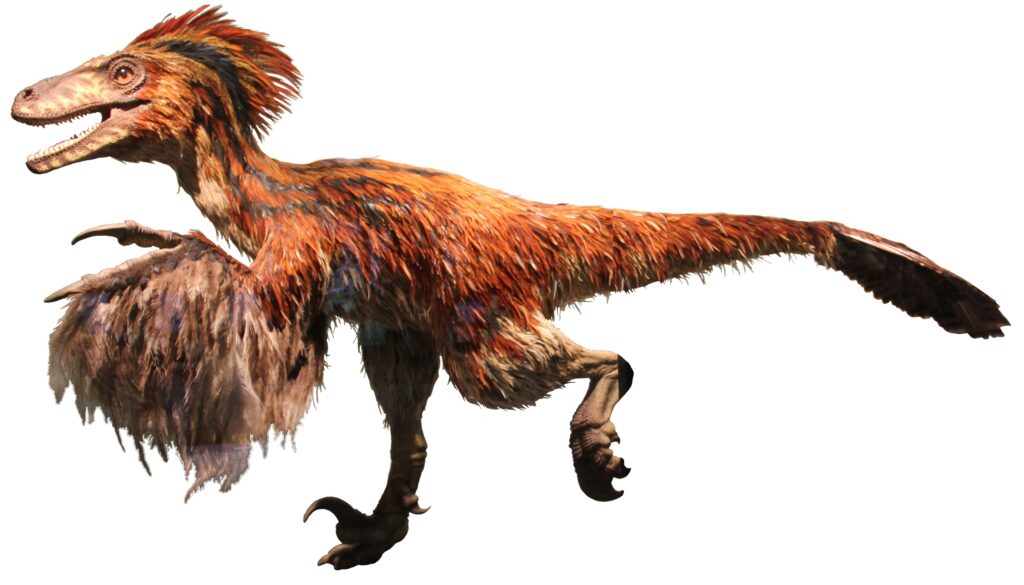
Imagine walking through a forest and seeing what looks, at first glance, like a giant, angry chicken step out of the undergrowth. It has feathers, a beak, long legs built for sprinting, and a tail that sways for balance. You might laugh for half a second – right before realizing this thing is not a farm bird at all, but a razor-fast, highly tuned predator that would happily put you on the menu. That strange mix of familiar and terrifying is exactly why one particular dinosaur has captured so many imaginations.
In the last few decades, paleontologists have uncovered fossils that show some carnivorous dinosaurs were not the scaly movie monsters many of us grew up with but feathered, birdlike hunters. Among them, Deinonychus stands out: a mid‑sized carnivore with the predatory mindset of a raptor and a body that, especially when reconstructed with feathers, looks uncannily like a massive, weaponized ground bird. Once you see that image in your head – a giant chicken with killer claws – it’s almost impossible to forget.
The Real “Giant Chicken”: Meet Deinonychus
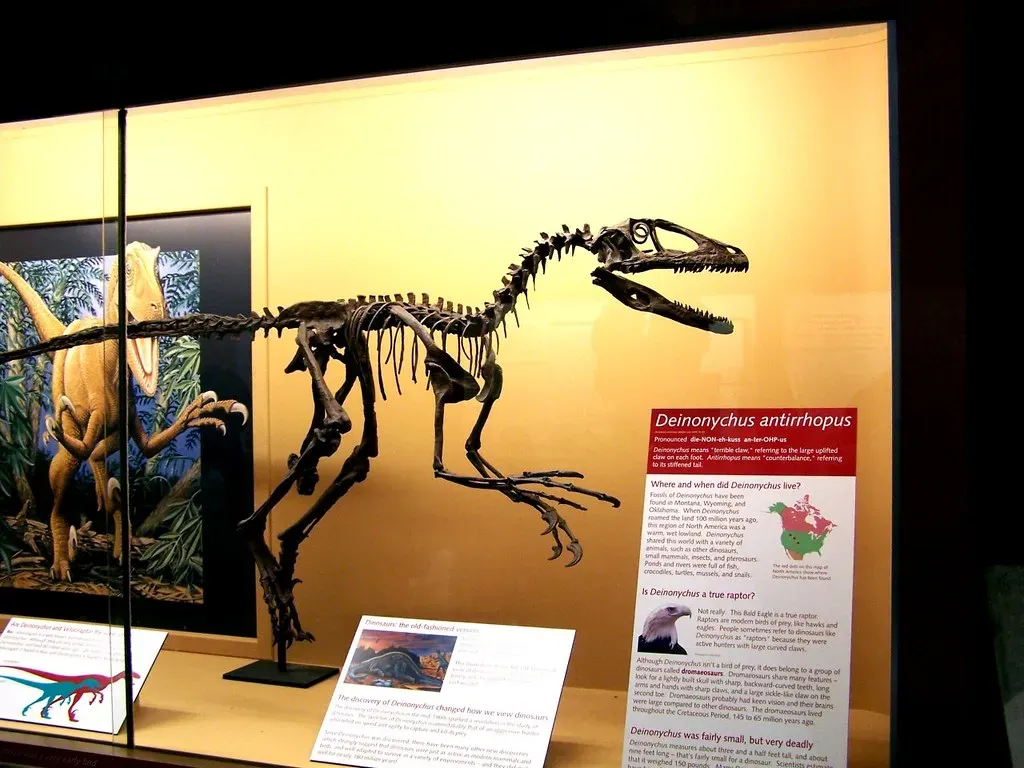
Deinonychus antirrhopus was not the biggest carnivorous dinosaur, but it was one of the most influential in how scientists and the public think about dinosaurs. It lived during the Early Cretaceous period, roughly a hundred and fifteen to a hundred and eight million years ago, in what is now North America. At around three meters long from snout to tail and roughly human‑sized in height, it fell into that unsettling category of animals big enough to kill you but nimble enough that you might never see it coming.
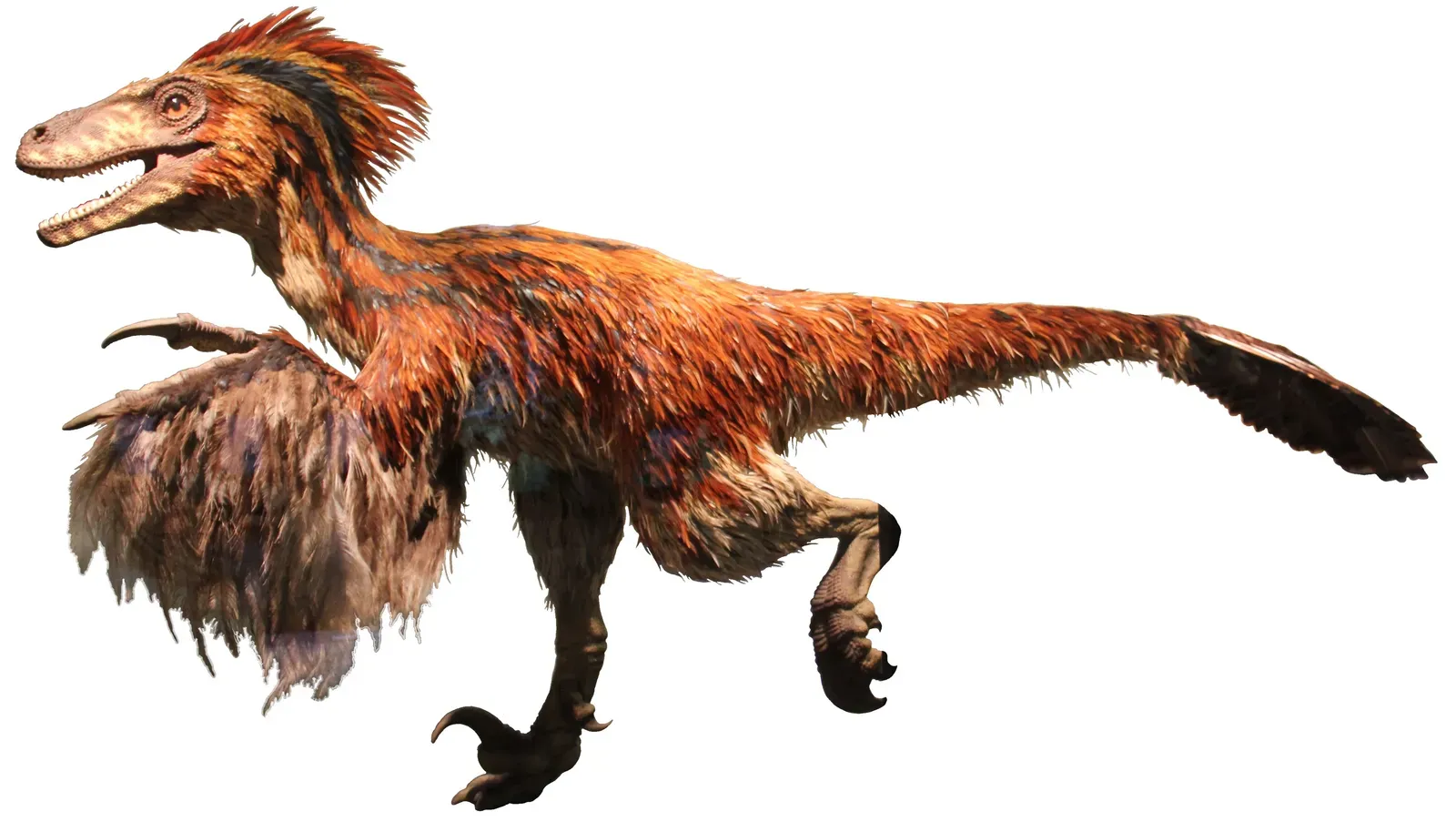
When you look at modern reconstructions based on fossil evidence, Deinonychus does not resemble a lizard. It looks startlingly like a giant, predatory ground bird: long legs, relatively short arms held close to the body, a stiff balancing tail, and a neck leading to a lightly built, birdlike skull. Add a coat of feathers – now widely accepted for its group – and suddenly you are staring at something that could pass for an overgrown, furious cassowary with better weapons. That uncanny resemblance is exactly why people jokingly call it the dinosaur that looked like a giant chicken, even though in reality it was more like a nightmare version of a modern raptor bird.
Feathers, Beaks, and Birdlike Bodies
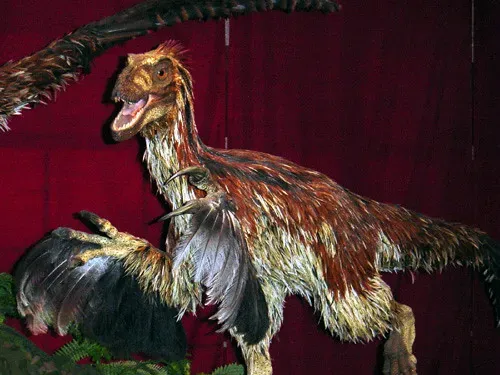
Part of what makes Deinonychus so fascinating is how it bridges the mental gap between chickens and classic movie dinosaurs. Fossils of its close relatives, like Velociraptor, preserve quill knobs – bony bumps where flight feathers anchored – strong evidence that this whole dromaeosaur family was feathered. Even though we lack direct feather impressions for Deinonychus itself, the anatomical similarities are so strong that a feathered coat is the most reasonable interpretation. Picture a body covered in insulating plumage, with larger feathers streaming from the arms and tail, and it immediately feels less like a reptile and more like an enormous killer bird.
It did not have a beak the way a modern chicken does, but its skull was light, with relatively thin bone and sharp, recurved teeth, more like an eagle dialed up to prehistoric size. The limbs were long and slender, and the hips were shaped for an upright, birdlike posture, with the body held more horizontally than vertically. When you put all of this together, Deinonychus was not just “kind of birdy.” It was a serious, deep evolutionary cousin of the birds we know, with a body plan that would not look entirely out of place alongside today’s big ground birds like emus or ostriches – just far more dangerous.
The Killing Claw: How a Birdlike Hunter Took Down Prey
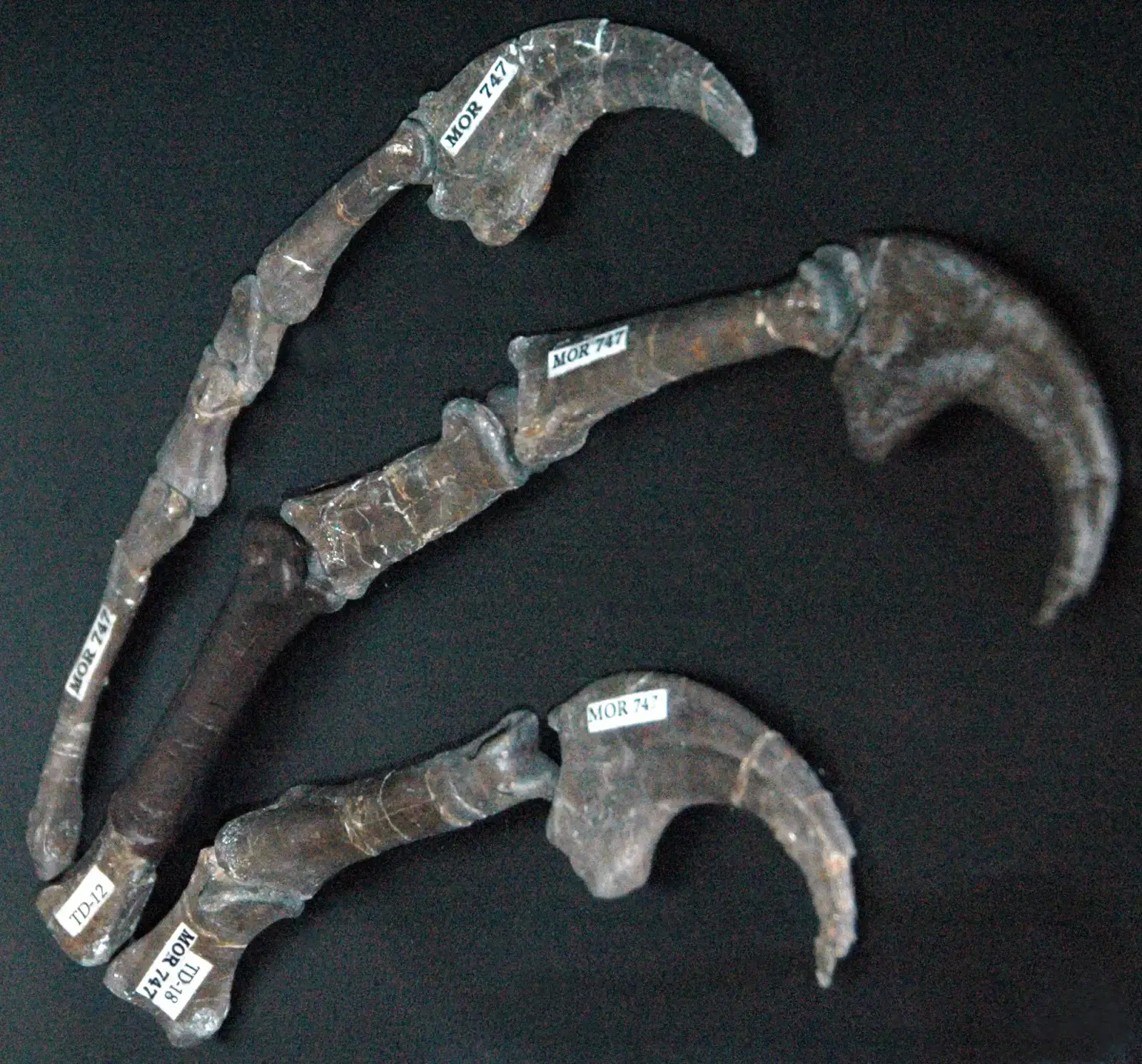
The most famous feature of Deinonychus is the enlarged, sickle-shaped claw on the second toe of each foot. This claw was held off the ground when the animal walked, like a hidden switchblade, and could be hyperextended and driven into prey with tremendous force. Early reconstructions suggested it used these claws to slash and disembowel, much like a fantasy monster. Later work has leaned toward a more controlled, grappling function, perhaps hooking into flesh or tendons to hold onto struggling prey, but however you frame it, this “toe dagger” was not a gentle tool.
Combine that claw with long legs and a stiff, rod‑like tail for balance, and you get a picture of a dinosaur that was built to move. Deinonychus could likely accelerate quickly, change direction with agility, and spring with enough power to latch onto prey that might be as large or larger than itself. Its hands bore sharp claws as well, giving it multiple points of contact once it hit its target. Think less about a lumbering reptile and more about a pack of hyper‑athletic, ground‑running birds that just happen to be armed with knives on both their feet and hands. That is the hunting energy this animal radiates.
Brains, Senses, and the Mind of a Predator
For many years, dinosaurs had an undeserved reputation as clumsy, unintelligent brutes. Deinonychus helped flip that script. Studies of its braincase and comparisons with both other theropods and modern birds indicate it had a relatively large brain for its body size, particularly in regions associated with vision, balance, and coordination. This does not mean it was solving math problems, but it does suggest a dinosaur capable of sophisticated movement and rapid decision‑making in a chaotic hunt.
The shape of its eye sockets and snout hint that vision played a strong role, likely with decent depth perception and quick tracking of moving targets. Inner ear studies from similar raptors point to excellent balance and spatial awareness – imagine what you’d need to land a precise, claw‑first leap onto a thrashing animal without breaking your own legs. To me, that mental image is far more unnerving than any roaring movie monster: a silent, feathered hunter watching, calculating, and then committing to a lightning‑fast strike when the odds swing in its favor.
Not a Lone Wolf: Evidence for Collaborative Hunting
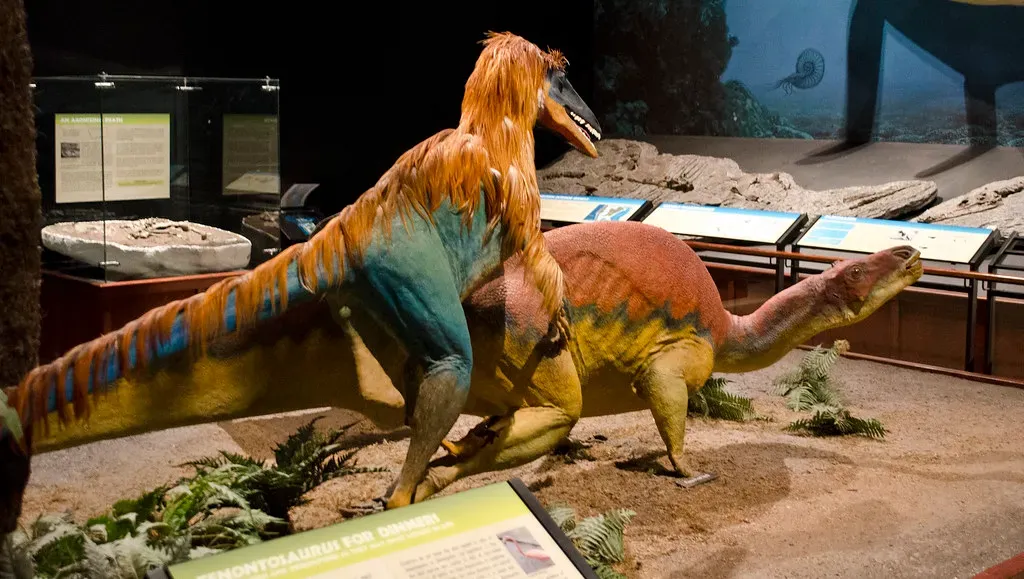
One of the most famous fossil sites linked to Deinonychus shows multiple individuals preserved alongside the bones of a much larger plant‑eating dinosaur, Tenontosaurus. This association has fueled the idea that these predators sometimes tackled prey that would be risky or impossible for a single animal, hinting at some level of group behavior. The Hollywood version turns that into tightly coordinated pack strategy, almost like wolves, but the reality is more nuanced and less certain.
Some researchers argue that these gatherings might have been more like opportunistic mobs, with several individuals drawn by the same carcass, sometimes cooperating loosely and sometimes competing fiercely. If you have ever watched vultures or large birds of prey pile onto a single food source, you have a modern analogy that is both messy and effective. Whether Deinonychus hunted with true strategy or just tolerated each other long enough to bring something down, the idea of several giant, chicken‑like predators swarming a struggling herbivore is the kind of scene that sticks in your brain.
From Monster Lizards to Murder Chickens: Why Deinonychus Changed Everything
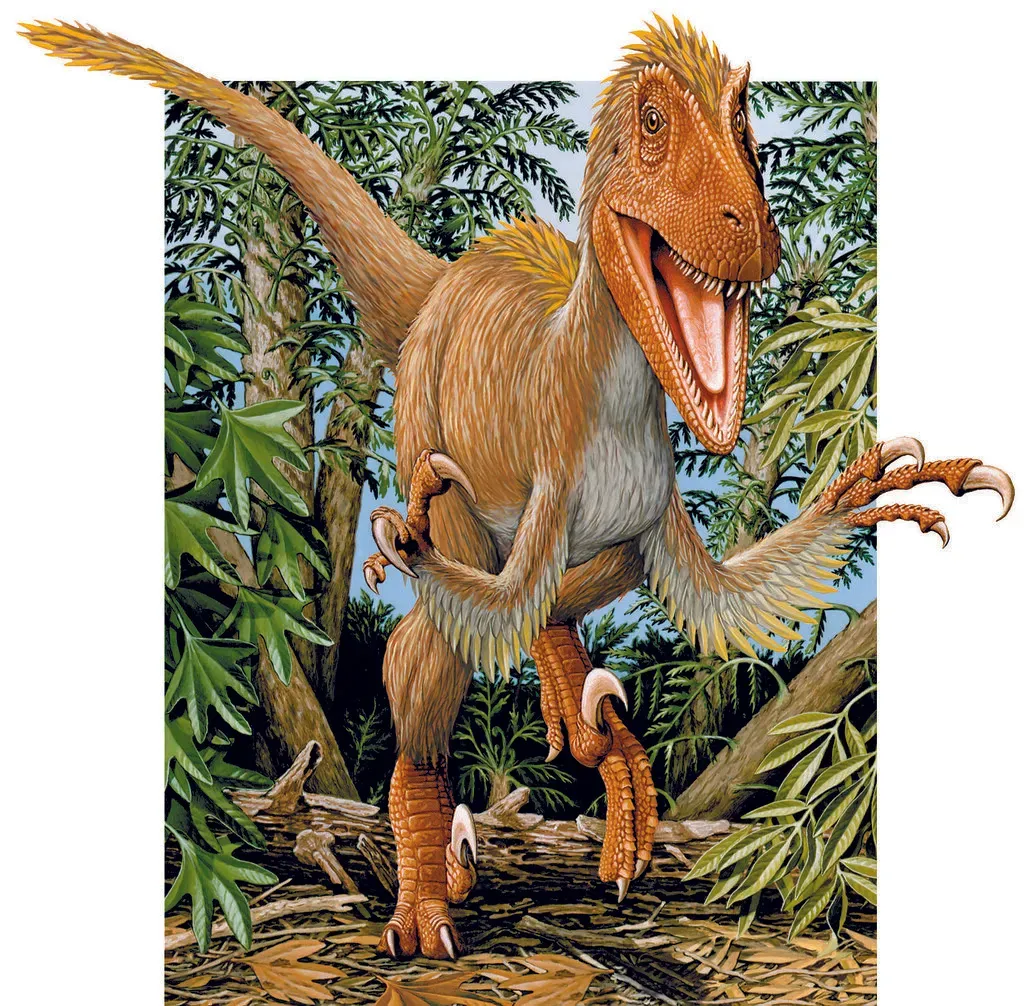
Deinonychus did more than just look cool; it helped kick off a scientific revolution. When its fossils were studied in detail in the late twentieth century, the anatomy – light bones, powerful legs, birdlike hips, grasping hands, and that lethal claw – forced scientists to rethink dinosaurs as active, warm‑blooded, and behaviorally complex animals. It was a major piece of the puzzle in solidifying the now‑standard view that birds are living dinosaurs, not just distant relatives. Without Deinonychus, we might still be stuck with slow, tail‑dragging lizards instead of dynamic murder chickens in our mental image of the past.
Pop culture picked up on this shift too. The “raptors” in movies owe more to Deinonychus than to the real Velociraptor, which was much smaller. Even though the details get mangled on screen, the underlying idea – a fast, intelligent, feathered or semi‑feathered predator – comes directly from this dinosaur and its kin. Personally, I think that legacy is more powerful than any individual fossil: it changed how millions of people picture evolution, extinction, and the deep history of birds. Every time someone jokes that a chicken is just a tiny dinosaur, they are, in a roundabout way, tipping their hat to creatures like Deinonychus.
Conclusion: The Terrifying Familiarity of a Giant “Chicken”
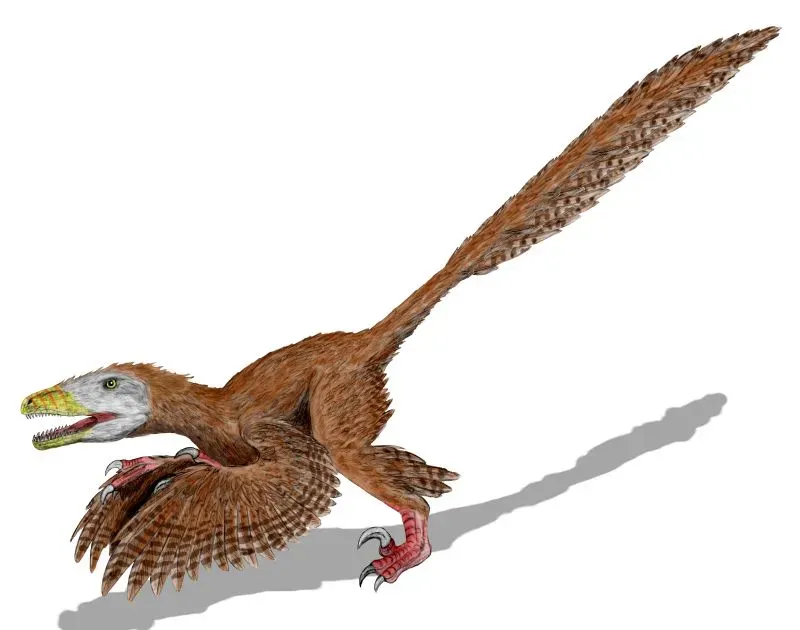
What makes Deinonychus so haunting is not just that it was dangerous, but that it feels strangely familiar. It is one thing to fear a dragon‑like monster that has no real‑world counterpart. It is another to realize that the same evolutionary line that gave us gentle backyard chickens and comical ostriches also produced a predator with hooked toe blades and a brain tuned for the chase. In my view, that contrast strips away the comfortable illusion that the Age of Dinosaurs was utterly alien; instead, it feels like a distorted mirror of our own world, full of birds, claws, and hungry eyes.
If anything, calling Deinonychus a giant chicken undersells it. It was a razor‑edged experiment in turning the bird body plan into a land‑based killing machine, and the only reason it does not still rule the forests is a roll of the cosmic dice sixty‑six million years ago. The next time you see a chicken pecking at the ground or a hawk stooping on a pigeon, it is worth remembering that you are watching the distant echo of animals like this predator. Beneath the feathers and the clucking, there is a lineage that once sprinted, leapt, and killed with terrifying efficiency – doesn’t that change how you look at every bird you see today?